3. Antigenic Variation

Description

L4 Immunology
Chloe Cavarretta
Slide Set by Chloe Cavarretta, updated more than 1 year ago
Chloe Cavarretta
Created by Chloe Cavarretta over 6 years ago
1
0

Resource summary

Slide 1

    Learning Outcomes: L4
    The significance of antigenic variation in Influenza virus The significance of the Variable Surface Glycoprotein (VSG) and the molecular basis of antigenic variation in T.brucei The significance of the PfEMP proteins and the molecular basis of antigenic variation in Plasmodium falciparum

Slide 2

    Antigenic Variation: Influenza
    Part of immune evasion pathogen survival strategy  Envelope has two important proteins: HA- attaches to host receptors (15 variants) NA- breaks down sialic acid to allow budding (9 variants) Antigenic drift: Minor mutations occur as a result of low fidelity viral polymerase (rapid replication= fast polymerase= less accurate) Antigenic shift: Major reassortment of genomic segments caused by two viruses that infect different species infecting a cell simultaneously and recombining genetic material  Epidemics: associated with antigenic drifts, cause seasonal flu outbreaks, cycle 2-3 years  Pandemics: associated with antigenic shifts, worldwide outbreaks of increased severity, cycle 10-40 years  

Slide 3

    Trypanosomes
    Trypanosoma brucei- causes sleeping sickness  Always extracellular Spread by tseste fly bite  2 stages: 1. Haemo-lymphatic (blood), 2. meningo-encephaltic (enters CNS, nastier phenotypes, drug has to break blood brain barrier)  3 sub-species of T.brucei: T.brucei brucie- not human infective  T brucei gambiense- human infective, chronic disease T brucei rhodesiense- human infective, acute disease    

Slide 4

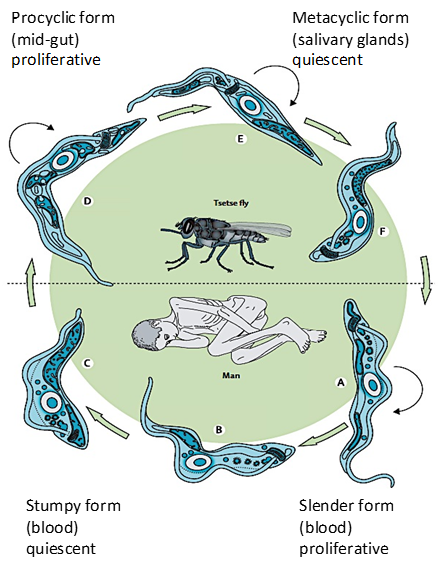
    T.brucei Digenetic Life Cycle
    Tsetse fly: Procyclic form- midgut, proliferative Metacyclic form- salivary gland, quiescent Human: Slender form- blood, proliferative  Stumpy form- blood, quiescent

Slide 5

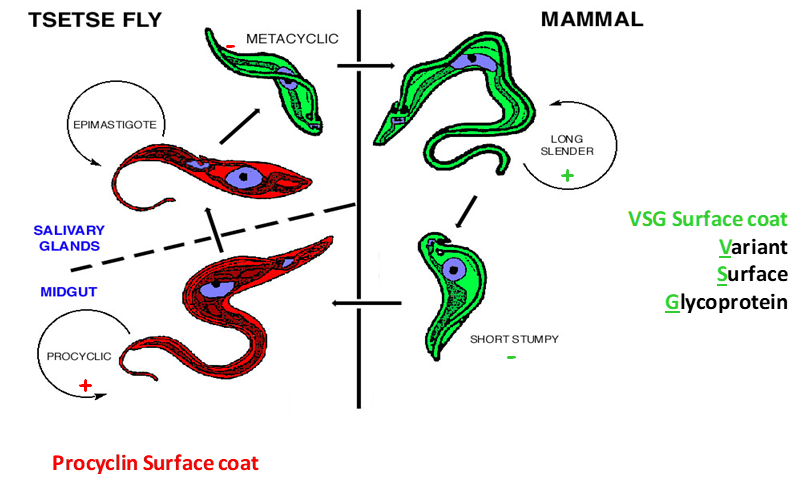
    T.brucei Digenetic Life Cycle: antigenic var
    2 different surface coats: Procyclin surface coat= in promastigote stages (motile, elongated form) VSG coat= metacylic and blood stream form (slender and stumpy)  VSG= Variation in surface glycoprotein= how parasite survives  When Ab/ immune system begins to recognise VSG= switch coats VSG genes expressed by metacyclic (salivary gland)  and blood stream stages, express one at a time and switch rate every 100+ divisions

Slide 6

    Antigenic Variation in Trypanosomes
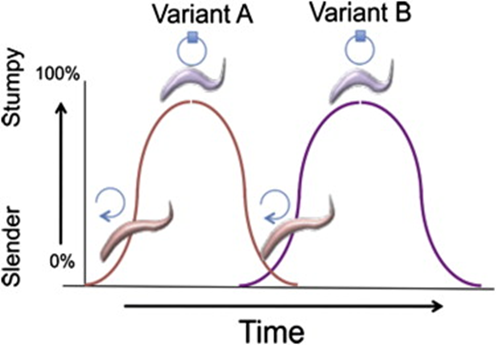
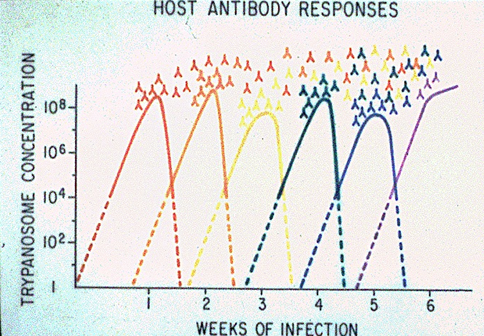
    Ross an Thompson observed that during a T.brucei infection there was a series of 'relapsing parasitemias'  Correlating with fever peaks Slender form continues to replicate (peak) then differentiate into stumpy stages (quiescent) and die off (unless taken up by tsetse) When stumpy dies off, small population of slender remaining give rise to next cycle (will most likely have a different coat)   

Slide 7

    Ross an Thompson observed that during a T.brucei infection there was a series of 'relapsing parasitemias' Injection of each relapse form into rabbits to produce an anitserum.. Each rabbit produced a different specific Ab for each of the different VSGs (switched coat)  Relapse forms differ antigenically 
    Ross an Thompson observed that during a T.brucei infection there was a series of 'relapsing parasitemias' 
    Antigenic Variation in Trypanosomes

Slide 8

    Variant Surface Glycoprotein (VSG)
    GPI-anchored proteins 5 X 10^7 molecules per parasite- 10% of total cell protein, 90% of surface coat, covers PM to protect RNA polymerase driven motor drives expression of genes at higher level than other mRNAs Entire VSG pool is internalised and recycled in 12.5min- Ab lands ans parasite swims and glides Ab into flagella pocket for endocytosis, Ab digested, VSG goes back to surface Basis of evasion of immune system by AV, enables to remain extracellular

Slide 9

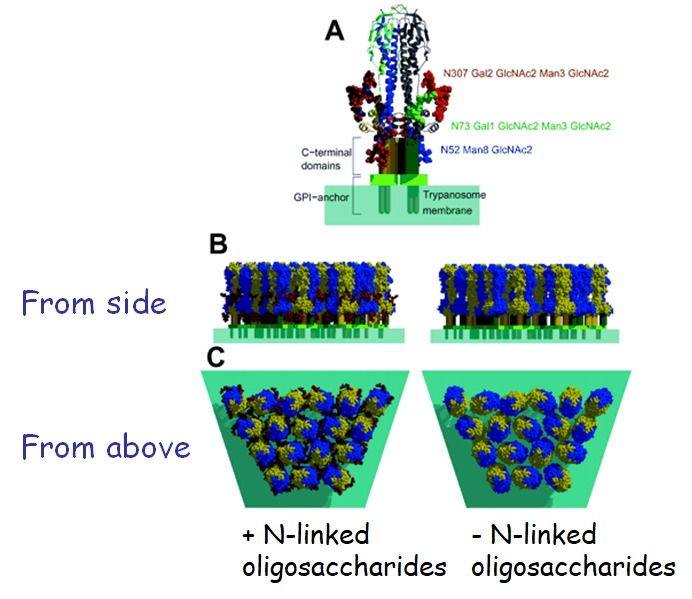
    Variant Surface Glycoprotein Structure
    Forms a tight barrier (12.5-13nm thick) from Ab's VSG primary protein sequences are not identical but similar structures- most variation in Ab binding region Modified N-oligosaccharides fill in places between VSGs  

Slide 10

    How does Trypanosome Switch VSG?
    T.brucei genome sequencing info: VSG gene repertioire for antigenic variation is larger than originally thought Almost all are pseudogenes or gene fragments Create new genes by recombining fragments VSG genes is expressed at telomeric expression site (ES) ~20 ES in trypanosome genome, only one ES active at a time (monoalleic expression)- expression of more than 1, would get multiple Ab in response= reduce ability to change in time Telomeric location of VSG ES suggests role for position effects in their regulation- specific structural features associated with DNA at 'silent' telomeres in bloodstream tryps

Slide 11

    How does Trypanosome Switch VSG?
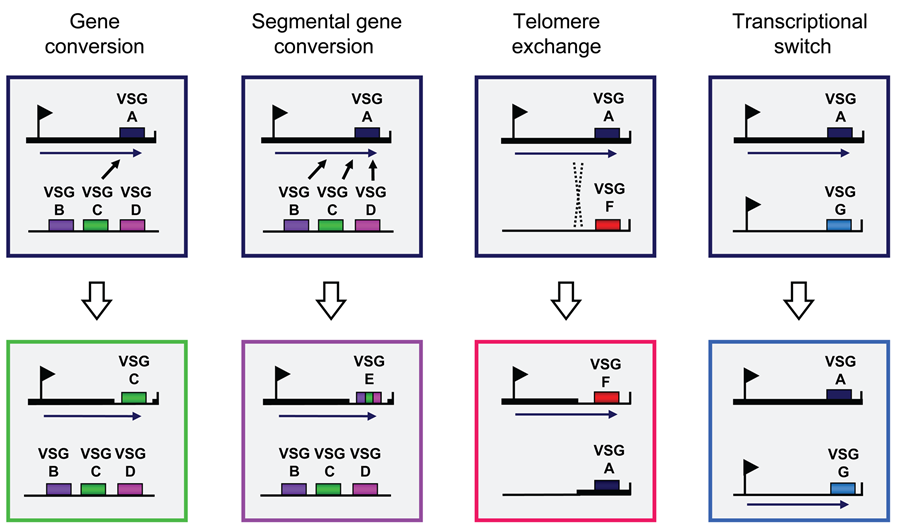
    Proposed mechanisms of activation (homologous recombination/gene conversion mechanisms): Gene conversion= at ES, one whole VSG genes is swapped for a different one  Segmental gene conversion= parts of different VSGs recombine within VSG for a specific area (eg Ab binding region) Telomeric exchange= multiple repeats in ES that recombine with another ESs VSG  Transcriptional switch/ES switch= more extreme, switch from transcription of one ES to a different ES  

Slide 12

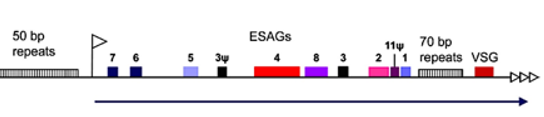
    Structure of VSG Expression Site (blood)
    VSG = last gene in ES  ESAGs upstream of VSG= expression site associated genes, invariant, highly upregulated by RNA pol I, can recombine with ESAGs from other ESs, VSG ESs define polycistronic transcriptional unit  Telomeric VSG (telomere repeats are arrow heads) ES promoter (open flag)= 50kb upstream of VSG gene 50bp and 70bp repeats (vertically striped boxes)= enable recombination  Psuedogenes (Ψ)

Slide 13

Slide 14

    Silencing of VSG
    Inactive VSG= silent, repressors present in nucleus  Active VSG= co-localises with RNA pol I and transcribed  Silencing involves separate telomere-binding and spreading factors eg RAP1 repressor of silent VSGs ​​​​​​, when removed get different variants of VSG expression Enzymatic pathway that regulates telomeric silencing of VSG expression  One of triggers for VSG switch  Mutants of this pathway showed de-repressed VSG transcription      
    Caption: :
    Caption: :

Slide 15

    Plasmodium
    Lifecycle: Transmitted from mosquito to human by bite In liver= exo erytrocytic cycle  RBC= erythrocytic cycle  Gametogenesis= dont fuse until in mosquito environment Malaria is characterised by fever and chills every 48hrs- related to synchronous bursting of RBC, release 20 parasites (merozoites) + toxic compounds per RBC Highly pathogenic- severe anaemia kills 50% of those infected

Slide 16

    Why is P.falciparum so Pathogenic?
    Infected RBC develop surface knob containing parasitic proteins = PfEMPs (var genes) Cause RBCs to stick in blood vessels and block capillaries Result in liver and brain inflammation and damage= cerebral malaria  PfEMP proteins cause antigenic variation and promote survival: Var genes recombine to form large PfEMP modular proteins Double domains: double α, double β, double γ CIDR domain: CIDR α  

Slide 17

    PfEMP1 domains
    Domains carry out 2 functions: Mediate the cytoadherence of RBCs to endothelial cells in organs to avoid the spleen  Evade specific immune response through antigenic variation Var genes switching in Plasmodium spp: Gene recombination occurs within domain classes and between subclasses Unlike T.brucei, location of genes prone to recombination are throughout entire genome and not restricted to telomeric regions

Slide 18

    Summary
    Influenza- not individual switching, independent genetic event, need 2 distinct viruses T. brucei- RNA pol 1 driven, telomeric, changes in surface of parasite themselves Plasmodium- Var genes, RNA pol 2 driven, PfEMP not expressed on parasite itself but on host, cloak host cell to avoid uptake/clearance by spleen, stick to endothelial walls
Show full summary Hide full summary

Similar

Infectious diseases
Clare Yu
Immune system(II)
Clare Yu
Immune system
Clare Yu
CD4 T cells: The Master Controllers of the Immune System
Ifeoma Ezepue
How does the immune system recognise pathogens?
Ifeoma Ezepue
Hypersensitivity
Maddie Geddes
Why is immunology important?
Ifeoma Ezepue
How do we eliminate pathogens that live inside cells?
Ifeoma Ezepue
How do we eliminate pathogens that live outside cells?
Ifeoma Ezepue
Basic Immunology Principles
Robyn Hokulani-C
Mnemonics for VACCINES
Tamara Ey Firsty