
4.1 Heat
Slides in this set (9)
-
- Heat is a form of energy that you can sense through receptors in your skin.
- Heat is a form of energy and describes the total energy of all particles within an object.
-
- Heat and temperature are both very different things.
- Temperature indicates how hot or cold something is. This depends on how quickly the particles inside it are moving and is a measure of the average kinetic energy of these particles.
- Hot= faster movement
- Cold= slow movement
- Temperature can be measured by a thermometer. An idea of the temperature can be identified by the receptors on the skin. Liquid expands when it is hot and contracts when cooled.
- 3 types of ways it can be measure: Celsius, Fahrenheit and Kelvin
-
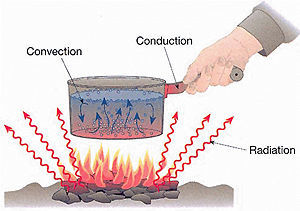
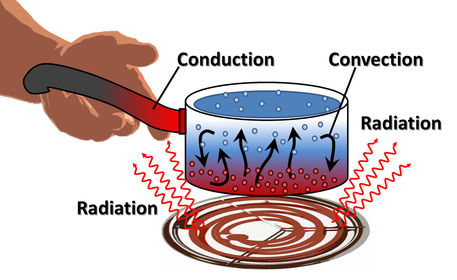
- Heat flows from an area of higher temperature to areas of low temperature. The greater the temperature difference the faster heat flows from one object into another.
- This happens in 3 ways:
- -Conduction
- -Convection
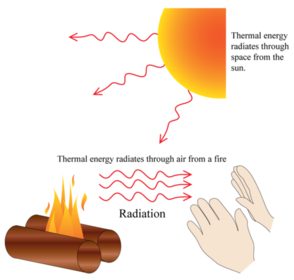
- -Radiation
-
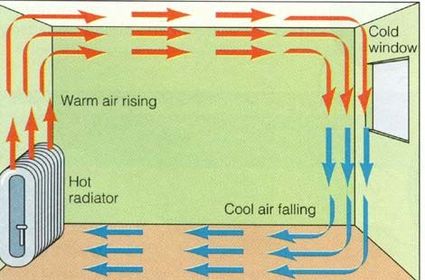
- As air is heated, its particles gain energy and move further apart. Hot air pushed up and cold air is pushed down.
-
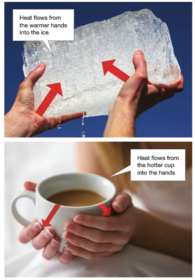
- Areas of high temperature flow towards areas of low temperature. This is a bit like diffusion.
- Hot substances have particles that move fast. These particles touch other particles and those particles touch other particles around it. This is how heat travels.
-
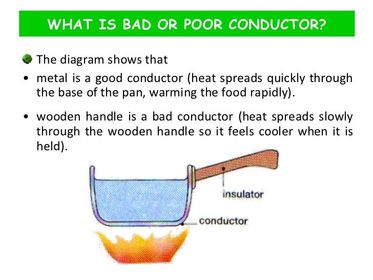
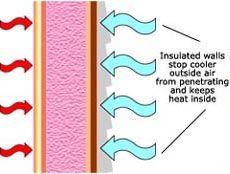
- Insulators are materials which are poor conductors of heat.
- Examples:
- -Plastic
- -Rubber
- -Cloth
- -Wood
- -Cotton
- -Porcelain
- -Glass
- Conductors are substances that transfer heat easily. Most metals are good conductors.
- Examples:
- -copper
- -Aluminium
- -Gold
- -Silver
- -Water
- -People and Animals
- -Trees
-
-
- The hotter something is, the more heat it radiates.
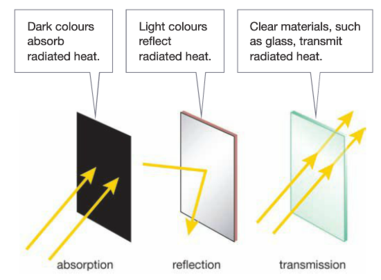
- When radiated heat hits a surface, the heat may be transmitted, absorbs or reflected off the surface. This is usually dependant on the material or colour.
- Dark Colours- ABSORB
- Light Colours- REFLECT
- Clear/Transparent- TRANSMIT
-
Information
- Description
- Slide Set on 4.1 Heat, created by Nina Alston on 08/09/2015.
- Created by
- Nina Alston · Sep 2015
- Updated
- Feb 19, 2016
- Views
- 2
- Rating