
The Process of Research
Slides in this set (4)
-
Formulating an Aim or Hypothesis
- A hypothesis is a possible explanation that can be tested by collecting evidence to prove it true or false.
- For example, we may suspect that family size affects educational achievement. If so, we can formulate a specific hypothesis as a cause-and-effect statement, such as: ‘differences in family size cause differences in achievement’. We can then collect evidence to test whether or not this is true. If the hypothesis turns out to be false, we must discard it.
- Discarding a hypothesis is not necessarily bad, as we can then focus on what the real explanation is.
- The advantage of a hypothesis is that it gives direction to our research. It will give a focus to our questions, since their purpose is to gather information that will either confirm or refute (disprove) our hypothesis.
- Positivists favour a hypothesis as the starting point for research. This is because they seek to discover cause-andeffect relationships – e.g. that large family size causes underachievement. Using quantitative methods such as questionnaires, they formulate questions designed to discover whether and why these factors are linked.
- An aim is more general. It identifies what we intend to study and hope to achieve through the research. Often it will simply be to collect data on a particular topic, such as the way of life of a subculture.
- The advantage of an aim is that it is more open-ended. We are not tied to trying to prove a particular hypothesis; instead we can gather data on anything that appears interesting about a situation. This can be very useful at the start of our research, when we know very little about the topic – since by definition, in this situation we would have no real idea about what hypothesis we wanted to test.
- Interpretivists often favour a broad aim rather than a hypothesis, since they are interested in understanding actors’ meanings, so the task is to find out what the actors themselves think is important, rather than to impose the researcher’s own possible explanations in the form of a hypothesis.
-
- Before testing a hypothesis, we must clearly define any sociological terms, such as 'working class', or 'elderly'.
- This allows us to change concepts into something we can actively measure.
- Once we have operationalised our concept, we can start devising questions that measure it. We might ask parents, ‘what is your job?’ to determine what social class their children are in.
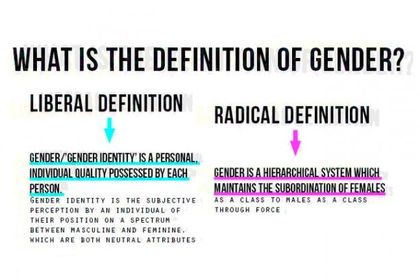
- Operationalising a concept may seem straightforward, but a problem can arise when different sociologists operationalise the same concept differently. For example, we might disagree about whether a routine office worker is workingclass or middle-class. This can make it hard to compare the findings of different pieces of research.
- Positivists are concerned to operationalise concepts because of the importance they place on creating and testing hypotheses. By contrast, interpretivists put less emphasis on operationalising concepts. This is because they are more interested in actors’ own definitions and understandings of ideas such as ‘class’, ‘achievement’ etc, than in imposing their own definitions of these concepts.
- Caption: Different feminists will define gender in different ways, therefore their research into gender may not be fully comparable.
-
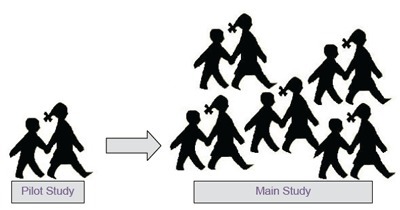
- A pilot study is a trial run before the real research takes place.
- Sociologists who use social surveys (questionnaires and structured interviews) often carry out a pilot study before conducting their main survey.
- The basic aim of the pilot study is to iron out any problems, refine or clarify questions and their wording and give interviewers practice, so that the actual survey goes as smoothly as possible.
- A pilot study may reveal that some questions are badly worded and hard to understand, or that the answers are difficult to analyse. After carrying out the pilot study, it should be possible to finalise the questionnaire or interview schedule.
Information
- Description
- A-Level (Year 1) Sociology (3a) Choosing a Research Method) Slide Set on The Process of Research, created by Summer Pearce on 24/01/2016.
- Created by
- Summer Pearce
- Views
- 1
- Rating