
Thermal Physics
Slides in this set (20)
-
- Thermodynamics:
- Thermodynamics is the study of energy & its effects on a system.
- Heat & Temperature:
- Temperature is a measure of the K.E of its molecules. Temperature indicates in which direction heat will flow when 2 bodies are placed close together.
- Heat is the thermal energy transferred from a body at a higher temperature to a body at lower temperature due solely to the temperature difference in Joules.
-
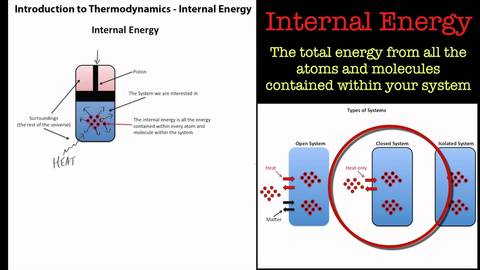
- Internal energy is defined as the sum of all the kinetic & potential energies of the molecules within a substance. It's represented by the Symbol U.
- Potential Energy: changes as molecules gets squeezed closer together & move further apart.
- The moving molecules in water, for example, have kinetic energy but their movement is disorganised-it changes all the time, randomly.
- Equation for Internal Energy:
- U= Kinetic energy of molecules + Potential energy of molecules (bonds)
-
Absolute 0 & the Kelvin temperature
- The Celsius scale starts at the freezing point of water- this isn't the fundamental temperature: it was chosen for convenience.
- There's a more important & fundamental temperature at -273℃- this is the absolute 0 of temperature
- Absolute 0 is the temperature at which the internal energy of any system at the lowest possible value. It can't cool a system that can't lose internal energy. It's the lowest possible value.
- Absolute temperature doesn't rely on changes in the property of a substance due to temperature. It's measured in Kelvin (K).
-
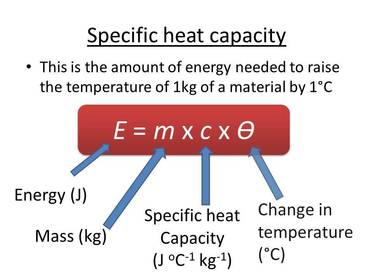
- For a substance being heated, the rise in temperature depends on the mass of the substance being heated & how much energy has been put in.
- It also depends on what the substance is. In fact:
- -change in internal energy, ΔU= mass*specific heat capacity *ΔT.
- -Equation can also be written as ΔQ(E)=mc ΔT
- Specific heat capacity depends on the substance
- Specific heat capacity definition:
- -The specific heat capacity is the energy needed to raise the temperature of 1kg by 1K (or 1 ℃).
-
Measuring Specific heat capacity
- A 60 W immersion heater was used in the experiment
- Beaker contained a kg of water at 21℃. After 5 minutes, the heater was switched off.
- The temperature of water went up to 25℃
- Result was too large
- https://www.youtube.com/watch?v=JuWtBR-rDQk (Embed)
-
Energy loss in measuring heat capacity
- why is the result so large?
- Not all the energy from the electrical heater go to increase the thermal energy of water, because some heat will have escaped to increase the internal energy of the room.
- There's also the apparatus-their internal energies have all gone up
- The increase in the internal energy must be less.
-
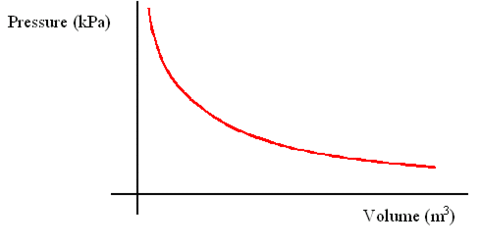
- What's the relationship between pressure & volume?
- The volume changes as pressure changes for a sample of gas at a constant temperature. If you double the volume, the pressure halves.
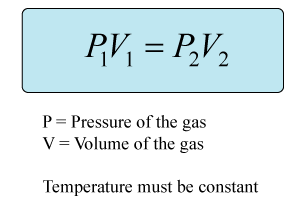
- This is Boyle's law
- -For a fixed mass of gas, at a constant temperature
- -Pressure p is inversely proportional to volume V
- -P1V1=P2V2
- https://www.youtube.com/watch?v=BxUS1K7xu30 (Embed)
-
-
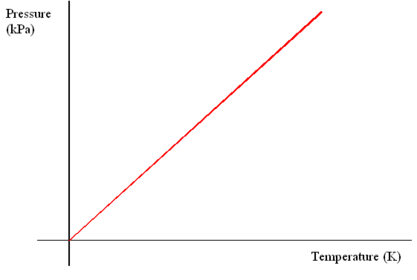
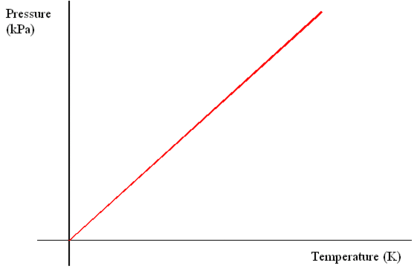
- The graph shows that the pressure of a fixed mass of gas at a constant volume is directly proportional to temperature.
- This is pressure law: p ∝ volume if the volume is constant.
- Caption: Pressure Law Graph
-
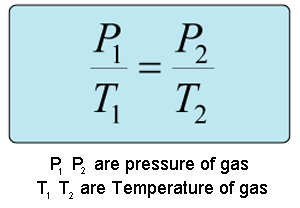
- Caption: Pressure law equation
-
- What happens if you keep only pressure constant?
- If you let a gas expand, so that the pressure stays constant, then the volume goes up in direct proportions to the absolute temperatures.
- From this it follows that:
- -Volume is directly proportional to temperature.
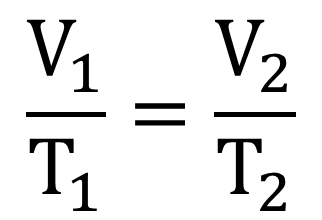
- Caption: Charles Law
-
- Caption: Charles law graph
-
- An ideal gas is one that obeys Boyle's law under all conditions however, in reality, no real gas is an ideal gas under all conditions.
- Under conditions of low pressure & high temperatures, real gases will obey Boyle's Law & are said to be behaving in an ideal manner.
-
- When describing an ideal gas, the following assumptions are made:
- The molecules have zero size
- molecules are identical
- molecules collide with each other and the walls of their containers without any loss of energy, in collisions which take zero time-elastic collision
- The molecules exert no forces on each other except during collisions
- there are enough molecules so that statistics can be applied.
- Newton's law of motions apply
- Molecules take up eligible volume
- Motion of all molecules is random
- All molecules travel in a straight line
- Internal energy of gas is kinetic energy
- Gravitational and electrostatic forces can be ignored
-
- What happens if you change the pressure & the volume & the temperature of a sample of gas?
- If you increase the temperature of the gas that would make the volume increase but if you increase pressure then Boyle's law predicts that the volume would decrease.
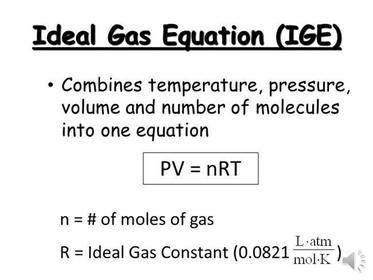
- To predict what happens when all 3 variables change, you need to use the ideal gas equation:
- PressurexVolume=nXa constant Rx Temperature
- PV=nRT
-
- Kinetic theory
- -Kinetic theory is about the movement of gas molecules
- Moving particles & gas pressure:
- -Kinetic theory of gases links the macroscopic behaviour of gas with its microscopic behaviour.
- How does Kinetic theory accounts for pressure?
- -For example, the molecule is heading for the wall & it has rebounded, going away from the wall.
- -This is because the wall has decelerated the molecule to a stop & then accelerated in the opposite direction to the same speed. The walls of the box has pushed the particles to the right to produce the acceleration & so the molecules must have pushed the walls to the left with the same force (Newton's 3rd Law)
- - The more massive a molecule is, the larger the force however the acceleration is the same.
- -When a faster molecule collides & rebounds, the change in velocity is greater which means the molecule accelerates more when it rebounds & so needs a larger force.
- - Pressure of a gas in a given volume depends on 3 factors: -mass of molecules
- -speed of molecules (speed^2)
- -how many molecules there are in the container.
-
- At constant temperature the speed of a particle won't remain the same as it'll change as it collides with other particles.
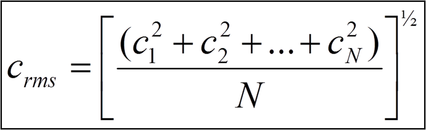
- However, the distribution of speed will remain the same as will average speed. This is the sum of all the speeds divided by the total number of particles.
- The root mean square of the molecules is different from the average speed.
-
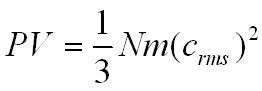
- -For an ideal gas, the kinetic theory equation is:
- pV=⅓NMC(rms)^2
-
Kinetic theory model assumptions
- -The kinetic theory equation requires certain assumptions to be made about gas particles:
- -particles move in constant, random motion
- -particles have eligible volume
- -all collisions between particles and the walls of the containers are completely elastic
- - Duration of each collision is much less than the time between collisions
- -Gravitational & electrostatic forces are negligible.
-
Kinetic Energy&Boltzman constant K
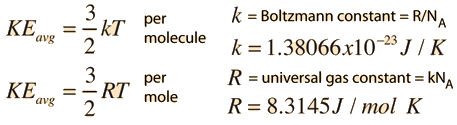
- The theoretical equation for an ideal gas & the ideal gas equation both give you an equation with pV as its subject.
- For 1 mole of gas, pV=⅓ Nmc(rms)^2 & pV=RT
- You can combine to give the equations on the right.
- K is the boltzsman constant
- This is the gas constant R divided by Avogadro constant N. Boltzman Constant: K=R/N
- But ½mc^2 is the mean kinetic energy of a gas molecule, so:
- Mean K.E of a gas molecule(J)= 3/2 x Boltzman constant x temperature (measured in Kelvin)
Information
- Description
- A-Level Physics (Unit 5) Slide Set on Thermal Physics, created by Haneen Al-Baghdadi on 05/04/2016.
- Created by
- Haneen Al-Baghdadi
- Views
- 3
- Rating