
Roots- unit 4
Slides in this set (12)
-
- During thee 20th century, populations in the UK chaned both on a national regional and at the level of individual households and families.
- >National- the UK census data gives a record of people in the UK going back to 1800. The news
- >Local-dating back to the middle ages, church records include information about, births, marriages, deaths
- >Personal- recollections of family members, interviews, speaking to people
- Why is so much money spent on producing this data?
- -compare data
- -monitor development
- -predict the future(planning)-goverments need to know for budgeting (eg. building parks for young people)
- KEY WORDS
- -GENEALOGY- the study of family history
- -GREYING POPULATION- a population structure in which the proportion of people aged 65 and over is high and rising. this is caused by increased and can be further exaggerated by low birth rates
- - AGE SELECTIVE MIGRATION- a movement of a particular age group or gender
- -EXTENDED FAMILY- members of the family beyond the core of parents and children
- -SOCIAL MOBILITY- the movement of individuals between the different levels of social heirchary
-
- Family size
- >The total population of the UK rose from around 38 million in 1901 to 64 million in 2015.
- >In contrast to the actual growth, individual household sizes have fallen.
- In the 1900's, it was normal to have 4 or 5 children
- Today it is more common to have around 2 children
- >many households consist of just one or two people, including pensioners, divorces or gay couples
- >increased life expectancy of grandparents, living longer can lead to increase the size of extended family households
- >The amount of siblings has decreased. MY grandma had 9 siblings and i have 2
- > In the 19th century people married younger however they were most commonly married for life. Now the amount of divprces is increasing as it is socially acceptable.
-
- The UK as a whole has a top heavy population structure.
- >in 1931 just 7% of the population were aged over 65
- >now 16% are due to increased life expectancy
- The average age to die in 1930was 58 for men and 60 for women
- Now this number has increased to 80 for men and 82 for women
- Migration
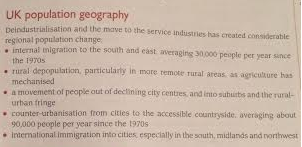
- -the mobility of the UK population has increased.
- -The most recent migrations has been movement away from manufacturing and mining towns, towards settlements with service sector jobs.
- -A general 'southeast' drift of the Uk population has resulted in 26% now living in the UK and the south east.
- -Counter urbanisation- significant numbers of people have left towns and cities to live in rural areas
- -Age selective migration- move of retired people to the seaside settlements and young adults leaving home to live in uni towns.
- -
-
- Employment
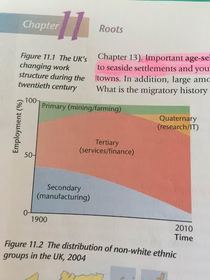
- - one of the most significant changes in the UK has been the delcine in primary (mining farming) and secondary (manufacturing) employment.
- in 1920 there were 1.2 million coal miners in UK
- now there are a few thousand
- 76% of the workforce is in the service industry (a business that does work for a customer, and occasionally provides goods, but is not involved in manufacturing)
- Social status
- The transition into a service based economy has not been easy
- In 1980 3 million people were unemployed as the UK industrialised.
- >by the 21st century tertiary economy hadn created many new jobs including hihgly paid professional jobs
- - wages rose, more people entering higher education.
- -rising affluence has led to mass car ownership, foreign holidays and second homes
- - all these changes have led to social mobility and increase the proportion of people in the UK who consider themselves to be middle class
- Ethnicity
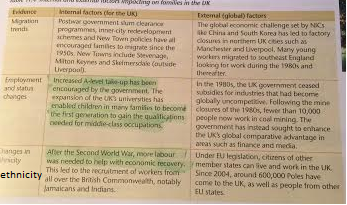
- -the ethnic mix of people living in the UK (both british citizens and foreign nationals) has significantly changed over time
- -from the 1950s o
-
-
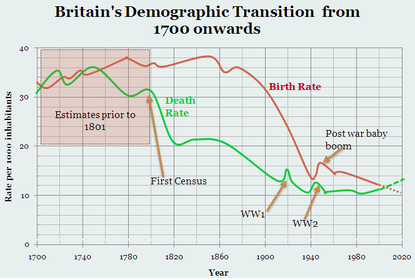
The Demographic Transition Model
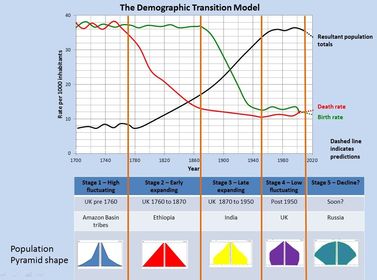
- Caption: This is the general demographic transition model
-
Demographic transition modle in UK
- mortality declining
- improved sanitation and hygiene and safety:
- provision of universal education raised public awareness of how diseases spread. demand that laws were set to regulate all hazardous aspects of peoples lives (eg. car seat belt use , hygeine in restaurants and fire exits)
- Improved food supply
- with the development of of infrastructure (eg. roads, canals). Innovations were wide spread by 1840 including crop rotation, stock-breeding, land drainage, new farm machinery
- healthcare, treatment and prevention
- the NHS was introduced in 1940s. accident and emergency departments provide immediate help for injured people. Vaccination against diseases has led to them dissapearing in the UK (polio). 90% of mortality decline in the second half of the 19th century is due to reduced impact of infectious diseases
- rise in standard of living
- per capita income increased and in better nutrition and warmth through the purchase of fuel.
- global connections
- the nature of work has changed. many dangerous occupations have become automated and most manufacturing and mining jobs have moved oversea.
- falling births
- legalisation
- women enjoyed improved status and work opportunities. women were excluded form the mines and the proportion of 11-14 year olds working declined from 30% to 17% in 1900. compulsory education act meant more peole were educated. women are postponing they age at which they start a family. As a result few women now have more than 2 children.
- contraception, abortion and education
- pills were legally made available in 1961. Aids awareness campaigns in the 1980s resulted in condoms becoming far more widely available. abortion was legalized in 1967
- costs
- the rising costs of living mean that parents may limit numbers of children in order to provide well for them and maintain their own lifestyles.
- economic changes
- increased demand for labour led to more women women entering the workforce. this resulted in higher family incomes and standards of living. The womens age was regarded as essential and large families prevented women from working
-
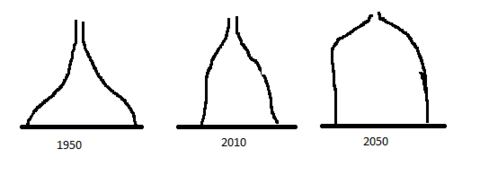
- today death rates (outside war zones) are generally low and stable, but birth rates in many countries are continuing to fall which results in a ageing population:
- -increased awareness of hygeine so fewer deaths due to infections
- -the universal use of antibiotics meaning that many onc fatal diseases can be controlled and the life expectancy increases
- -the education of women which often results in the delay off first pregnancy and fewer children
- -women being part of the work force means they focus on their career first leaving less time for child rearing
- -increase expence of bringing up children so fewer children
- 1950---48 life expectancy---5 fertility rate
- 2010---68 life expectancy---2.5 fertility rate
-
- dependency ratio: The dependency ratio is a measure showing the number of dependents (aged 0-14 and over the age of 65) to the total population (aged 15-64)
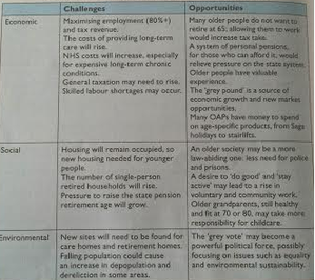
- SOCIAL:
- -smaller families, due to decreased fertility rate, means older people are more likely to into industrialized care the % of older people living with a child has fallen from 90% to 48%
- -more older people will be living in poverty because the pensions are becoming a burden as dependence ratio is increase
- in 2013, 1.2 million pensioners lived in poverty
- -most rapidly expending sector of population is over 80s
- very high % of over 85. 2030 expected to be an 106% increase in 85+.
- this is a burden on government, local councils and tax payers and families
- ECONOMICAL
- -strain on goverment as it puts an impact on health care and social services
- Japanese elderly population over 65 is 30 million. total pop is 130 mill.
- One in six people aged 80 and over have dementia.
- By 2015 there will be 850,000 people with dementia in the UK.
- this causes a problem of care and money to finance it.
- - work force is decreasing more are demanding higher
- wages
- germany 16 pensioners/ per 100 workers 1960
- 30 pensioners/ per 100 workers 2006
- -these economical difficulties are difficulties are hard enough for developed countries. the implications for health care and pension provision is challenging in developing countries due to less people paying taxes and corrupt government.
- concern for western governments especially these with existing debt issues and unfunded pension schemes
-
- ENVIRONMENT:
- -elderly people have different housing needs, easily reached accessible accommodation needed.
- tokyo alone have around 400 residential homes for the elderly now 800 is needed and that number is going to continue to grow
- -public transport will need to be futher developed in the UK
- -increased number needing care- more elderly requiring care either in nursing homes or on their own
- 30% of dorset population are pensioners.
- POLITICAL
- -goverments are not able to finance growing population or provide work for them
- 6/55 african states provide some kind of social pension , they are considered fragile states
-
responses to ageing population
- RAISE THE NORMAL AGE OF RETIREMENT THIS REDUCING THE PENSION BILL
- -uk government has brought women pensionable age the same as men at 65 soon to rise to 67
- ALLOW LARGE FLOWS OF INTERNATIONAL MIGRANTS TO FILL EMPLOYMENT GAPS
- -in the uk it rised from 1993: 7 million
- 2014: 17 million working in the uk
- CHANGE HEALTH SYSTEMS SO THAT EMPHASIS IS ON DISEASE PREVENTION IN EARLIER YEARS SO PEOPLE LIVE TO HAVE HEALTHY OLD AGE
- non communicable diseases are usually treated later in life and are more expensive
- ENCOURAGE/ALLOW OLDER PEOPLE TO WORK SO THEY CONTINUE TO CONTRIBUTE INTO THE TAX SYSTEM
- Japanese government are encouraging over 65s to take jobs in the community and keep healthy andd total retirement age is pushed to increase
- NOT ALWAYS BAD
- -estimated that over 65s have a net contribution of £40 billion for the terms and care they provide (grandchildren, disabled spouse)
- -spending money on goods and services
- -earning money and paying tax
-
Information
- Description
- gcse Geography- As level Slide Set on Roots- unit 4, created by Caitlin Davies on 18/04/2016.
- Created by
- Caitlin Davies
- Views
- 1
- Rating