
Physics - Circuits and Electricity
Slides in this set (10)
-
- Physics Notes slide Revision
-
- Electrical signals in your body travel along nerves. If an electric current passes through your body you may get an electric shock. This could burn you, or stop your lungs working.
- Electricity can be used to help the body. A pacemaker is used to help people whose hearts do not work properly. A defibrillator can be used to start someone's heart if it has stopped beating.
-
- https://www.youtube.com/watch?v=D2monVkCkX4 (Embed)
- Caption: A 10 minute video about Electricity and Circuits
- Electricity is a flow of electrons. Electricity can flow through conductors but not through insulators. Metals are good conductors of electricity. Plastics are good insulators. Cells and power packs provide safe, low voltage electricity. Most appliances use mains electricity. This can be dangerous if it is not used properly.
-
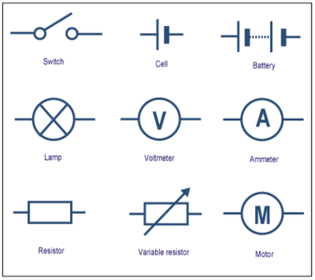
- A complete circuit is needed for electricity to flow. We use symbols when we draw circuits and a few are displayed here ->
- The current is the amount of electricity flowing in the circuit. The unit for current is the amp (A). Current is measured using an ammeter.
-
- Cell = This is a source of energy
- Battery = This is a bunch of multiple cells. It is also a source of energy.
- Bulb = This shows you if the circuit is complete.
- Switch = This is used to open/close the circuit (off/on)
- Fuse = This melts if too much electricity flows.
- Ammeter = This measures the current.
-
- The resistance of a current is a way of saying how easy or difficult it is for electricity to flow.
- High resistance = hard for electricity to flow = small current
- Low resistance = easy for electricity to flow = large current
- Thin wires and resistors have high resistances. Thick wires have low resistance.
-
- When electricity flows through a wire, the wire can get hot. Hot wires are used in electrical fires, irons and cookers.
- A fuse is a thin piece of wire that melts if too much electricity flows through it. It is used for safety so that fires do not occur.
-
- We can use models to help us to think about electricity and circuits. a model is a way of showing what something looks like and how it works without it being the actual thing. One model for a circuit is a central heating system. The boiler and pump represent the cell and, the pipes represent the wires, and the radiators represent bulbs.
- Circuits can be parallel or series circuits:
-
- https://www.youtube.com/watch?v=zx2yqSQ-sWs (Embed)
- Series Circuits:
- If one bulb breaks all the others go off.
- The current is the same everywhere.
- The resistance of the circuit is higher.
- If you put more bulbs in they will be dimmer, because it is harder for the electricity to get through.
-
- https://www.youtube.com/watch?v=FDHOdlnrIKI (Embed)
- Parallel Circuits:
- If one bulb breaks, the bulbs in the other branches stay on.
- The current splits up when it comes to a branch. The current in all the branches adds up to the current in the main part of the circuit.
- If you add more bulbs, they stay bright. It is easier for the current to flow with more branches because there are more ways for the electrons to go.
Information
- Description
- ks3 Science (Physics) Slide Set on Physics - Circuits and Electricity, created by Havana Picken on 24/05/2016.
- Created by
- Havana Picken
- Views
- 1
- Rating