
Reactions and Mechanisms of Benzene
Slides in this set (6)
-
- Bonding
- Nitrification
- Halogenation
- Friedel-Crafts Alkylation
-
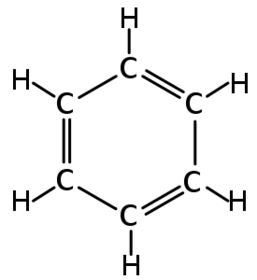
- Kekule assumed that benzene had the bonding of cyclohex-1,3,5-triene (pictured right). However there were isues with this:
- Measurements from X-Ray diffraction showed equal electron density around the ring
- All the bond lengths were equal, whereas C=C bonds are shorter than C-C bonds are.
- The enthalpy of hydrogenation was not simply three times that of cyclohexene. Cyclohexene is -120kJ/mol, expecting Kekule's benzene to be -360kJ/mol, but instead it is -208kJ/mol.
- Therefore, it was proven that bonding in benzene instead has a ring of delocalised electrons, making it more stable than expected.
- Caption: Kekule's benzene
-
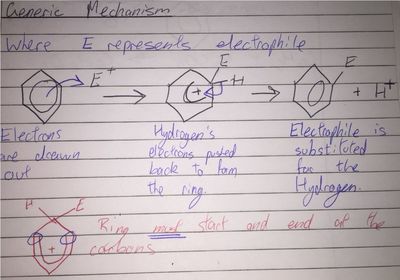
- Caption: Electrophilic substitution
-
- The electrophile in this reaction is (NO2)+, Nitronium.
- It is generated by mixing conc sulphuric acid and conc nitric acid and heating to 50 degrees Celcius.

- Caption: Formation of the Nitronium ion
-
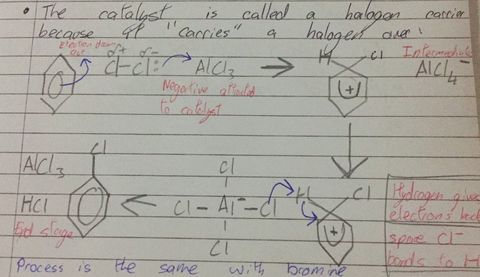
- Benzene reacts with halogens in the same way it does with nitration - electrophilic substitution, however this time, a catalyst is needed, this is called a "Halogen Carrier".
- If benzene is reacting with Chlorine, traditionally Aluminium Trichloride (AlCl3) is used, and if with Bromine, Iron Tribromide (FeBr3) is used.
- The reaction takes place at room temperature.
-
- This is exactly the same as Halogenation from the previous slide.
- But instead of a diatomic halogen, there is an alkyl chloride (haloalkane).
- The entire alkyl group is added on to the benzene ring in the place of the halogen from the slide before.
Information
- Description
- A2 Chemistry (St Julians work) Slide Set on Reactions and Mechanisms of Benzene, created by David Morgan on 10/11/2016.
- Created by
- David Morgan
- Views
- 82
- Tags
- Rating