
Flashcards
Projectmanagement Sript 6 Übung 6
Cards in this deck (14)
- 1Waht is Risk management:the art of identifying,
analyzing, and responding to risk factors throughout
the life of a project and in the best interest of its
objectives. - 2Project risk– any possible event that can negatively
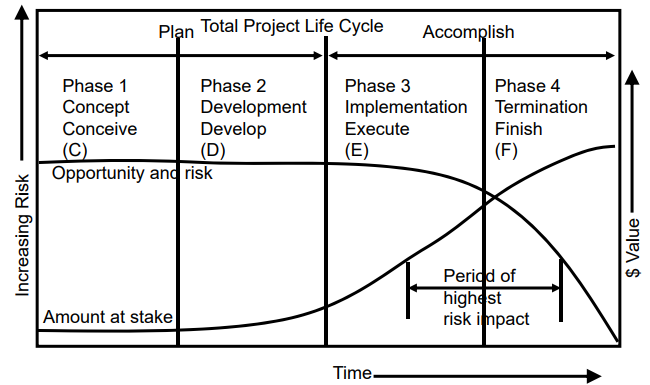
affecta projec - 3Risk Vs Amount at Stake
- 4What are the Four Stages of Risk Management? Risk identification
Analysis of probability and consequences
Risk mitigation strategies
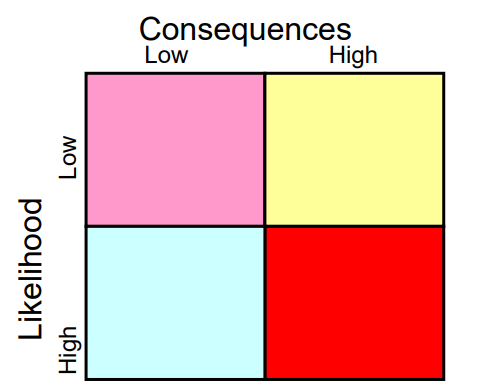
Control and documentation - 5Risk Management Assessment Matrix
- 6What are any four common categories of risk?• Financial
• Technical
• Commercial
• Execution - 7What are some Risk Mitigation Strategies?Accept
• Minimize
• Share
• Transfer
• Contingency Reserves
– Task contingency
– Managerial contingency
• Mentoring
• Cross training - 8Control & Documentation Help managers classify and codify risks, responses, and outcomes Change management report system answers are?• What?
• Who?
• When?
• Why?
• How? - 9Exercise 1 How does risk level vary with project life cycle stage? Where is the period of highest risk impact? WhyRisk is at its highest during a project's concept phase, falling off gradually
during development phase and reduces dramatically during implementation
and termination phases. At project completion, risk is at its lowest point.
- see risk life cycle table - 10Exercise 2 What are the four distinct stages of systematic risk management and what takes place at each?Risk identification — the process of determining the specific risk factors that
can reasonably be expected to affect the project.
Analysis of probability and consequences — the potential impact of these
risk factors is determined by how likely they are to occur and the effect they
would have on the project if they did occur.
Risk mitigation strategies — steps taken to minimize the potential impact of
these risk factors deemed sufficiently threatening to the project.
Control and documentation — creating a knowledge base for future projects
based on lessons learned. - 11Exercise 3 What are any four common categories of risk? What is an element of each category??- Financial risk refers to the financial exposure a firm opens itself up to
when developing a project. - Up-front capital expenditures are at risk in any
project.
- Technical risk emerges when a project contains unique technical
elements or new and unproven technology.
- Commercial risk must be handled when a project is being developed for
definite commercial intent since success in the marketplace is never
guaranteed.
- Execution risk is a broad category relating to the unknowns associated
with the project plan being carried out. - 12Exercise 4 What are the basic qualitative methods for identifying risk factors? What are the advantages and disadvantages of each method?-A brainstorming meeting: generate mayn ideas, one member might dominate
-The Delphi method: collects expert opinions anonymously in two or more rounds of questions posed by
an expert.
-Multiple (or team-based) assessments:bring together many different members of a group, have a wider perspective of risks.
-The "experience counts"approach looks for individuals in the organization that have had similar
project experiences and seeks their input with regards to "lessons learned" and risks anticipated. - 13Exercise 5 Sketch a 2x2 risk management assessment matrix and discuss the impact of each quadrant.
- 14Exercise 6 What are the four alternatives a project organization can adopt in deciding how to address their risks? What are the advantages and disadvantages of each? Which is best and why?Accept-consequences are low so not too bad
• Minimize- lower condequences
• Share- share with members to have more power over risk and consequences
• Transfer- give problem away, risky because no control over
the risk