
Quiz
OS final
Erstelle ein kostenloses Konto, um dieses Quiz zu beenden
Speichere deinen Fortschritt und sieh dir dein Endergebnis an.
oder mit deiner E-Mail registrieren
Schon ein Konto? Anmelden
Fragen in diesem Quiz (200)
1In the blocking send, blocking receive
- Aboth sender and receiver are blocked until message is delivered
- Bnone of the above
- Cthe sending process sends the message and resumes operation
- Dthe sending process sends the message while receiver is blocked
2The table _____ contains the base address of each page in physical memory
- Aprocess
- Bmemory
- Cpage
- Dframe
3A state is safe, if:
- Athe system can allocate resources to each process in some order and still avoid deadlock
- Bthe system does not crash due to deadlock occurrence
- Cthe state keeps the system protected and safe
- Dall of the above
4In fixed sized partition, the degree of multiprogramming is bounded by ____
- Athe memory size
- Ball of the above
- Cthe number of partitions
- Dthe CPU utilization
5_____ is generally faster than_____
- Aworst fit, best fit
- Bbest fit, first fit
- Cfirst fit, best fit
- Dnone of the above
6The two atomic operations permissible on semaphores are: (several answer)
- Await
- Bsignal
- Chold
- Dstop
7Program:
- Ais the device where information stored
- Bis a sequence of the instructions
- Cis a device that performs a sequence of operations specified by instructions in memory
- Dis typically characterized by interactive processing and time-slicing of the CPU’s time to allow quick response to each user
8“Mutual exclusion” condition for deadlock is defined as:
- AOnly one process may use a resource at a time
- BNo resource can be forcibly removed from process holding it
- CProcess holds a resource while awaiting for other resource
- DEach process holds resource needed by next process in chain
9“Hold and wait” condition for a deadlock is defined as:
- AOnly one process may use a resource at a time
- BNo resource can be forcibly removed from process holding it
- CProcess holds a resource while awaiting for other resource
- DEach process holds resource needed by next process in chain
10A monitor is a type of:
- Anone of the above
- Bhigh level synchronization construct
- Clow level synchronization construct
- Dsemaphore
11What is NOT the example of consumable resources?
- AInformation in I\O buffers
- BSignals
- CMain memory
- DMessages
12Which one is a synchronization tool?
- Asocket
- Bthread
- Cpipe
- Dsemaphore
13A Process Control Block(PCB) does not contain which of the following?
- Astack
- Bdata
- Cprocess state
- Dbootstrap program
- Ecode
14With ……………… only one process can execute at a time; meanwhile all other process are waiting for the processor. With ……………….. more than one process can be running simultaneously each on a different processor.
- AMultiprocessing, multiprogramming
- BUniprogramming, Multiprocessing
- CMultiprogramming, Uniprocessing
- DMultiprogramming, Multiprocessing
15Memory:
- Ais the device where information stored
- Bis a sequence of the instructions
- Cis a device that performs a sequence of operations specified by instructions in memory
- Dis typically characterized by interactive processing and time-slicing of the CPU’s time to allow quick response to each user
16This resource can be safely used by only one process at a time and is not depleted by that use:
- Arefurbished resource
- Breplenishing resource
- Creusable resource
- Drefreshing resource
17Which of the following condition is required for the deadlock to be possible?
- Amutual exclusion
- Ball of the above
- Cno resource can be forcibly removed from a process holding it
- Da process may hold allocated resources while awaiting assignment of other resources
18The ________ is used as an index into the page table
- Apage number
- Bpage offset
- Cframe bit
- Dframe offset
19A page fault:
- Aoccurs when a program accesses a page of memory
- Bis a reference to a page belonging to another program
- Cis an access to a page not currently in memory
- Dis an error is a specific page
20A state of a process is defined by:
- Athe activity is just executed by the process
- Bthe final activity of the process
- Cthe activity to next be executed by the process
- Dthe current activity of the process
21Suppose that a process is in “Blocked” state waiting for some I\O service. When a service is completed, it goes to the:
- AReady state
- BRunning state
- CTerminated state
- DSuspended state
22The link between two processes P and Q to send and receive a message is called:
- Amessage-passing link
- Ball of the above
- Ccommunication link
- Dsynchronization link
23Message passing system allows processes to:
- Ashare data
- Bcommunicate with one another without resorting to shared data
- Cname the recipient or sender of the message
- Dcommunicate with one another by resorting shared data
24Which of the following statements is false?
- AI\O transfers are more efficient with large pages
- Ba large page size causes instructions and data that will not be referenced brought into primary storage
- Ca small page size causes large page tables
- Dinternal fragmentation is increased with small pages
25The systems which allows only one process execution at a time, are called:
- Aunitasking systems
- Buniprocessing systems
- Cuniprogramming systems
- Dunicasting systems
26Remote Procedure Calls(RPC) are used:
- Anone of the above
- Bfor communication between two processes on separate systems
- Cfor communication between two processes on the same systems
- Dfor communication between two processes remotely different from each other on the same system
27A minimum of ______ variable(s) is/are required to be shared between processes to solve the critical section problem?
- Atwo
- Bthree
- Cone
- Dfour
28This resource can be created and destroyed
- Aresumable resource
- Brestartable resource
- Cconsumable resource
- Dfinite resource
29Fixed-length block of data in secondary memory is called:
- Apages
- Bnone of the above
- Cframes
- Dsegments
30A relationship between processes such that each has some part (critical section) which must not be executed while the critical section of another is being executing, is known as?
- AMultitasking
- BSemaphore
- CMutual exclusion
- DMultiprogramming
31Every address generated by the CPU is divided into two parts: (several answers)
- Aframe offset
- Bpage number
- Cframe bit
- Dpage offset
32True or false: segmentation suffers from external fragmentation?
- ATrue
- BFalse
33For each process OS creates and manages:
- AProcess control block
- BProgram code
- CProgram
- DThread control block
34What is a trap/exception?
- Auser generated interrupt caused by an error
- Bfailure of the system
- Chardware generated interrupt caused by an error
- Dsoftware generated interrupt caused by an error
35What is the reusable resource:
- Anone of the above
- Bthat can be used by more than one process at a time
- Cthat can be used by one process at a time and is not depleted by that use
- Dthat can be shared between various threads
36Interprocess communication:
- Anone of the above
- Ballows the processes to only synchronize their actions without communication
- Callows processes to communicate and synchronize their actions when using the same address space
- Dallows processes to communicate and synchronize their actions without using the same address space
37Which of the following transitions is not possible?
- Ablocked to running
- Brunning to blocked
- Cblocked to ready
- Dready to running
38Any program, no matter how small, will occupy an entire partition results in:
- Ainternal fragmentation
- Bsegmentation
- Cpaging
- Dexternal fragmentation
39This matrix defines requirements of processes i for the resources j
- AClaim matrix
- BAllocation matrix
- CResource matrix
- DRequest matrix
40Several processes access and manipulate the same data concurrently and the outcome of the execution depends on the particular order in which the access takes place, is called a(n)____
- ARace section
- BEntry section
- CShared memory segments
- DProcess synchronization
41The context of a process in the PCB of a process DOES NOT contain:
- Acontext switch time
- Bthe process state
- Cmemory-management information
- Dthe value of the CPU registers
42External fragmentation will not occur when:
- Ano matter which algorithm is used, it will always occur
- Bfirst fit is used
- Cbest fit is used
- Dnext fit is used
43A deadlock avoidance algorithm dynamically examines the _____, to ensure that a circular wait condition can never exist
- Aresource allocation state
- Bresources
- Coperating system
- Dsystem storage state
44The process control block is:
- Aprocess type variable
- Bdata structure
- Cblock in memory
- Dsecondary storage section
45This illustrates the progress of two processes competing for two resources:
- Ajoint process diagram
- Bjoint ingres diagram
- Cjoint regress diagram
- Djoint progress diagram
46In a multiprogramming environment:
- Athe programs are developed by more than one person
- Bmore than one process resides in the memory
- Csingle user can execute many programs at the same time
- Dthe processor executes more than one process at a time
47When high priority task is indirectly preempted by medium priority task effectively inverting the relative priority of the two tasks, the scenario is called:
- Apriority exchange
- Bpriority inversion
- Cpriority removal
- Dpriority modification
48Main memory is broken into fixed-sized blocks called____
- Anone of the above
- Bpages
- Cframes
- Dsegments
49The first fit, best fit and worst fit are strategies to select a
- Aprocess from a queue to put in memory
- Ball of the above
- Cfree hole from a set of available holes
- Dprocessor to run the next process
50The Banker’s algorithm is referred to as
- Adenial of service
- Bresource allocation denial
- Cloan allocation denial
- Dresource allocation refusal
51The code that changes the value of the semaphore is:
- Anon-critical section code
- Bremainder section code
- Cnone of the above
- Dcritical section code
52The two kinds of semaphore are: (Several answers)
- Amutex
- Bcounting
- Cbinary
- Ddecimal
53“Circular wait” condition for deadlock is defined as:
- AOnly one process may use a resource at a time
- BNo resource can be forcibly removed from process holding it
- CProcess holds a resource while awaiting for other resource
- DEach process holds resource needed by next process in chain
54Banker’s algorithm for resource allocation deals with:
- Adeadlock prevention
- Bmutual exclusion
- Cdeadlock recovery
- Ddeadlock avoidance
55What is compaction?
- Aa paging technique
- Ba technique for overcoming fatal error
- Ca technique for overcoming internal fragmentation
- Da technique for overcoming external fragmentation
56Process is:
- Aa job in secondary memory
- Ba unit of activity characterized by execution of a sequence of instructions, a current state, and an associated set
- Ccontents of main memory
- Dprogram in high level language kept on disk
57A single thread of control allows the process to perform:
- Aboth
- Bone task at a time
- Cmultiple tasks at a time
58When the memory allocated to a process is slightly larger than a process, then:
- Aboth will occur
- Bexternal fragmentation occurs
- Cinternal fragmentation occurs
- Dnone of the above
59A problem encountered in multitasking when a process is perpetually denied necessary resources is called:
- Astarvation
- Bdeadlock
- Caging
- Dinversion
60The memory allocation scheme subject to “internal fragmentation” is:
- Asegmentation
- Bvirtual memory segmentation
- Cfixed partitioning
- Dpure demand paging
61Which one is deadlock avoidance algorithm?
- Adining philosophers problem
- Belevator algorithm
- Cbanker's algorithm
- Dround-robin algorithm
62What is a method of memory allocation by which the program is subdivided into equal portions, or pages and core is subdivided into equal portions or blocks?
- Avirtual memory
- Bsegmentation
- Cpaging
- Dpartition
63Variable-length block of data that resides in secondary memory is called:
- Anone of the above
- Bframes
- Csegments
- Dpages
64The memory allocation scheme subject to “external fragmentation” is:
- Asegmentation
- Bswapping
- Cmultiple contiguous fixed partitionings
- Dpure demand paging
65Four necessary conditions for deadlock to exist are: mutual exclusion, no-preemption, circular wait and
- Arace condition
- Bdeadlock avoidance
- Chold and wait
- Dstarvation
66A binary semaphore is semaphore with integer values: (Several answers)
- A1
- B-1
- C0
- D0.5
67Program always deals with:
- Alogical address
- Bphysical address
- Crelative address
- Dabsolute address
68The systems which allows only one process execution at a time, are called
- Auniprogramming systems
- Bunitasking systems
- Cuniprocessing systems
- Dunicasting systems
69Swapping:
- Aallows many programs to use memory simultaneously
- Ballows each program in turn to use the memory
- Cdoes not work with overlaying
- Dnone of the above
70When several processes access the same data concurrently and the outcome of the execution depends on the particular order in which the access take place, is called:
- Adynamic condition
- Brace condition
- Ccritical condition
- Dessential condition
71If a page table entry is present in the TLB, then it is known as a:
- Abuffer miss
- BTLB miss
- Cpage fault
- DTLB hit
72With paging there is no _____ fragmentation
- Aeither type of
- Bnone of the above
- Cexternal
- Dinternal
73The address of a page table in memory is pointed by:
- Apage table base register
- Bstack pointer
- Cpage register
- Dprogram counter
74What is a medium-term scheduler?
- Ait selects which process has to be executed next and allocates CPU
- Bnone of the above
- Cit selects which process has to be brought into the ready queue
- Dit selects which process has to remove from memory by swapping
75“No preemption” condition for a deadlock is defined as:
- AOnly one process may use a resource at a time
- BNo resource can be forcibly removed from process holding it
- CProcess holds a resource while awaiting for other resource
- DEach process holds resource needed by next process in chain
76Processor:
- Ais the device where information stored
- Bis a sequence of the instructions
- Cis a device that performs a sequence of operations specified by instructions in memory
- Dis typically characterized by interactive processing and time-slicing of the CPU’s time to allow quick response to each user
77Fixed-length block of main memory is called____:
- Aframes
- Bsegments
- Cnone of the above
- Dpages
78The initial value of the semaphore that allows only one of the many processes to enter their critical section, is?
- A1
- B0
- C2
- D10
79Mutual exclusion means that:
- Aif a process is executing in its critical section, then other processes must be executing in their critical section
- Bif a process is executing in its critical section, then all the resources of the system must be blocked until it finishes exclusion
- Cif a process is executing in its critical section, then no other process must be executing in their critical sections
- Dnone of the above
80For every process there is a_________.
- Apointer to page table
- Bcopy of page table
- Cframe table
- Dpage table
81In operating system, each process has its own
- Aall of the mentioned
- Baddress space and global variables
- Cset of data
- Dprogram code
82Listing the sequence of instructions that are executed is called:
- Atrace
- Bprogram counter
- Cinstruction
- Dcontrol block
83The segment of code in which the process may change common variables, update tables, write into files known as:
- Acritical section
- Bprogram
- Cnon-critical section
- Dmutual exclusion
84Deadlock inevitable region can be referred as:
- Afun region
- Bfatal region
- Cfinal region
- Dfalse region
85How to solve a problem of equal-size partitions?
- Aunequal-size partitions
- Bsegmentation
- Ccompaction
- Dvirtual memory segmentation
86Paging?
- Aallows multiple programs to reside in separate areas of core at the time
- Bis a method of memory allocation by which the program is subdivided into equal portions, or pages and core is subdivided equal portions or blocks
- Cis a method of allocating processor time
- Dconsists of those addresses that may be generated by a processor during execution of a computation
87In internal fragmentation, memory is internal to a partition and:
- Ais not being used
- Bnone of the above
- Cis always used
- Dis being used
88A set of processes is deadlock if:
- Aeach process is blocked and will remain so forever
- Bnone of the above
- Call processes are trying to kill each other
- Deach process is terminated
89A memory used to provide a high speed is called?
- Acache
- Bmain memory
- Cdisk buffer
- Dstack pointer
90In indirect communication between processes P and Q:
- Athere is a mailbox to help communication between P and Q
- Bnone of the above
- Cthere is another machine between the two processes to help communication
- Dthere is another process R to handle and pass on the messages between P and Q
91Semaphore is a/an ______ to solve the critical section problem?
- Aspecial program for a system
- Bcomplex structure
- Cinteger variable
- Dhardware for a system
92Which of the following is not the state of a process?
- Anew
- Brunning
- Cterminated
- Dold
- Eready
93The address of the next instruction to be executed by the current process is provided by the:
- Apipe
- Bprogram counter
- CCPU registers
- Dprocess stack
94Which of the following is not true about the memory management?
- Asegmentation suffers from external fragmentation
- Bpaging suffers from internal fragmentation
- Cvirtual memory is used only in multi-user systems
- Dsegmented memory can be paged
95The primary distinction between the short-term scheduler and long-term scheduler is:
- Athe length of their queues
- Bnone of the above
- Cthe type of processes the schedule
- Dthe frequency of their execution
96In the non-blocking send:
- Athe sending process sends the message and resumes operation
- Bthe sending process keeps sending until the message is received
- Cthe sending process keeps sending until it receives a message
- Dnone of the above
97The objective of multi-programming is to:
- Ahave multiple programs waiting in a queue ready to run
- Bto maximize CPU utilization
- Cto minimize CPU utilization
98A system is in the safe state if:
- Aa) the system can allocate resources to each process in some order and stil avoid a deadlock
- Bb) there exist a safe sequence
- Cboth a) and b)
- Dnone of the above
99When memory is divided into a several fixed sized partitions, each partition may contain_____
- Aexactly one process
- Bnone of the above
- Cat least one process
- Dmultiple processes at once
100In the non-blocking send, non-blocking receive:
- Athe sending process keeps sending until it receives a message
- Bneither of processes are required to wait
- Cthe sending process keeps sending until the message is received
- Dthe sending process sends the message and resumes operation
101A process can be terminated due to:
- Afatal error
- Bnormal exit
- Call of the mentioned
- Dkilled by another process
102What is a short-term scheduler?
- Ait selects which process has to be executed next and allocates CPU
- Bnone of the above
- Cit selects which process has to be brought into the ready queue
- Dit selects which process has to remove from memory by swapping
103In contiguous memory allocation:
- Aeach process is contained in a single contiguous section of memory
- Bnone of the above
- Cthe memory space is contiguous
- Dall processes is contained in a single contiguous section of memory
104External fragmentation exists when:
- Anone of the above
- Bthe total memory is insufficient to satisfy a request
- Cenough total memory exists to satisfy a request but it is not contiguous
- Da request cannot be satisfied even when the total memory is free
105CPU fetches the instruction from memory according to the value of?
- Astatus register
- Bprogram counter
- Cinstruction register
- Dprogram status word
106A sequence of instructions, in a computer language, to get the desired result, is known as:
- Aalgorithm
- Binstruction
- Cprocess
- Dprogram
107Semaphores:
- Aare used for memory management
- Bsynchronize critical resources to prevent deadlock
- Care used to do I/O
- Dsynchronize critical resources to prevent contention
108This matrix defines the current allocation to process i of the resource j
- AAllocation matrix
- BResource matrix
- CRequest matrix
- DClaim matrix
109The operating system maintains a ___ table that keeps track of how many frames have been allocated, how many are there, and how many are available
- Amemory
- Bpage
- Cframe
- Dsegment
110For non-sharable resources like a printer, mutual exclusion:
- Amust exist
- Bnone of the above
- Cmust not exist
- Dmay exist
111If a process is executing in its critical section, then no other processes can be executing in their critical section. This condition is called
- Acritical exclusion
- Basynchronous exclusion
- Cmutual exclusion
- Dsynchronous exclusion
112Interprocess communication:
- Aallows process to synchronize activity
- Bis never necessary
- Cis usually done via disk drives
- Dis required for all processes
113The available vector defines:
- Atotal amount of resources required for all processes
- Btotal amount of each resource in the system
- Ctotal amount of each resource allocated to all processes
- Dtotal amount of each resource NOT allocated to any process
114A task in a blocked state
- Ais running
- Bis executable
- Cmust still be placed in the run queues
- Dis waiting for same temporarily unavailable resources
115The systems which allows only one process execution at a time, are called:
- Aunitasking systems
- Buniprocessing systems
- Cuniprogramming systems
- Dnone of the above
116True or false: segmentation suffers from external fragmentation
- ATrue
- BFalse
117What is NOT an example of reusable resource?
- Asemaphores
- Bprocessors
- Cinterrupt
- Di/o channels
118An un-interruptible unit is known as:
- Asingle
- Bnone of the above
- Cstatic
- Datomic
119How to solve a problem of “external” fragmentation?
- Aunequal-size partitions
- Bsegmentation
- Ccompaction
- Dvirtual memory segmentation
120Runtime mapping from virtual to physical address is done by?
- ACPU
- Bnone of the above
- Cmemory management unit
- DPCI
121A solution to the problem of external fragmentation is:
- Acompaction
- Blarger memory size
- Cunequal size parts
- Dsmaller memory space
122A situation where several processes access and manipulate the same data concurrently and the outcome of the execution depends on the particular order in which access takes place is called:
- Arace condition
- Bdata consistency
- Cstarvation
- Dmutual exclusion
123Which one of the following is the address generated by CPU?
- Alogical address
- Bphysical address
- Cabsolute address
- Dnone of the above
124What is the ready state of a process?
- Awhen process is scheduled to run after some execution
- Bnone of the above
- Cwhen process is using CPU
- Dwhen process is unable to run until some task has been completed
125Mutual exclusion can be provided by the:
- Anone of the above
- Bmutex locks
- Cboth
- Dbinary semaphores
126What is a long-term scheduler?
- Ait selects which process has to be executed next and allocates CPU
- Bnone of the above
- Cit selects which process has to be brought into the ready queue
- Dit selects which process has to remove from memory by swapping
127Operating system maintains the page table for
- Aeach process
- Beach thread
- Ceach instruction
- Deach address
128If a page number is not found in the TLB, then it is known as a:
- ATLB miss
- Bbuffer miss
- CTLB hit
129Part of a program where the shared memory is accessed and which should be executed invisibly, is called:
- Asemaphores
- Bmutual exclusion
- Ccritical section
- Ddirectory
130In memory systems, boundary registers?
- Atrack the beginning and ending of programs
- Btrack page boundaries
- Care only necessary with fixed partitions
- Dare used for temporary program variable storage
131The resource vector defines
- Atotal amount of resources required for all processes
- Btotal amount of each resource in the system
- Ctotal amount of each resource allocated to all processes
- Dtotal amount of each resource NOT allocated to any process
132When each process in the set is blocked awaiting for resource seized by another blocked process
- Ait is a deadend
- Bit is a deadlock
- Cit is a softlock
- Dit is a mortallock
133The number of resources requested be a process:
- Amust exceed the total number of resources available in the system
- Bmust always be equal to the total number of resources available in the system
- Cmust not exceed the total number of resources available in the system
- Dmust always be less than the total number of resources available in the system
134What is interprocess communication?
- Acommunication between two process
- Bcommunication between two threads of same process
- Cnone of the above
- Dcommunication within the process
135The degree of multi-programming is:
- Athe number of processes executed per unit time
- Bthe number of processes in the I/O queue
- Cthe number of processes in the ready queue
- Dthe number of processes in main memory
136This matrix defines the amount of resources of type j requested by process i
- AAllocation matrix
- BResource matrix
- CRequest matrix
- DClaim matrix
137If a page table entry is not in main memory, then it is known as a:
- Apage fault
- Bbuffer miss
- CTLB hit
- DTLB miss
138To avoid the race condition, the number of processes that may be simultaneously inside their critical section is:
- A10
- B0
- C1
- D2
139Which process can be affected by other processes executing in the system?
- Ainit process
- Bcooperating process
- Cchild process
- Dparent process
140Which of the following registers are used by the processor to exchange data with memory?
- AMAR and MBR
- BPC and IR
- CProgram status word
- DI/OAR and I/OBR
141Which of the following registers are used by the processor to exchange data with input/output module?
- AMAR and MBR
- BPC and IR
- CProgram status word
- DI/OAR and I/OBR
142The main disadvantage of this technique: consumes a lot of processor time, because every word
- ADirect memory access (DMA)
- BManual memory access
- CInterrupt-driven I/O
- DProgrammed I/O
143The processor issues an I/O command to a module and then go on to some other useful work. The I/O module performs the requested action and alerts the processor to request service when it is ready to exchange data with the processor. The described technique is:
- ADirect memory access (DMA)
- BManual memory access
- CInterrupt-driven I/O
- DProgrammed I/O
144Which of the following is not a technique possible for I/O operations?
- ADirect memory access (DMA)
- BManual memory access
- CInterrupt-driven I/O
- DProgrammed I/O
145The figure below illustrates a partial program execution.
What is the memory location of the data is addressed in the instruction?
- A301
- B940
- C302
- D941
146The figure below illustrates a partial program execution.
What is the address of the instruction that will be executed next?
- A301
- B940
- C300
- D941
147Choose the micro-instruction that reflect instruction execution stage shown in the figure below:

- APC -> MAR 300
M -> MAR 1940
MBR -> IR 1940 - BPC -> MAR 301
M -> MBR 1940
MBR -> IR 1940 - CM -> MAR 300
M -> MBR 1940
MBR -> IR 1940 - DPC -> MAR 300
M -> MBR 1940
MBR -> IR 1940
- APC -> MAR 300
148Choose the micro-instruction that reflect instruction execution stage shown in the figure below:

- APC -> MAR 301
M -> MBR 6941
MBR -> IR 5941 - BPC -> MAR 301
M -> MBR 5941
MBR -> IR 5941 - CIR -> MAR 941
M -> MBR 0002
MBR -> AC 0002 - DIR -> MAR 941
AC -> MBR 0003
MBR -> M 0003
- APC -> MAR 301
149The figure a) demonstrates the program timing diagram for:

- AInterrupts; fast I/O wait
- BInterrupts; slow I/O wait
- CNo interrupts
- DInterrupts; long I/O wait
- EInterrupts; short I/O wait
150The figure b) demonstrates the program timing diagram for:

- AInterrupts; fast I/O wait
- BInterrupts; slow I/O wait
- CNo interrupts
- DInterrupts; long I/O wait
- EInterrupts; short I/O wait
151The following figure demonstrates:

- AInterrupts; fast I/O wait
- BInterrupts; slow I/O wait
- CNo interrupts
- DInterrupts; long I/O wait
- EInterrupts; short I/O wait
152The figure a) demonstrates the program timing diagram for:

- AInterrupts; fast I/O wait
- BInterrupts; slow I/O wait
- CNo interrupts
- DInterrupts; long I/O wait
- EInterrupts; short I/O wait
153The figure b) demonstrates the program timing diagram for:
- AInterrupts; fast I/O wait
- BInterrupts; slow I/O wait
- CNo interrupts
- DInterrupts; long I/O wait
- EInterrupts; short I/O wait
154We have
Ts = average (system) access time
T1 = access time of M1 (cache)
T2 = access time of M2 (main memory)
T3 = access time of M3 (disk)
H1 = hit ratio, fraction of time reference is found i M1
H2 = hit ratio, fraction of time reference is found i M2
The average time to access an item, in case the item in disk is:- ATs = H1*T1 + H2*T2 + (1-H2)*T3
- BTs = H1*T1 + (1-H1)*(H1*T1 + H2*(T1 + T2) + (1 - H2)*(T2 + T3))
- CTs = H1*T1 + (1-H1)*H2*(T2 + T3)
- DTs = H1*T1 + (1-H1)*(H2*(T1 + T2) + (1 - H2)*(T1 + T2 + T3))
155This chooses which block to replace when a new block is to be loaded into the cache and the cache already had all slots filled with other blocks:
- Areplacement algorithm
- Bwrite policy
- Ccache size
- Dlocality of reference
156If the accessed word is found in the faster memory, that is defined as a:
- Abingo
- Bwin
- Chit
- Devrika
157If the accessed word is not found in the faster memory, that is defined as a:
- Amiss
- Bricochet
- Czero
- Dloss
158The processor contains a single data register, called
- APSW
- BPC
- CIR
- DAC
159Which register contains the instruction most recently fetched?
- Ainstruction register
- Bexecution register
- Cprogram counter
- Dprocess counter
160This register specifies the location in memory for the next read or write
- AMemory address register
- BI/OAR
- CMemory buffer register
- DI/OBR
161Which of the following element of a computer system moves data between the computer and its external environment?
- AMain memory
- BProcessor
- CSystem bus
- DI/O modules
162This main disadvantage of this technique: consumes a lot of processor time, because every word of data that goes from memory to I/O module or from I/O module to memory must pass through the processor
- ADirect memory access (DMA)
- BManual memory access
- CInterrupt-driven I/O
- DProgrammed I/O
163The processor issues an I/O command to a separate module, by sending the type of operation (read/write), the address of the I/O device, the starting location in memory for data, number of words. Then the processor continues with other work. The module transfers the entire block of data to/from memory without going through the processor. The described technique is:
- ADirect access memory (DMA)
- BManual memory access
- CInterrupt-driven I/O
- DProgrammed I/O
164The processor issues an I/O command to a module and waits, periodically checking the status of the I/O module until it finds that the operation is complete.
The I/O module performs the requested action and then sets the appropriate bits in the I/O status register but takes no further action to alert the processor.
The described technique is:- ADirect access memory (DMA)
- BManual memory access
- CInterrupt-driven I/O
- DProgrammed I/O
165The figure below illustrates a partial program execution.
Instruction in the IR will:
- ALoad 3 to AC from the memory
- BAdd 3 to AC from the memory
- CStore 3 to AC from the memory
- DAdd 2 to AC from the memory
166The figure below illustrates a partial program execution.
Instruction in the IR will:
- ALoad 3 to AC from the memory
- BAdd 3 to AC from the memory
- CStore 3 to AC from the memory
- DAdd 2 to AC from the memory
167Choose the micro-instructions that reflect instruction execution stage shown in the figure below

- AIR -> MAR 941
M -> MBR 0002
MBR ->AC 0005 - BPC -> MAR 301
M -> I/OBR 5941
I/OBR 5941 - CIR -> MAR 941
M -> MBR 0002
MBR -> AC 0002 - DPC -> MAR 302
M -> MBR 2941
MBR -> IR 294
- AIR -> MAR 941
168The processor is executing “Load AC from memory” instruction. Choose the correct micro-instruction:
- APC -> MAR
M -> MBR
MBR -> AC
IR -> MAR
M -> MBR
MBR -> AC - BPC -> MBR
M -> MAR
MAR -> IR
IR -> MAR
M -> MBR
MBR -> AC - CPC -> MAR
M -> MBR
MBR -> IR
IR -> MAR
M -> MBR
MBR -> AC - DPC -> MAR
M -> MBR
MBR -> IR
IR -> MBR
M -> MAR
MAR -> AC
- APC -> MAR
169The following figure demonstrates:

- AInterrupts; fast I/O wait
- BInterrupts; slow I/O wait
- CNo interrupts
- DInterrupts; long I/O wait
- EInterrupts; short I/O wait
170If there no interrupts, after each write operation, the processor must:
- ALoad new PC value
- BFinish execution of current instruction
- CSave the PSW and PC onto control stack
- DPause and remain idle until the I/O operation finishes
171Complete the relationship concerning the memory systems: greater capacity
- Alower capacity
- Bgreater cost per bit
- Cfaster access speed
- Dsmaller cost per bit
172As one goes down the memory hierarchy following occurs:

- Aincreasing frequency of access to the memory by the processor
- Bincreasing cost per bit
- Cdecreasing access time
- Dincreasing capacity
173User-visible registers minimize main memory references by optimizing register use
- ATrue
- BFalse
174This register contains the data to be written into memory or which receives the data read from memory
- AI/OAR
- Bmemory buffer register
- Cmemory address register
- DI/OBR
175Which of the following element of a computer system controls the operation of the computer and performs its data processing functions?
- ASystem bus
- BMain memory
- CI/O modules
- DProcessor
176The main disadvantages of this technique: there is a competition for bus usage
- AInterrupt-driven I/O
- BProgrammed I/O
- CManual memory access
- DDirect access memory (DMA)
177At the beginning of each instruction cycle, the processor fetches an instruction from the memory. The address of the instruction is held in
- AIR
- BMBR
- CMAR
- DPC
178The smaller, more expensive, faster memory is:
- ACache
- BDisk drive
- CMain memory
- DRegister
179The figure a) demonstrates the program timing diagram for:

- AInterrupts; fast I/O wait
- BInterrupts; slow I/O wait
- CNo interrupts
- DInterrupts; long I/O wait
- EInterrupts; short I/O wait
180There were no OS with
- ASimple batch systems
- BSerial processing
- CTime-sharing-systems
- DMultiprogrammed batch systems
181The principal objective of the time-sharing system is to
- AMinimize response time
- BMinimize processor utilization
- CMaximize response time
- DMaximize processor utilization
182Serial processing was used
- AIn early 1960s
- BFrom late 1940s to the mid-1950s
- CFrom the mid-1950s to early 1960s
183The programmer interacted directly with the computer hardware with
- ASimple batch systems
- BSerial processing
- CTime-sharing systems
- DMultiprogrammed batch systems
184In operation system security and protection, availability is:
- AConcerned with the proper verification of the identity of users and the validity of messages or data
- BAssuring that users cannot read data for which access is unauthorized
- CProtection of data from unauthorized modification
- DConcerned with protecting the system against interruption
185Choose the storage management responsibility for “The OS can achieve efficiency by assigning memory to jobs only as needed”
- AProcess isolation
- BProtection and access control
- CLong-term storage
- DSupport of modular programming
- EAutomatic allocation and management
186The limit register:
- ADefines the size of the region of memory occupied by the process (in bytes or words)
- BContains the index into the process list of the process currently controlling the processor
- CPoints to the next instruction in that process to be executed
- DContains the staring address of the region of memory occupied by the process
187In operating system security and protection, authenticity: is:
- AConcerned with the proper verification of the identity of users and the validity of messages or data
- BAssuring that users cannot read data for which access is unauthorized
- CProtection of data from unauthorized modification
- DConcerned with protecting the system against interruption
188An application programs is developed by the
- AApplication programmer
- BEnd user
- COperating system
- DHardware
189“The OS as a User/Computer interface” corresponds to the following objective
- AEfficiency
- BConvenience
- CAbility to evolve
190Process is:
- AProgram in High level language kept on disk
- BContents of main memory
- CA job in secondary memory
- DA program in execution
191If a process is executing in its critical section, then no other processes can be executing in their critical section. This condition is called
- ASynchronous exclusion
- BCritical exclusion
- CAsynchronous exclusion
- DMutual exclusion
192CTSS is illustrated in the figure There are four interactive users with the following memory requirements
JOB1: 15000 words
JOB2: 20000 words
JOB3: 5000 words
JOB4: 10000 words
In (d) control is transferred back to the JOB1. A portion of JOB2, remaining in main memory is equal to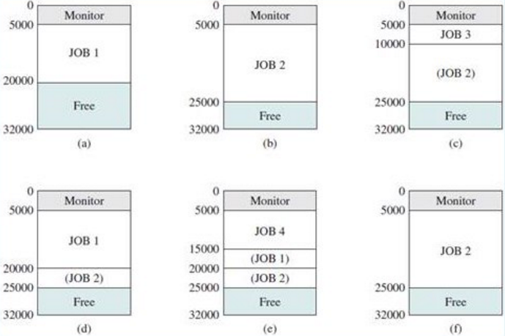
- A15000 words
- B20000 words
- C5000 words
- D25000 words
193193. CTSS is illustrated in the figure There are four interactive users with the following memory requirements
JOB1: 15000 words
JOB2: 20000 words
JOB3: 5000 words
JOB4: 10000 words
In (e) JOB4 is loaded. A portion of JOB1, remaining in main memory, is equal to- A15000 words
- B20000 words
- C5000 words
- D25000 words
194In operating system security and protection, сonfidentiality is:
- AConcerned with the proper verification of the identity of users and the validity of messages or data
- BAssuring that users cannot read data for which access is unauthorized
- CProtection of data from unauthorized modification
- DConcerned with protecting the system against interruption
195In operating system security and protection, Data integrity is:
- AConcerned with the proper verification of the identity of users and the validity of messages or data
- BAssuring that users cannot read data for which access is unauthorized
- CProtection of data from unauthorized modification
- DConcerned with protecting the system against interruption
196When the time required for the I/O operation is less that the time to complete the execution of instructions between write operations in the user program, it is:
- AFast I/O wait
- BSlow I/O wait
- CLong I/O wait
- DShort I/O wait
197This type of memory is nonvolatile:
- ARegister
- BSecondary memory
- CCache
- DMain memory
198If the contents of a block in the cache are altered, then it is needed to save it back to main memory before replacing it. This is called:
- Awrite policy
- Bmapping function
- Clocality of reference
- Dreplacement algorithm
199What is not a structural element of a computer system?
- ASystem bus
- BMain memory
- COperating system
- DProcessor
200The main disadvantage of this technique: it is a time-consuming process that keeps the processor busy needlessly
- ADirect memory access (DMA)
- BManual memory access
- CInterrupt-driven I/O
- DProgrammed I/O
Informationen
- Beschreibung
- Quiz am OS final, erstellt von Aidar Darmesh am 29/05/2017.
- Autor
- Aidar Darmesh
- Sprache
- English
- Aufrufe
- 18
- Bewertung
- Noch keine Bewertungen Bewerte dieses Quiz
Mehr zu Processes, Threads and Communication