
Karteikarten
marketing

Karten in diesem Stapel (53)
- 1What is marketing? (T1 introduction)Marketing is the activity, set of institutions, and processes for creating, communicating, delivering, and exchanging offerings that have value for customers, clients, partners, and society at large.
- 2How is the ideal marketing manager? (T1 introduction)Essential skills for ESADE’s Marketing Managers
1. Intuition and creativity
2. With scientific and analytic tools = CREATIVE
CRITICAL THINKING
3. Empathetic and confident = TO LEAD THEIR TEAMS WITH A HOLISTIC APPROACH
4. Socially responsible and honest = WITH THE COMPANY, HIMSELF/HERSELF and THE SOCIETY - 3describe Competitive evolution (T1 introduction)
- 4The production concept (T1 introduction)Holds that consumers will favor products that are available and highly affordable.
Therefore, management should focus on improving production and distribution efficiency in order to reduce costs.Major profits. (demand>supply) - 5Sales Orientation (T1 introduction)Profits from previous stages have attracted new competitors.Consumers will buy products to the extent that the selling organisation makes an effort to make the buying process easy and attractive.An initial approach to the consumer is established. Awareness of the need for a marketing research department.Stagnating profits.( demand=supply)
- 6Market Orientation (T1 introduction)Increased competition means reduced sales and profits for those who are not "competitive“.Consumer needs should be identified and profitably satisfied. Development of technological innovations that are customer-driven. Research and strategic planning will be the new paradigm. (demand
- 7Multistakeholder orientation (T1 introduction)The organisation’s job is to determine the needs, interests, and demands of individuals, offering their satisfaction more effectively and efficiently than competitors while preserving or enhancing the welfare of consumers and the society. (demand
- 8Market orientation (T1 introduction)

- 9Market orientation (T1 introduction)FIRST, the target and their needs are defined. THEN, we look for products
- 10What is a “market”? (T1 introduction)

- 11Potential market? (T1 introduction)Maximum number of buyers available for all firms in a sector. If these buyers receive sufficient marketing stimulus they may buy the product/service.
- 12Real Market (Time and Place)? (T1 introduction)Those who demand, purchase, and/or consume a product. Their value is measured in sales volume for all firms in a sector.
- 13Market share? (T1 introduction)Proportion of euros, units, consumers/customers, representing sales of a brand in relation to potential demand within a product category in a given period.
- 14Unmotivated Market? (T1 introduction)Groups of individuals or organizations in need of product and able to purchase, but who do not buy or consume because of a negative or indifferent attitude.
- 15market graphic (T1 introduction)

- 16market graphic (T1 introduction)

- 17How to grow? (T1 introduction)

- 18Useful metrics? (T1 introduction)

- 19example of market metrics (T1 introduction)

- 20definition of market (T1 introduction)a market is a group of people
needing (potentially needing) solutions these people DON’T buy products, they buy what products do for them = “need satisfactors”
- 21Undestanding the market is.. (T1 introduction)Market definition is NOT an identification of the “sector,” it is the first strategic decision that the company should make... it will automatically identify

- 22Market Analysis (frame) (T1 introduction)

- 23social forces that affect the market (T1 introduction)Political
Economic
Social / Cultural / Demographic Technological
Ecological (environment) Legal - 24explain the study of consumer behavior (T2 consumer behavior)

- 25What is that marketers try to understand? Why? (T2 consumer behavior)Marketers try to understand:
1. who the consumer is (buyer characteristics)
2. how the consumer makes choices (buyer decision processes)
• Why? To predict how consumers will respond to different “stimuli” - 26From prediction comes influence... (explain) (T2 consumer behavior)If marketers can predict how consumers will respond to different stimuli, then marketers can influence consumer responses. Stimulus X Consumer = Response

- 27What buyer characteristics are inside a consumer’s “black box”? (T2 consumer behavior)

- 28The buying process: roles and involvement. Explain (T2 consumer behavior)Consumers have needs; brands have features that satisfy those needs. (Brand benefits can be thought of as “the need‐satisfying features provided by brands.”) Normally, brands offer a mixture of functional, symbolic, and experiential benefits. Knowing which needs are behind the consumption of certain products or brands can help us decide on the positioning or “brand promise.”
- 29What are the types of Consumer Needs? (T2 consumer behavior)FUNCTIONAL
SYMBOLIC
EXPERIENTIAL - 30explain functional consumer needs (T2 consumer behavior)related to consumers’ actual or potential consumption- related problems (e.g., consumers’ needs for convenience, safety, good health, cleanliness, good service, fast delivery times, etc.).Directly related to the physical characteristics of the product.
- 31explain symbolic consumer needs (T2 consumer behavior)related to consumers’ psychological desires (e.g., for self-enhancement, group membership, affiliation, altruism (i.e., being fair and socially responsible), and other abstract need states that involve aspects of consumption not solved by practical product benefits).Referring to those aspects related to the product that allow the consumer
to express his lifestyle, position or status. - 32explain experiential consumer needs (T2 consumer behavior)related to consumers’ desires for products that provide sensory pleasure, variety, and, in some cases, intellectual (cognitive) stimulation. Brands positioned towards experiential needs are promoted as being out of the ordinary and high in sensory value (looking elegant, feeling wonderful, tasting or smelling great, sounding divine, being exhilarating, and so on), or rich in the potential for cognitive stimulation (exciting, challenging, mentally entertaining, and so on). Related to the sensory aspects of consumption or purchase: aesthetics, taste, smell, touch and hearing.
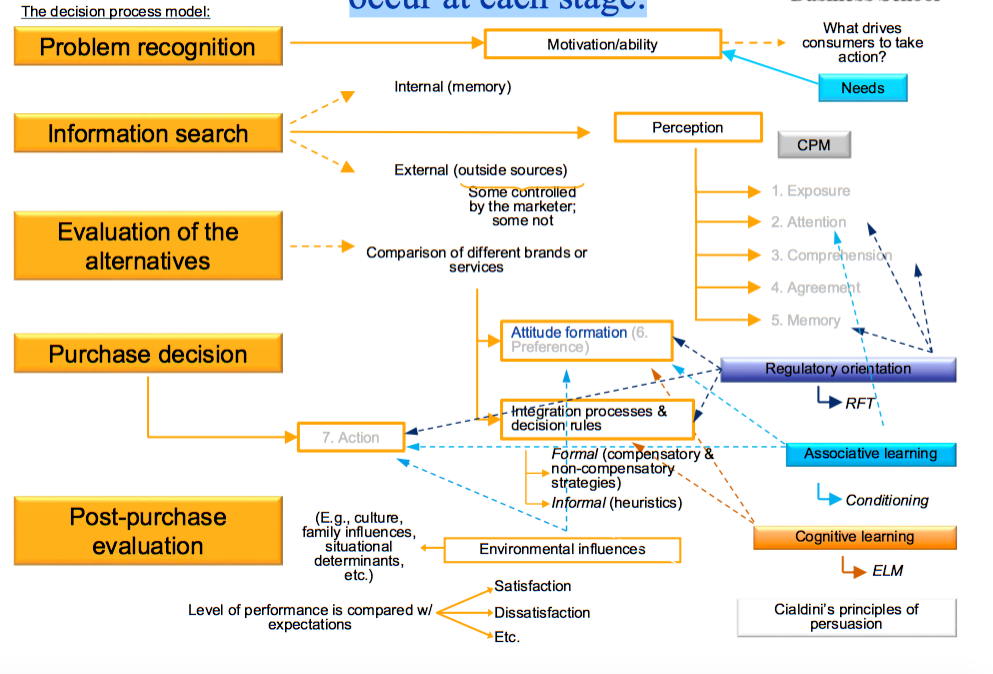
- 33decision process (T2 consumer behavior)

- 34Internal psychological processes that occur at each stage (T2 consumer behavior)
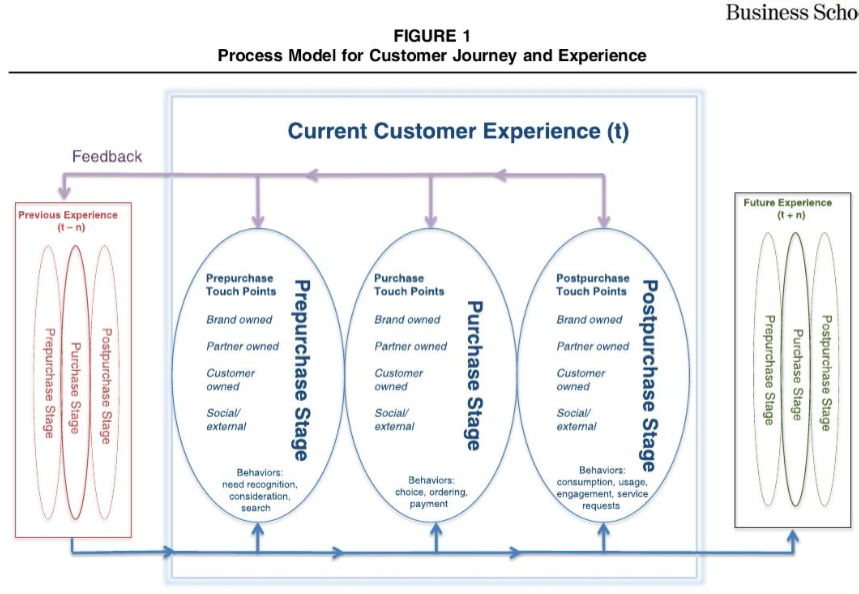
- 35process model for customer journey and experience. (T2 consumer behavior)
- 36Connecting “Funnel” with Potential Actions (T2 consumer behavior)

- 37Customer experience and purchase journey (T2 consumer behavior).

- 38The matrix of the purchasing process (T2 consumer behavior).

- 39what is Involvement of a consumer? (T2 consumer behavior)The concern and enthusiasm you feel for something. To define and measure involvement by analysing the consumer’s reaction to a persuasive stimulus, such as an advertisement. Involvement is the number of “connections” that are “conscious, bridging experiences or personal references that a subject makes between the content of the persuasive stimulus and the content of his own life.”
- 40Qualitative technique: The Means-End Chain Theory (T2 consumer behavior)

- 41example of apply The Means-End Chain Theory (T2 consumer behavior)Q: “Why did you choose that meat?”
A: “Because it is organically produced.”
Q: “Why is it important that the product be organically produced?”
A: “Because it makes me feel good to buy organic products.”
Q: “Why do you feel good when buying organic products?”
A: “Because I feel like I am doing something for the environment.”
Q: “Why is it important to do something for the environment?”
A: “Because it’s important that we keep the earth clean.”
4. Concern about the environment (value)
3.Desire to do something good for the environment (consequence)
2.Feel better when environmentally friendly (consequence)
1.Organically produced (attribute) - 42Key concepts of consumer behavior (T2 consumer behavior)

- 43What is an insight? (T3 Consumer insights and behaviors)The needs, wants, drives, and
desires of an individual that lead him or her toward the purchase of products or ideas
- 44Types of insights (T3 Consumer insights and behaviors)

- 45what is a potent insight ? (T3 Consumer insights and behaviors)A potent insight is normally a statement that is not literally accurate, but which has the power to ‘evoke.’
- 46process to detect insights (T3 Consumer insights and behaviors)

- 47To find an insight is... (T3 Consumer insights and behaviors)Observe the little things
Look again at the obvious
Interpret the meaning
Observe what could be
Observe what’s missing
- 48The appropriate research tools (T3 Consumer insights and behaviors)

- 49consumer trends nowadays (T3 Consumer insights and behaviors)

- 50explain a valid insight (T3 Consumer insights and behaviors)Is Real
– Consumer truth
• Is Relevant
– For his/her consumption habits
• Produces Resonance
– Shared by several consumers
• Provokes a Reaction
– Inspiring, possibility to react
“Validating” = Quantitative techniques and Desk Research (Secondary data) - 51the six key criteria (T3 Consumer insights and behaviors)

- 52OTN methodology (T3 Consumer insights and behaviors)

- 53—
Informationen
- Beschreibung
- MARKETING Karteikarten am marketing, erstellt von giulia vitulli quinzan am 14/05/2018.
- Erstellt von
- giulia vitulli quinzan
- Aufrufe
- 6
- Bewertung