
Karteikarten
GCSE AQA Chemistry - Unit 2
Karten in diesem Stapel (86)
- 1Ionic compounds: What are they? What are they held together by?Giant structures of ions.
Strong forces of attraction between oppositely charged ions, that act in all directions. - 2Ionic compounds: Do they have high or low melting and boiling points? Do they conduct electricity?High melting and boiling points
They conduct electricity, but only when molten or in a solution, because the charge ions are free to move about and carry the current - 3Fill in the missing gaps: The alkali metals have ____ electron/s in their outermost shell. They react with ___________ elements to form ______ compounds.One (electron)
(React with) non-metal (elements to form) ionic (compounds). - 4Fill in the missing gaps: The halogens have ______ electron/s in their outermost shell. They react with ______ ______ to form ______ compounds.Seven (electrons)
(They react with) alkali metals (to form) ionic (compounds). - 5What does a mixture consist of?Two or more elements or compounds that are NOT CHEMICALLY COMBINED.
- 6What type of substances are compounds?Substances in which the atoms of two or more elements ARE CHEMICALLY COMBINED.
- 7Fill in the missing gaps: Simple molecular compounds have ____ melting and boiling points, because they have _______ intermolecular forces.Low
Weak - 8What does a covalent bond occur between?Non-metals
- 9Is a covalent bond strong or weak?Strong
- 10Fill in the missing gaps: All of the atoms in a giant covalent structures are linked by _______ ___________ _______. This means they have very _____ _________ _______.Strong covalent bonds
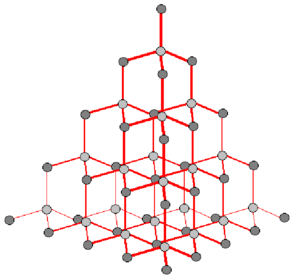
High melting points - 11What is Diamond? (Describe the bonds as well)A form of carbon that has a giant, rigid covalent structure (lattice). Each carbon atom forms four covalent bonds with other carbon atoms.
- 12What is Graphite? (Describe the bonds as well)A form of carbon that also has a giant covalent structure. Each carbon atom forms three covalent bonds with other carbon atoms in a LAYERED STRUCTURE.
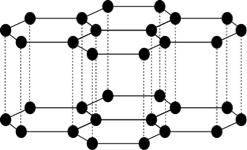
- 13What type of forces are the layers in graphite held together by?WEAK intermolecular forces
- 14How is it possible for graphite to conduct electricity?One electron from each carbon atom is delocalised. These delocalised electrons allow graphite to conduct heat and electricity.
- 15Fill in the missing gaps: Silicon dioxide has a ________ structure similar to ________. Each oxygen atom is joined to _____ silicon atoms, and each silicon atom is joined to _____ oxygen atoms.Lattice (structure)
Diamond
Two (silicon atoms)
four (oxygen atoms) - 16What are fullerenes?The fullerenes are a large class of allotropes of carbon and are made of balls, ‘cages’ or tubes of carbon atoms.
- 17What happens when electrons in the highest energy level in a metal become delocalised?A regular arrangement (lattice) of positive ions that are held together by electrons using electrostatic attraction is produced.
- 18What is an alloy?A mixture that contains a metal and at least one other element.
- 19What is a Smart Alloy?An alloy that "remembers" its original shape.
- 20What do thermo-softening polymers consist of?Individual polymer chains that are tangled together (Like spaghetti)
- 21What do thermo-setting polymers consist of? Do they melt when heated?Polymer chains that are joined together by cross-links between them.
They don't melt when they're heated.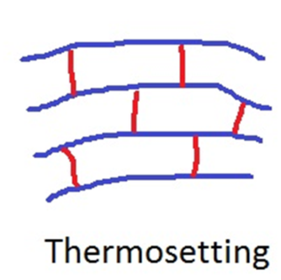
- 22What is nanoscience? What is one nanometre, in metres?The study of very small structures.
One nanometre = 0.000 000 001m (One billionth of a metre) - 23Give some potential uses of nanoparticles...Computers, catalysts, coatings, highly selective sensors, stronger and lighter construction materials and cosmetics.
- 24What is the mass number of an element? What is the atomic number of an element?Mass number = total number of protons and neutrons in the atom
Atomic number = Number of protons in the atom - 25What are isotopes?Atoms of the same element, that have different numbers of neutrons.
They have the SAME atomic number, but a DIFFERENT mass number. - 26What is the relative atomic mass?The atomic mass of an element.
The mass of a particular atom, compared with a twelfth of the mass of a carbon atom (the 12C isotope).
The Ar is an AVERAGE value for all of the isotopes of the element. - 27What is the relative formula mass of a compound?The relative atomic masses of all its elements added together.
- 28How can you work out the percentage mass of an element in a compound?

- 29What is the empirical formula of a compound?The simplest whole number ratio of each kind of atom in the compound.
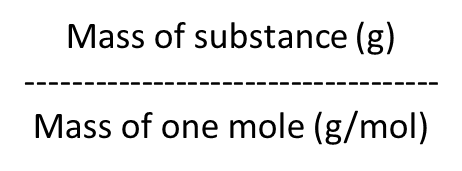
- 30What is a Mole? What is it measured in?A measure of the number of particles contained in a substance.
One mole of a substance is its relative formula mass or Ar, in grams. - 31How can you work out the number of moles of substance?
- 32How does a GC-MS (Gas Chromatography-Mass Spectrometry) work? (DESCRIBE!!!)By allowing different substances, carried by a gas, to travel through a column packed with solid material at different speeds so that they separate. Each substance will produce a separate peak on an output known as a gas chromatograph. The number of peaks on this output shows the number of compounds present in the original sample. The position of the peaks on the output graph indicates the retention time, i.e. the time taken to pass through the gas chromatograph.
If the output of the gas chromatography column is linked to a mass spectrometer then this can also be used to identify the substances leaving the column. - 33What can the mass spectrometer give? How is this given?The relative molecular mass (Mr) of each substance separated in the column.
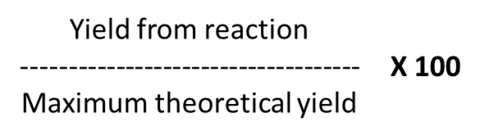
The molecular mass is given my the molecular ion peak on the spectrum. - 34How can the percentage yield be calculated?
- 35How are reversible reactions represented?(This example is using the Haber process, which is part of Chemistry C3)

- 36Give some advantages of using instrumental methods to detect and identify elements...- Instrumental methods are accurate
- Sensitive and rapid
- Useful when dealing with small quantities - 37Give some reasons why it may not always be possible to calculate the amount of a product formed in a reaction...- The reaction may be reversible.
- Some of the product may be lost when it's separated from the reaction mixture.
- Some of the reactants may react in ways different to the expected reaction. - 38What is the activation energy?The minimum amount of energy required to cause a reaction.
- 39RATES OF REACTION: How does temperature affect the rate of reaction?WARMER = FASTER
COLDER = SLOWER
In a cold reaction mixture, the particles move quite slowly, they collide less often, with less energy, so fewer collisions take place, and vice versa. - 40RATES OF REACTION: How does concentration affect the rate of reaction?LOW CONCENTRATION = SLOWER
HIGH CONCENTRATION = FASTER
In a low concentration, the particles spread out. They collide less often, so there are fewer successful collisions, and vice versa. - 41RATES OF REACTION: What is the concentration of a solution measured in?Moles per cubic decimetre (Mol/dm3)
- 42RATES OF REACTION: How does pressure affect the rate of reaction?An increase in pressure will increase the rate of reaction. This works in a similar way to concentration.
- 43RATES OF REACTION: How does surface area affect the rate of reaction?LARGER SURFACE AREA = FASTER
SMALLER SURFACE AREA = SLOWER
Large pieces of a solid material have a small surface area in relation to their volume. Fewer particles are exposed and available for collisions. - 44RATES OF REACTION: How does the use of a catalyst affect the rate of reaction?It reduces the amount of energy needed for a successful collision. Speeds up the reaction.
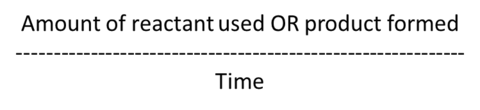
A catalyst works by providing a surface for the molecules to attach to, which increases their chances of bumping into each other. - 45RATES OF REACTION: How do you calculate the rate of reaction?
- 46Exothermic reactions are accompanied by a temperature...rise.
- 47Endothermic reactions are accompanied by a temperature...fall.
- 48In a reversible reaction, if the forward reaction is endothermic, what can you conclude about the backward reaction?It is exothermic!
- 49When is an aqueous solution produced?When a substance is dissolved in water.
- 50What is a salt? (Chemistry reaction terms)Any metal compound formed from the reaction between a metal and an acid.
- 51What is formed when metals react with dilute acid?A metal salt and hydrogen.
- 52What are bases? What are soluble bases called?The oxides and hydroxides of metals.
Soluble bases are called alkalis. - 53Are the oxides and hydroxides of transition metals soluble or insoluble?Insoluble
- 54How are the salts of transition metals produced?1. The metal oxide or hydroxide is added to an acid until no more will react.
2. The excess metal oxide or hydroxide is then filtered, leaving a solution of the salt.
3.The salt solution is then evaporated. - 55How can this reaction be written generally?acid + base --> neutral salt solution + water
- 56What is produced when an acid is reacted with an alkaline hydroxide solution?A neutral salt solution and water.
- 57What is a precipitate?A precipitate is a product in solid state, that forms in a chemical reaction in a solution.
It is called a precipitate because in most cases it accumulates at the bottom of the containter where the reaction is taking place. - 58What ions do acids contain?Hydrogen ions, H+
- 59What ions do alkalis contain?Hydroxide ions, OH-
- 60What type of gas in ammonia?An alkaline gas
- 61Ammonia neutralises Nitric acid to produce...Ammonium Nitrate.
- 62What are indicators?Dyes that change colour depending on whether they are in acidic or alkaline solutions.
- 63What is the pH scale?A measure of the acidity or alkalinity of an aqueous solution, across a 14-point scale.
- 64What are ammonium salts used as?Fertilisers
- 65What is electrolysis?The breaking down of a compound containing ions into its elements using an electrical current.
- 66What is the substance being broken down known as?The Electrolyte
- 67In electrolysis, where do the positive and negative ions move to?The positive ions move to the negative electrode.
The negative ions move to the positive electrode. - 68What are the positive and negative electrodes also known as?Positive = Anode
Negative = Cathode - 69What is a redox reaction?A chemical reaction where both reduction and oxidation occur.
- 70What is reduction?When positively charged ions gain electrons at the negative electrode.
- 71What is oxidation?When negatively charged ions lose electrons at the positive electrode.
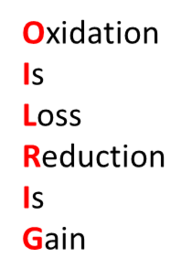
- 72How can you remember what oxidation and reduction does?The word oilrig:
- 73What can electroplating be used to do?Electroplate objects with metals such as silver.
- 74How is aluminium obtained?The electrolysis of aluminium oxide that has been mixed with cryolite.
- 75What does the cryolite do?Lowers the melting point of the aluminium oxide, meaning cheaper energy costs.
- 76What does the electrolysis of sodium chloride produce? (And where?)- Chlorine gas (at the positive electrode).
- Hydrogen gas (at the negative electrode).
- Sodium hydroxide solution (passed out of the cell). - 77How can reactions that occur at the electrodes be represented?By using half-equations
- 78Electrolysis of Ionic Solutions: If the negative ion is a halogen, i.e. chloride, bromide, iodide, what is produced at the positive electrode?The Halogen
- 79Electrolysis of Ionic Solutions: If the negative ion is not a halogen, i.e. sulphate, nitrate, carbonate, what is produced at the positive electrode?Oxygen
- 80Electrolysis of Ionic Solutions: If the positive ion is more reactive that hydrogen, what is produced at the negative electrode?Hydrogen
- 81Electrolysis of Ionic Solutions: If the positive ion is less reactive that hydrogen, what is produced at the negative electrode?The metal
- 82Give some examples of exothermic reactions...- Neutralising acids with alkalis
- Oxidation
- Combustion
- Handwarmers - 83Give some examples of Endothermic reactions...- Thermal Decomposition
- Dissolving Aluminium - 84What happens when substances dissolve in water... (To do with acidity and alkalinity)Substances dissolve into their individual ions:
Hydroxide ions, make solutions alkaline
Hydrogen ions, make solutions acidic - 85How can precipitation be used to soften water?The calcium (or magnesium) ions are precipitated out as insoluble calcium (or magnesium) carbonate.
- 86What damage can nitrates do if they find their way into streams, rivers, or groundwater?- Upset the natural balance of water.
- Contaminate our drinking water.
Informationen
- Beschreibung
- The fun continues in the next installment of the AQA Chemistry GCSE series!
- Erstellt von
- James Jolliffe
- Aufrufe
- 3.255
- Tags
- Bewertung