
Karteikarten
The Tibia
Karten in diesem Stapel (28)
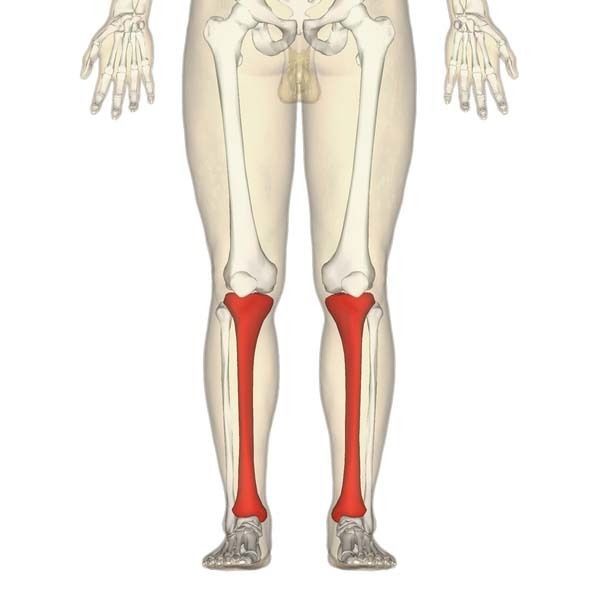
- 1What is the tibia and what is its role in the body?The tibia is the main bone of the lower leg, it is the second largest bone in the body and is a key weight-bearing structure.
- 2The tibia expands at its proximal end, articulating at which joint?The knee joint.
- 3The tibia expands at its distal end, articulating at which joint?The ankle joint.
- 4What is the proximal tibia widened by and what is the role of these structures?The proximal tibia is widened by the medial and lateral condyles, which aid in weight bearing.
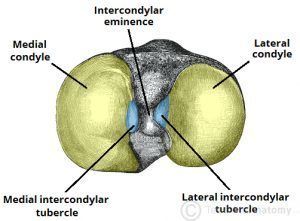
- 5What is the flat surface formed by the medial and lateral condyles of the proximal tibia known as?The condyles form a flat surface, known as the tibial plateau.
- 6What does the tibial plateau articulate with and to form what?The tibial plateau articulates with the femoral condyles to form the key articulation of the knee joint.
- 7What is located between the medial and lateral condyles of the proximal tibia and what does this project upwards to form?Located between the condyles is a region called the intercondylar eminence- this projects upwards on either side as the medial and lateral intercondylar tubercles.
- 8What are the medial and lateral intercondylar tubercles (intercondylar eminence) of the proximal tibia the main site of attachment for?This area is the main site of attachment for the ligaments and menisci of the knee joint.
- 9What do the intercondylar tubercles of the proximal tibia articulate with?The intercondylar fossa of the femur.
- 10What is the shape of the tibial shaft? Name the 3 tibial shaft borders. Name the 3 tibial shaft surfaces.The shaft of the tibia is prism shaped.
Anterior, posterior and lateral borders.
Anterior posterior and lateral surfaces.
(only clinically/anatomically important borders/surfaces mentioned). - 11Where is the anterior border of the tibial shaft palpable? What is the proximal aspect of the anterior border marked by and what attaches here?The anterior border is palpable subcutaneously down the anterior surface of the leg as the shin.
The proximal aspect of the anterior border is marked by the tibial tuberosity, the attachment site for the patella ligament.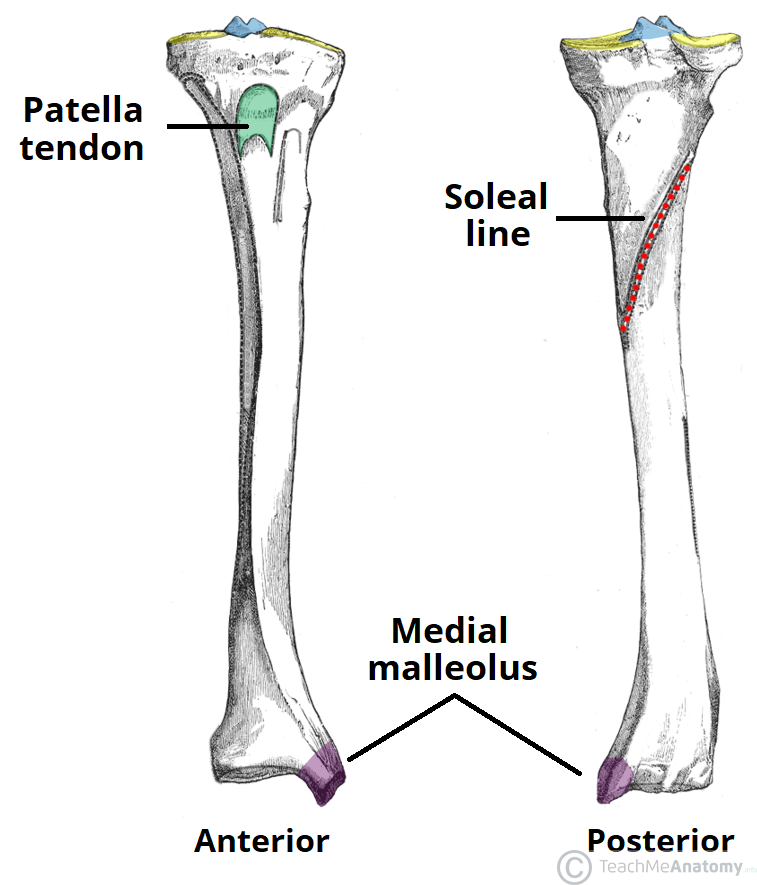
- 12What is the posterior surface of the tibial shaft marked by and what is this the site of origin for?The posterior surface is marked by a ridge of bone known as the soleal line. This line is the site of origin for part of the soleus muscle.
- 13How does the soleal line extend and what is usually proximal to it?The soleal line extends inferomedially, eventually blending with the medial border of the tibia.
There is usually a nutrient artery proximal to the soleal line. - 14What is the lateral border of the tibial shaft also known as and what does it give attachment for?The lateral border is also known as the interosseous border. It gives attachment to the interosseous membrane that binds the tibia and the fibula together.
- 15What is intraosseous access and what does it allow?Intraosseous access is a form of vascular access used in emergency settings. It allows the administration of fluids,blood products and medications directing into the bone marrow.
- 16When is intraosseous access typically used and which two tibial shaft sites are suitable for IO access?IO access is typically used in an emergency when intravenous access is not obtainable.
The two main sites in the tibial that are suitable for IO access are:
-The anteromedial surface, 2-3cm below the tibial tuberosity.
-Proximal to the medial malleolus. - 17What are possible complications of intraosseous access?Osteomyelitis, iatrogenic fracture and compartment syndrome.
- 18If IV access has been achieved, what should be done about intraosseous infusions?IO infusions should be discontinued when IV access has been achieved.
- 19Why does the distal end of the tibia widen?To assist with weight-bearing.
- 20What is the medial malleolus and what does it articulate with to form which joint?The medial malleolus is a bony projection continuing inferiorly on the medial aspect of the tibia. It articulates with the tarsal bones to form the ankle joint.
- 21What is present on the posterior surface of the distal tibia?On the posterior surface of the tibia, there is a groove through which the tendon of tibialis posterior passes.
- 22What binds to the tibia at the fibular notch (lateral distal tibia) and to form which joint?Laterally is the fibular notch, where the fibula is bound to the tibia - forming the distal tibiofibular joint.
- 23What are the two main types of tibia fractures and which group do they occur in?High energy trauma- occurs predominantly in the younger population.
Low energy trauma or insufficiency fractures- occurs predominantly in the elderly. - 24Which region of the tibia is more commonly fractures and what is this associated with?Fractures most commonly occur at the shaft of the tibia, and are typically associated with fibula fractures.
- 25What are fractures of the proximal tibia known as and what happens in this type of fracture?Fractures of the proximal tibia are known as tibial plateau fractures. The condyles may be broken and injury to the menisci and ligaments of the knee is not uncommon.
- 26How are tibial plateau fractures classified and when may operative management be necessary- if this is the case what should patients be monitored for in pre and post-op phases?Tibial plateau fractures are classified using the Schatzker classification, and if very displaced will likely require operative management.
It is important to monitor patients for signs of compartment syndrome in the pre-and post-operative phases. - 27What can be fractured at the ankle and what is this caused by?At the ankle, the medial malleolus can be fractured. This is caused by the ankle being twisted inwards (over-inversion)- the talus of the foot is forced against the medial malleolus, causing a spiral fracture.
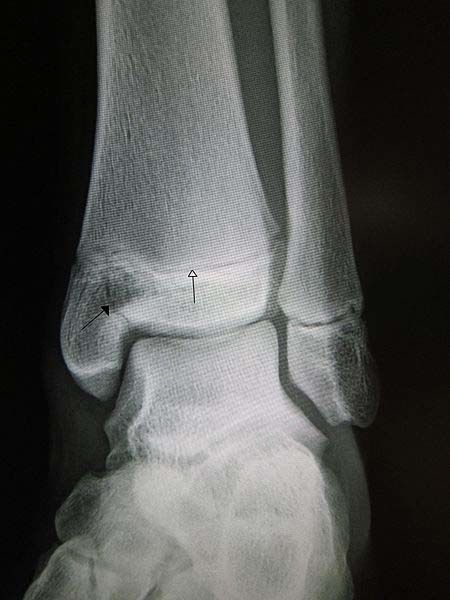
- 28What typically also occurs when the medial malleolus is fractures and what can this potentially produce?The medial malleolus is rarely fractured in isolation, typically the lateral malleolus is also fractured. This potentially produces an unstable fracture that requires operative management.
Informationen
- Beschreibung
- Year 1 Medicine Year 1 (Musculoskeletal System) Karteikarten am The Tibia, erstellt von Shahzadah Jafri am 19/09/2021.
- Erstellt von
- Shahzadah Jafri
- Aufrufe
- 3
- Bewertung