
Karteikarten
Risk Analysis

Karten in diesem Stapel (63)
- 1Define FailureDeviation from normal design intent or operating standard
- 2Define HazardA situation with the potential to cause death, injury, damage, losses or liabilities
- 3Define AccidentAn unplanned, uncontrolled
event giving rise to death,
injury, ill health, damage or
loss. - 4Define ConsequencesAn outcome resulting from an
accident. - 5Define SeveritiesA measure of the consequence
- 6=================================== HAZOP ======================================================================
HAZOP
=================================== - 7Define Hazard AnalsysisThe identification of events which lead to a hazard and an analysis of way in which these event could occur and how likely harmful effects are
- 8What does HAZOP stand for?Hazard and operability studies
- 9What actually is Hazop?The application of a formal, systematic, critical examination of the intentions of new facilities to assess the hazard potential of mal-operation of pieces of equipment and the consequential effects on the facility as a whole.
- 10Aims of HazopAims to stimulate the imagination of designers and operators in a systematic manner so that they can identify the causes of potential hazards in the design.
- 11Who carries out a HAZOP?A team of experts
- 12Define Intention (Re. an item in hazop)How the part is expected to function
- 13Define deviations (Re. an item in hazop)deviations from the design intention which are discovered by systematic application of the guide words.
- 14Define causes (Re. an item in hazop)reasons why deviations might occur. Causes can be classified as realistic or unrealistic.
- 15What can we do with unrealistic causesreject them
- 16Define Consequences (Re. an item in hazop)the results of the deviations.
- 17What are the collums of a HAZOP table left to right
- 18meaning of guidewords? NO/NOT MORE THAN/ LESS THAN AS WELL AS PART OF REVERSE OTHER THANParameter is zero
increase of decrease in a parameter
qualitative increase
qualitative decrease
opposite
subsitution - 19Give some standard process parameters the guide words may describe• Pressure
• Temperature
• Flow - 20Give some examples of HAZOP application areas• chemical
• oil and gas
• pharmaceutical
• food processing
• UAVS
• fork lift truck activities
• nuclear - 21HAZOP limitations- Cannot detect every weakness
(e.g. layout problems)
- Cannot make up for lack of knowledge
- Assumes system constructed and operated as designed. - 22=================================== FMEA ======================================================================
FMEA
=================================== - 23What does FMEA stand for?Failure mode and effects analysis
- 24What does FMECA stand for?Failure Mode, Effects and
Criticality Analysis - 25What does FMECA include that FMEA doesn'tclassification of each potential failure effect according to its severity
- 26State and describe the 2 types of FMEA• Product - Analysis of product and how failures effect product operation
• Process - Analysis of product manufacturing, maintenance and usage and effect on product operation - 27State and describe the 2 FMEA Approaches• Functional - sub assemblies considered e.g. A valve control system
• Hardware - each component considered e.g. Sensor, controller, valve. - 28What are the first 6 stages of FMEA?1. Define the system
2. Construct block diagrams
3. Record all assumptions made
4. Define failure modes of system
5. Define failure modes of components
6. Complete FMEA worksheets. - 29FMEA Stage 1. What must the definition of the system include.• What the system comprises
• Boundaries and interfaces
• Function in all operation modes
• Environment profile
• System phases
• System mission and objectives - 30FMEA Stage 2. Hierarchical diagrams
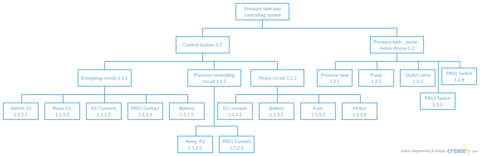
- 31FMEA Standard table

- 32What are the last 2 stages of FMEA?7. Review worksheets to determine reliability critical components
8. Make recommendations for design improvements and further work - 33What are the 4 severity classifications in FMECA1. Minor
2. Marginal
3. Critical
4. Catastrophic - 34What is the equations for criticalityCriticality = Frequency x Severity
- 35What table heading must we ad to our FMEA table for FMECA?Severity class and frequency
- 36What is the equation for the critically number of a failure modeLambda 0 - failure mode rate
t - mission or phase time
- 37What is the equation for failure mode rate?a - portion of failure in specified mode
b - probabilities that effect will result
lambda p - part failure rate
- 38What does RPN stand for?Risk priority number
- 39What is the RPN equation?RPN=occurrence x severity x detection
when all are measure out of 10 - 40What is the equation for the criticality number of a part?n - number of failure modes
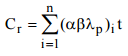
- 41FMEA Features (pro and cons)+ it is rigorous and systematic.
- time consuming and expensive.
- It does not consider the effects
of multiple failures. - 42=================================== Fault Tree Analysis ======================================================================
Fault Tree Analysis
=================================== - 43Name these gatesOR - 1 or more
AND - all inputs
k out of n (voting) - at least k of n
Exclusive OR - one but not both
- 44Name these gatesInhibit - requires event and condition
Priority AND - order left to right
Not - Output if input event does not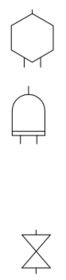
- 45Name these eventsIntermediate - Event description
Basic - Event for which data is available
Undeveloped - system event 2 b developed
conditional - condition of inhibit gate
House - definitely occurring or not. e.g. maintence
- 46Define cut setA list of failure events such that if they occur then so does the top event.
- 47Define minimal cut setA cut set such that if any component failure event is removed the combination will no longer cause system failure
- 48What is the distributive law of cut sets(A + B) . (C + D) = A.C + A.D + B.C + B.D
- 49What is the idempotent law of minimal cut setsA + A = A
(Removes repeated cut sets)
A . A = A
(Removes repeated event) - 50what is the absorption law of minimal cut setsA + A . B = A
(Removes redundant combinations) - 51What is order culling? (RE. minimal cut sets)Produce cut sets or order k or less
- 52What is probability culling? (RE. minimal cut sets)Produce only cuts sets with probability of occurrence greater or equal to a specified value
- 53What is frequency culling? (RE. minimal cut sets)Produce only cuts with frequency of occurrence greater or equal to a specified value
- 54How do you change a fault tree to a dual tree?Switch
AND gates to OR gates
OR gates to AND gates
Basic events to Complemented events - 55What is the dual tree equivalent of a minimal cut set?A minimal path set which is a smallest number of things that need to be true for system to work
- 56The downtime of a system or component depends on?• Time taken to detect the failure
• Time taken to repair the failure inc.
- Diagnosis
- Obtaining new parts
- Intalling new parts
• Time taken to test to check it works - 57Define reliabilityReliability, R(t), is the probability that the component/system works continuously over that time interval, t.
- 58How do you determine unreliability, F(t)?Unreliability = 1 - Reliability
F(t) = 1 - R(t) - 59What are the 3 definitions of availability, A(t)?1) Probability that a component/system works on demand.
2) Probability that a component/system is working at time t.
3) Fraction of the total time that a system/ component can perform its required function. - 60How do you determine unavailability, Q(t)Unavailability = 1 - Availability
Q(t) = 1 - A(t) - 61for what type of components does: Availability = Reliability A(t) = R(t)non-repairable components
- 62What is the failure density function, f(t)?f(t) = dF(t)/dt
- 63What is the equation of the conditional failure rate (hazard rate), h(t)h(t) = f(t) / (1 - F(t))
h(t) = f(t) / (R(t))
Informationen
- Beschreibung
- Loughborough uni aae part a risk analysis
- Erstellt von
- Ben Jenner
- Aufrufe
- 35
- Tags
- Bewertung