
Karteikarten
Chapter 9 - Integumentary
Karten in diesem Stapel (93)
- 1The skin has many functions:- Provide a barrier
- Regulations body temp through sweat, piloerection of hair, and vadodilation/vasoconstriction of blood vessels
- Synthesis of Vitamin D by UV light - 2The skin has sensory perception:- Touch, pain, temp, and pressure
- 3The skin can provide nonverbal communication such as:- Blushing that can mean embarrassment, infection
- 4The skin also allows wound repairThrough sweating, you can eliminate electrolytes
- 5The skin has 3 layers:(1) Epidermis - the most superficial layer
(2) Dermis - the middle layer that's nutrition for the epidermis and contains hair follicles
(3) SubQ / Fatty - the deepest layer - 6If you have an injury to the dermis layer, you can no longer grow hair in that areaYou'll be hairless!
- 7There are 4 Pigments of Skin:(1) Melanin
(2) Carotene
(3) Oxyhemoglobin
(4) Deoxyhemoglobin - 8Melanin is...brown, increased with sunlight
- 9Carotene is...a golden yellow found mainly in SubQ fat, palms, and soles
- 10Oxyhemoglobin is...red, as seen when someone is blushing
- 11Deoxyhemoglobin is...blue as seen in cyanosis; no oxygene
- 12Jaundice is yellowing of the skin caused by a disposition of bilirubin- Is easier to see in sclera and nail beds
- Can be seen with liver disease & biliary duct obstruction - 13Central cyanosis is a bluish color meaning lack of O2Cyanosis can best be seen in oral mucosa, the tongue, and lips
- Typically seen in advanced lung disease - 14Peripheral cyanosis is a lack of blood flowThe o2 level however is normal.
- 15In what condition can you see peripheral cyanosis in?Congestive Heart Failure
- 16You have 2 types of hair:(1) Vellus
(2) Terminal - 17Vellus Hair is short, fine, and...Unpigmented
- 18Terminal Hair is:- Coarse
- Thicker
- Pigmented
Ex: Scalp Hair - 19Nails protect the distal ends of your fingers & toesThe nail plate/bed is usually pink in color
- Lunula "white moon" can be seen in some nail plates - 20Cuticleshelp protect space between nail fold and nail plate from moisture
- 212 Types of Glands:(1) Sebaceous Glands
(2) Sweat Glands - 22(1) Sebaceous Glands- Produce sebum (oil)
- Lubricates hair and skin; this is why your hair gets oily
- Reduces water loss through skin - 23(2) Sweat Glands(1) Eccrine
(2) Aprocrine - 24Eccrine Sweat glands are widenly distributed:- Helps control body temp.
- 25Apocrine Sweat glands are responsible for body odor:- Found in axillary & genital area
- Stimulated by emotional stress - 26A person's skin can tell a lot about that person:As a RN, you will need to do a skin health history
- 27In the "skin" healthy history, identify some of the following:- Diseases of the skin
- Physical abuse
- Risk for pressure ulcers
- Health promotion regarding skin
- Risk for melanoma - 28Some skin symptoms that can raise eyebrows are:- Moles
- Rash; allergies?
- Hair loss
- Ecchymosis (bruising); abuse maybe?
- Lesions - 29Rules for physically assessing the skin:- Look for increased pigmentation, loss of pigmentation, or redness of the skin (oxyhemoglobin)
- Look for cyanosis or pallor (paleness)
- Look for yellowing of the skin - jaundice?
- Always inspect & palpate ( used for capillary refill and edema) - 30When performing an assessment of the skin:- Use natural light and ensure that you provide privacy
- 31Vitilgo:has areas of depigmentation
- 32Tinea versicolor: a fungal infection of the skinCharacterized by hypopigmented scaly lesions
- 33Note if skin is dry, oily, or if patient is sweating- Don't forget to assess skin folds in females ( breasts) and in people with more body fat
*The skin should be dry to touch without flaking or cracking - 34To assess temp. use the dorsal surface of hand- Note warmth/coolness
- Note elevated warmness noted with erythma - infection? - 35Note if skin is rough or smooth...Roughness can indicate scaliness/dryness
- 36To assess mobility & turgor:- Lift fold of skin below clavicle, forearm, and abdomen
- 37The ease at which the skin lifts is caled mobilityDecreased mobility can be seen in scleroderma
- 38Scleroderma:The tightening/hardening of the skin and its connective tissues
- 39Turgor is the speed at which the skin returns to it's original shape:Poor skin turgor can mean dehydration
- 40Edema is extra fluid in interstitial spaces- Noted by skin feeling puffy and tight
- 414 Types of Edema:(1) Pitting
(2) Localized
(3) Nonpitting - seen in brawny edema ( found in lower extremities); local infection or trauma
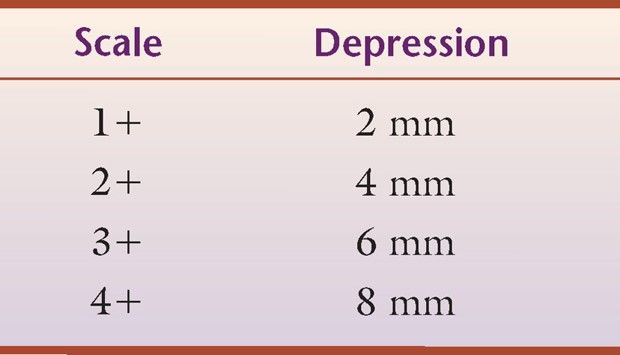
(4) Systemic - 42Pitting Edema:Interstitial fluid is mobile and depression is left for 5 - 30 sec.
- Can use Pitting Edema Scale to measure depression - 43Nonpitting Edema:- As seen in Brawny Edema - hard to touch, scaly, seen in lower part of extremities
- 44Systemic Edema:- dependent portions of the body
- 45Localized Edema:- seen with an injury
- 46Pityriasis Rosea:- Thought to stem from viral infection
- Characterized by reddish, oval ringworm like lesions.
- Christmas tree pattern
- Lasts approx 4 - 8 weeks - 47Atopic Eczema:- Flexor surfaces
Usually, allergy related - 48Characteristics of Psoriasis:- Silver plaques
- 1 cm or larger
- Can be noted by "papules" - 49Papules are smaller than nodules- Seen in psoriasis
- 50Nodules are larger than 0.5 cmMore deeper and firmer than papules
- 51A cyst is a nodule filled with liquid or semi-solid materialA wheal is an irregular, transient, superficial area of localized skin edem
- 52Herpes simplex is characterized by cavities that are filled with serous fluid that are palpableHerpes Zoster (shingles) is a painful rash on one side of the body
- 53Bulla's are also known as boils- Filled with serous fluids
- Are 1 cm or larger - 54Pustule - AcneCan be filled with pus
- 55Burrow scabies- Causes by a mite and is spread by skin-to-skin contact
- Very itchy, especially at night
- Burrows are tunnel like, found between webs of finger and toes - 56Fissures are seen in athlete's foot- Characterized by a linear crack in skin
- 57Ulcer- brought on by pressure; especially seen in diabetics
- Deep loss of epidermis and dermis - 58Ecchymosis is bruising- Blue/Purple in color
- Over time, it changes green, yellow, brown - 59Petechia/Purpura:- Is a deep red
- 60Patients with decreased mobility are susceptible to ulcersPressure sores are brought on by:
- Compression
- Shearing forces like bed sheets - 61Ulcers are always easier to prevent than to heal!!!Fun Fact!!!
- 62Braden Scale for Predicting Pressure Sore Risk:(1) Sensory perception
(2) Moisture
(3) Activity
(4) Mobility
(5) Nutrition
(6) Friction & Shear - 63Stage I Pressure Ulcers Characterized by:- Change in temp
- Consistency (firm/boggy)
- Sensation (pain/itchiness)
- Color - red/blue - 64Stage II Pressure Ulcers are Characterized by:- partial thickness, skin loss
- may involve epidermis, dermis, or both - 65Stage III Pressure Ulcers are Characterized by:- full thickness of skin loss
- Necrosis to subcutaneous tissue - 66Stage IV Pressure Ulcer Characterize by:- full thickness of skin
- necrosis of muscle, bone, or any supporting structures - 67When assessing hair, ask about any laser hair removal treatmentsIt's just good to know!!!
- 68Loss of hair on legs may be a sign of:Peripheral artery disease
- 69Changes in pubic or axillary hair may be a sign of:Hormonal Problems
- 70Alopecia Areata:- Usaully affects young adults & children
- Scalp is normal, there's just no hair
- Characterized by demarcated round/oval patches - 71Tinea Capitus ( ringworm):- Is a fungal infection
- Scaly
- Hairs are broken off - 72Don't forget to inspect the nails:Inspect & palpate fingernails as well as toenails
- 73Nails should be:- Round in shape
- Smooth & firm in texture
- should have a pink nail plate with white lunulae
- Be at a 160 degree angle - 74Clubbing of the nail is notarized by:- An angle >160
- Nail bed feels spongy instead of firm & smooth - 75Clubbing of the nail bed can be seen in those with suspected:- CHF
- Inflammatory bowel diseases
- Lung disease/cancer - 763 Types of Skin Cancer:(1) Basal cell carcinoma
(2) Squamous cell carcinoma
(3) Melanoma - 77Basal cell carcinoma:- Accounts for 80% of skin cancers
- Rarely metastasize
- Affects basal level of epidermis
- Pearly white, translucent, and grow slowly - 78Squamous Cell Carcinoma:- Affects upper layer of epidermis
- Can metastasize
- Accounts for 16% of skin cancers
- Crusted, scaly, and inflammed - 79Melanoma:- Accounts for 4% of skin cancers; most fatal
- Arises from melanocytes in epidermis
- Can metastasize - 80Here's what can put you at an increased for skin cancer:- Having 50+ moles
- Not wearing sunscreen
- Red or light colored hair
- Males are more susceptible
- Family history of melanoma - 81Here's how you can prevent skin caner:- Wear sunscreen
- Reduce sun exposure
- Avoid tanning beds - 82Skin Cancer Screening:- You can self examine yourself by using ABCDE - EFG method
- 83ABCDEA = Assymetry
B = Irregular Borders
C = Change in color
D = Diameter >6 mm
E = Evolving mole that is changing over time - 84Central cyanosis can also be seen in a pt's:- Chest
- Abdomen - 85Peripheral cyanosis is related to lack of blood flow; can be seen in a pt's:Finger and toes
- 86Freckles and certain birthmarks are examples of Macules:Flat, non-palpable
- Can be tan, white, brown - 87Vesicle/BullaA circumcised elevated mass with fluid
Ex: Herpes simplex - 88A papule is what when compared to a nodule?Smaller
- 89PapuleA solid, circumscribed, palpable superficial lesion
- 90NoduleA solid palpable mass
- 91WhealAn elevated, solid, transient lesion
- Often irregularly shaped - 92A sudden loss of hair can mean:- Hypothyroidism
- 93With use of an oral steroid over a period of time, you can expect the skin to be:Thin
Informationen
- Beschreibung
- Nursing Karteikarten am Chapter 9 - Integumentary, erstellt von Ashley Rivers am 28/09/2017.
- Erstellt von
- Ashley Rivers
- Aufrufe
- 0
- Tags
- Bewertung