
Karteikarten
Unit 5: Evolution
Karten in diesem Stapel (32)
- 1What are heritable characteristics?characteristics than an organism possesses due to its genetic make-up
- 2What is the difference between selective breeding and natural selection?Natural selection occurs in nature, while selective breeding occurs through human intervention
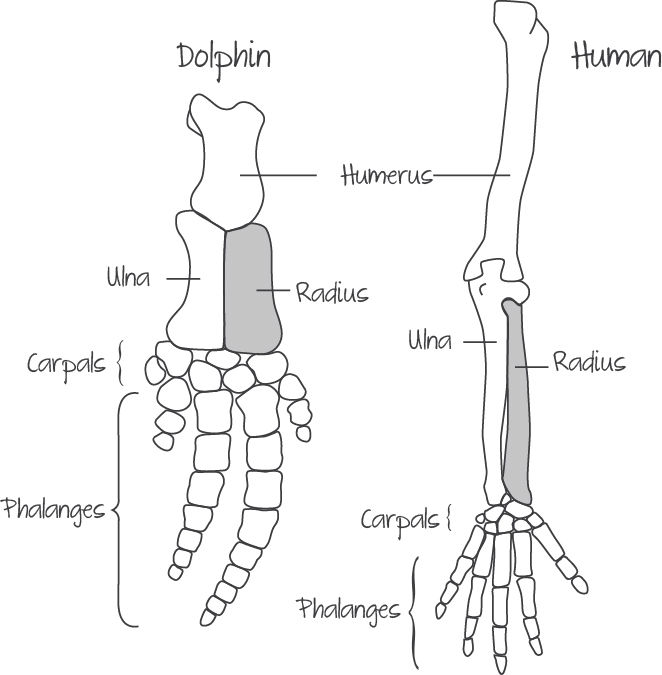
- 3What are homologous structures?structures that are similar because of shared ancestry, but have different functions due to divergent evolution
- 4What's the form of selection that occurs in selective breedingArtificial selection, this differs due to humans choosing organisms to breed that have preferred characteristics
- 5What is speciation?populations of species that gradually diverge into separate species due to evolution
- 6What are sources of variation within a population?Mutation, meiosis, and sexual reproduction
- 7Does natural selection diversify a population?Increases the frequency of characteristics that make individuals better adapted and decrease the frequency of other characteristics leading to changes within the species
- 8How does the binomial system work?the genus name begins with a capital letter and species name with a lower-case letter
ex. Linnaea borealis
can be reduced to L. borealis after mentioned - 9What is the hierarchy of taxa?Domain (highest), kingdom, phylum, class, order, family, genus, species (lowest)
- 10What are the three domains of classification?Archaea, Bacteria, and Eukarya
- 11How are the domains of classification differentiated?based on the differences in the sequences of nucleotides in the cell's RNA, the cell's membrane structure (lipids), and sensitivity to antibiotics
- 12What is natural classification?The classification of organisms based on their relation and evolution from a common ancestor
- 13What are the advantages of natural classification?Allows for predictions to be made of shared characteristics shared within a group
- 14What characteristics does Eubacteria?Histones are absent
Introns are absent
Cell membrane: glycerol-esters of lipids, D-form of glycerol
Cell wall: peptidoglycan - 15What characteristics does Archaea have?Histones: present in some species
Introns: present in some species
Cell membrane: glycerol-ether lipids, L-form of glycerol
Cell wall: not made of peptidoglycan - 16What are the characteristics of Eukaryotes?Histones: Present
Introns: Present
Cell membrane: glycerol ester lipids, D-form of glycerol
Cell wall: not made of peptidoglycan, sometimes absent - 17What is porifera?Porifera: sponges
-multicellular and have pores and channels allowing water circulation
-do not possess anus or mouth
-no nervous, digestive, or circulatory system
-aquatic and have a skeleton of calcium carbonate (same material of shells) - 18What are cnidaria?Cnidaria: jellyfish, corals, anemones
-forms: swimming medusae and sessile (attached to rocks and other substrates)
-medusae have umbrella-shaped bodies with trailing tentacles
-have radial symmetry
-have a single opening in body cavity (digestion and waste disposal)
-have nervous system - 19What is Platyhelmintha?Platyhelmintha: flatworms
-bilateral symmetry
-three layers of tissue in their body
-no body cavity
-have mouth
-no anus
-found in water or in the form of parasites - 20What is Annelida?Annelida: segmented worms and leeches
-bilateral symmetry
-separate mouth and anus
-divided into ringed segments
-found in marine/aquatic/wet environments - 21What is Mollusca?Mollusca: snails, slugs, octopi, oysters, mussels
-three common features: mantles with a cavity for breathing and excretion, have radula (similar to a tongue), and simple nervous system
-have mouth and anus
-some have shell (calcium carbonate) - 22What is anthropoda?Anthropoda: insects, crustaceans, spiders, and scorpions
-exoskeleton of chitin, shed exoskeleton and form new one
-exoskeleton limits size
-bilateral symmetry
-segmented bodies
-jointed appendages - 23What is Chordata?Chordata: fish, mammals, reptiles, amphibians, birds
-bilateral symmetry
-separate mouth and anus
-possess a notochord, cartilaginous rod that supports the nerve cord - 24What is a clade?A group of organisms that have evolved from a common ancestor
- 25What evidence provides a reason for two organisms sharing the same clade?base sequences of a gene; corresponding amino acid sequence of protein
- 26What are analogous structures?structures that have similar functions but have evolved separately through convergent evolution from different ancestral features
- 27What are examples of homologous structures?Pentadactyl limb of man and of bats
- 28What are examples of analogous structures?wings of insects and the wings of bats
- 29What is Byrophytes?Bryophytes: mosses, liverworts, and hornworts
-non-flowering plants
-grow in clumps or mats in dark or shady locations (swamps and moors)
-do not have vascular tissue for water transport
-produce spore capsules held above the plant on thin stalks
-do not have proper roots, have rhizoids (threadlike outgrowths that hold them in the soil); rhizoids aren't used to absorb nutrients
- - 30What is Filicinophytes?Filicinophytes: ferns and horsetails
-shallow roots, leaves are fronds
-primitive vascular system
-grow in small tree-like form but do not have woody stems
-spores are produced in clusters on underside of their fronds - 31What is Coniferophytes?known as conifers
examples: cedars, redwoods, spruces, yews, cypresses, douglas fir
-are gymnosperms (seeds are enclosed in an ovary)
-cone-bearing seed trees with vascular tissue
-made of wood with narrow leaves with thick waxy cuticle
-monoecious plants: produce male and female reproductive structures or cones on the same plant
-produce sexually through release of pollen from male cones, and then is carried by the wind to female cones where ovules are fertilised to form seeds - 32What is Angiospermophytes?examples: wheat, cabbage, daisies
-flowering plants with vascular tissue
-fruit trees and important crop plants are in group
-stem may be woody as in case of shrubs and trees
- flowering plants can be classified as monocotyledons or dicotyledons (each have specific leaf and root structure)
-reproduction involves the transfer of pollen grains from anthers to stigma of carpels, followed by fertilisation of ovules found in the ovary
-ovules form seeds while the ovaries develop into a fruit
Informationen
- Beschreibung
- International Baccalaureate Biology Karteikarten am Unit 5: Evolution , erstellt von Tristin Darnell am 05/12/2017.
- Erstellt von
- Tristin Darnell
- Aufrufe
- 1
- Bewertung