
Karteikarten
3 Consumer Behaviour
Karten in diesem Stapel (16)
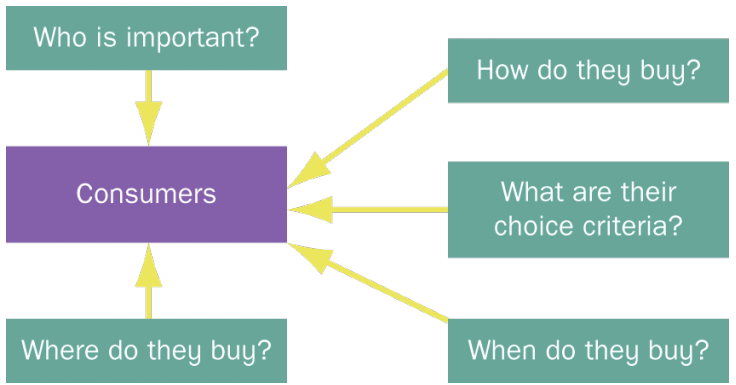
- 1—Who is important? How do they buy? What are their choice criteria? Where do they buy? When do they buy?
- 2Who Buys?Individual vs group
Buying centres (initiator, influencer, decider, buyer, user)
Different people may play different roles
It is key to target the right person with marketing activities - 3What is this?Consumer Decision Process

- 4What is problem recognition?A significant difference between the current state of affairs and some desired or ideal state.
Exposure to stimuli may cause a problem to be recognised - marketing influence?
Motivation to act depends on the size of the discrepancy, and how important it is - 5What is this?Homeostasis See-Saw
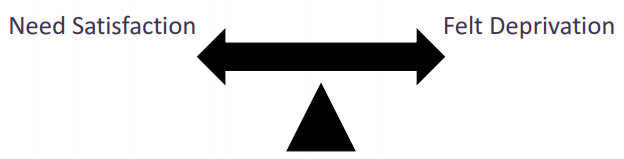

- 6Explain the Homeostasis see-sawWe strive for equilibrium (homeostasis)
Physiological needs (hunger) move us away from this
But so do social and psychological needs
Need inhibitors versus need stimulators - 7What is information search?Internal Search - the first state after problem recognition. Recalling and reviewing relevant information in the memory.
External Search - other sources, friends, salespeople, store displays, product testing.
Objective is to build up the awareness set. - 8How much do consumers search?Rise of internet has increases search behaviour, especially for complex purchases.
Amount of external search is dependent on the individual and the purchase under consideration. - 9What is evaluation of alternatives?Consumers reduce larger awareness set to a smaller one
Consumers use choice criteria
Consumers have unique perceptions and criteria of importance (similar brands may be evaluated differently) - 10What is Choice Criteria6 to 9 criteria
Change over time
Tend to use less, and simpler criteria for less risky, less complex, more habitual purchases. - 11What are the types of Choice CriteriaTechnical
Economic
Social
Personal
Differ across people and over time. - 12Where does this sit within the extended purchase process?In between Evaluation of Alternatives and Purchase Decision
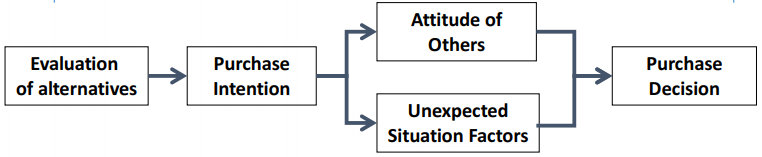
- 13What is Post-ConsumptionWhat this a good decision?
Consumer satisfaction, cognitive dissonance
can be influenced by aftersales service
Divestment
Disposal/Recycling (can even be a point of differentiation). - 14How do marketers encourage Impulse Buying?Atmospherics, checkouts/POS, shelf positionings, the internet, RfID, GPS, Loyalty schemes, service worker encouragement
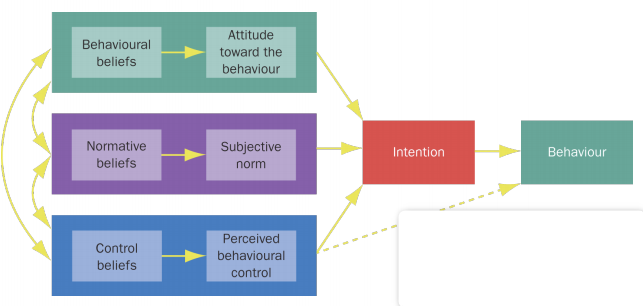
- 15What is this and what is it used for?Theory or Reasoned Action: Very commonly used to think about higher involvement purchases and more complex decisions/actions/choices
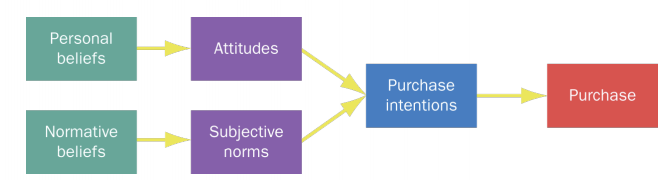
- 16—Theory of Planned Behaviour: Adds the idea of control, whether you believe you can take the action, and what factors influence this (e.g. Culture). Often used to explain complex and difficult choices, particularly around health and risk.
Informationen
- Beschreibung
- Marketing Karteikarten am 3 Consumer Behaviour, erstellt von Jamie Keith` am 27/08/2018.
- Erstellt von
- Jamie Keith`
- Aufrufe
- 0
- Bewertung