
Karteikarten
EPCO
Karten in diesem Stapel (26)
- 1Examples Thesis StatementThe purpose of the text is to persuade, which is evident in the use of positively-connotated adjectives, the semantic field of XYZ, and the direct personal address of the reader.
The text at hand achieves its primarily informative purpose through the use of …
This text clearly represents a typical example of the text type of the XYZ, which can be seen in the move structure, the register, and the use of genre-specific persuasive strategies. - 2Moves of a Complaint Letter(addresses)
date
subject line
salutation
(providing background information: e.g. introducing the writer, the situation, etc.)
stating reason for writing
elaborating on the problem (e.g. facts, details, order number, dates, times, remedies already tried, etc.)
stating the consequences of the problem
call for action (e.g. compensation)
(threat)
(polite pre-closing)
closing - 3Some core moves of shareholders letters-giving the title of the text
-greeting the reader (salutation)
-giving information about past performance: profits, income, spending, investments
-information about market situation, challenges met
-information about changes in company structure
-presenting an outlook and priorities for the future
-showing willingness to keep on working hard for the shareholders’ benefit
-expressing thanks for support
-closing salutation
-indicating the date of writing
-writer’s signature, name and position in company - 4Style/FormalityStyle = ‘HOW’ (rather than ‘WHAT’)
Level of formality (LoF) - Is the LoF appropriate for the text? (in relation to social context, i.e. communicative situation, audience, sender-receiver relationship, etc.)
Scale of formality (Martin Joos 1961) Continuum (low level vs. high level of formality – 5 styles)
Frozen- Formal - Consultatuve - Casual - Intimate - 5(1) Frozen Some characteristicsGreat social distance between sender and receiver
Impersonal
Static (fixed expressions)
Terms of Latin origin
Example:
“My father has deceased to join the heavenly - 6(2) Formal Some characteristicsMarked by social distance between interactants
Logically sequenced
Strongly cohesive
Impersonal
Absence of contractions
Absence of subjectivity markers
Many passive constructions
Choice of words (lexis) – denotation
Academic vocabulary – Latin words
Examples:
“My father has passed away.”
“I beg your pardon?”
“How are you doing?” - 7(3) Consultative Some characteristics‘neutral’ language
Explicit and/or implicit receiver participation – tries to elicit some kind of response from the receiver
Conversational expressions and structures
Examples:
“My father has died.”
“Pardon?”
“How are you? - 8(4) Casual Some characteristicsMarked by implicitness because of intimacy (social closeness) between the sender and receiver
Style used among friends (acquaintances)
Simple sentence structure (syntax)
Contractions are common (e.g. don’t)
Informal words and expressions
Colloquial words and expressions (e.g. slang)
Examples:
“My dad has died.”
“Sorry?”
“How’re you?” - 9(5) Intimate Some characteristicsUsed among people who are very close (social closeness) and have a maximum of shared background knowledge
Style used among family members and close friends
Includes nonverbal messages
Very personal, non-public
‘Private’ vocabulary
Examples:
“My old man just kicked the bucket.”
“What?”
“What’s up, buddy?” - 10FormalI am applying for the receptionist position advertised in the local paper. I am an excellent candidate for the job because of my significant secretarial experience, good language skills, and sense of organization.
- 11Semi-formal (consultative)I am applying for the receptionist position that is currently open in the company. As you are aware, I have worked as a temporary employee at your company in this position before. As such, I not only have experience and knowledge of this position, but also already understand the company’s needs and requirements for this job.
- 12Informal (casual):Hi! I read in the paper that ya’ll be looking for a receptionist. I think that I’m good for this job because I’ve done stuff like this in the past, am good with words, and am incredibly well-organized
- 13Formality (cont.)Formality may be a question of syntactic and lexical choices:
Passive or active employment of verbs
Register (lexical choices, vocabulary/terminology)
Use of person deixis refers to persons (e.g. personal or possessive pronouns) indicates relationship between the sender and receiver
Hedging (e.g. modal verbs, qualifiers) vs. categorical statements
Use of contractions
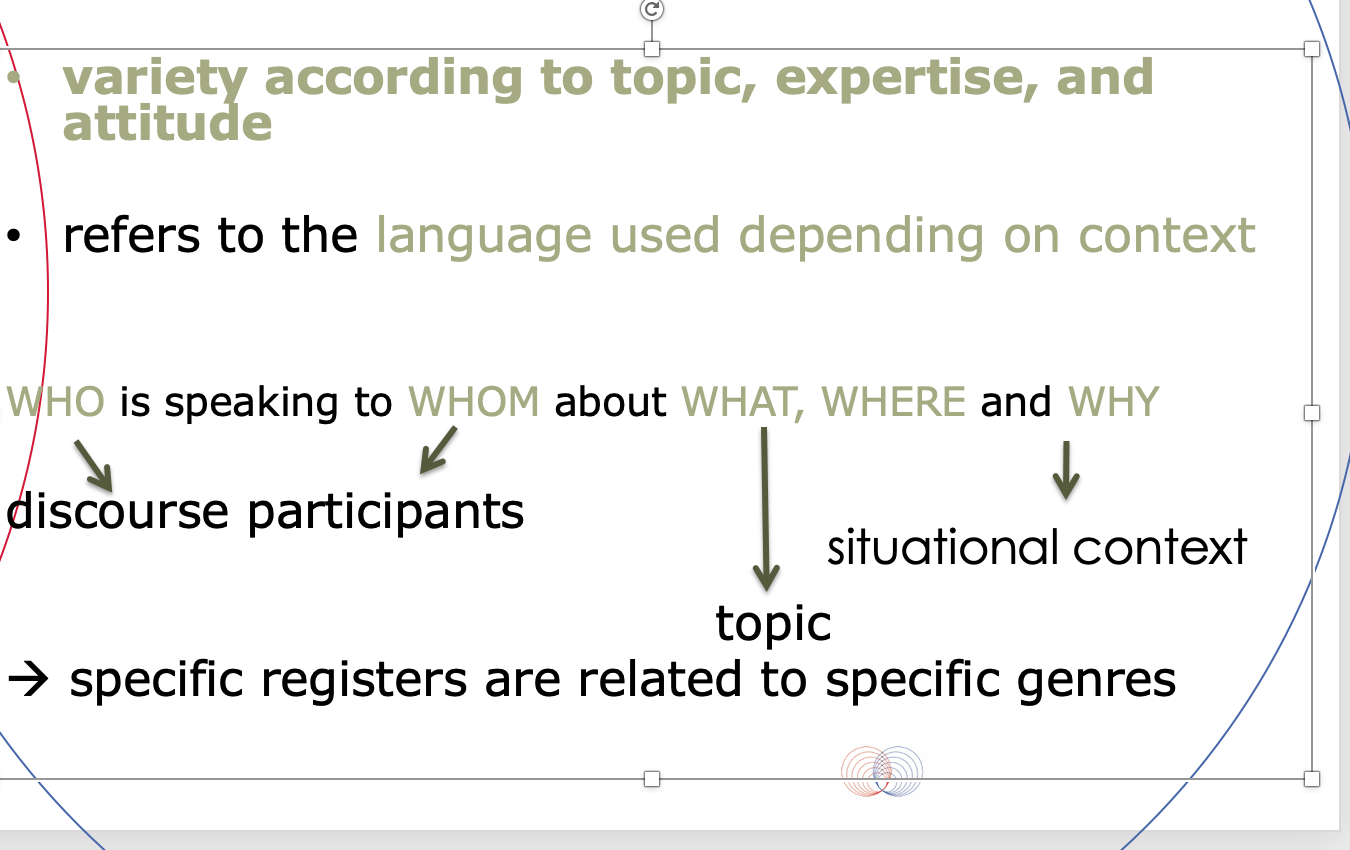
Use of titles - 14RegisterIn sociolinguistics often used interchangeably with ‘style’
Language variation
Occupational style/jargon “specific vocabulary associated with different occupational groups” (Holmes 2000: 259)
e.g. the language of airline pilots, politicians, journalists, lawyers, DJs, sports, etc., baby-talk - 15Register
- 16Lexical choices: useful terminology# (1) Denotation- literal meaning of a word
Typically related to the appeal form logos
Example: ‘husband’, ‘car’ - 17(2) Connotation- associations or emotional suggestions linked to a word
Typically related to the appeal forms ethos and/or pathos
Example: ‘significant other’, ‘better half’, ‘my man’ - 18(3) Euphemism- substitution of an offensive expression with one more agreeable
Example: ‘challenge’ (euphemism for ‘problem - 19Linguistic aspects of registers Technical vocabularyTechnical vocabulary: common words vs. uncommon words (or uses of common words) with unambiguous definitions (technical terms related to a specific field)
technical terms indicate expertise
e.g. cardiac arrest vs. heart attack - 20Impersonality:Impersonality: impersonal vs. personal (e.g. use of active or passive verbs, choice of pronoun)
impersonal constructions indicate a distanced + neutral attitude
e.g. I wasn’t expecting him. vs. One wasn’t expecting him or He was’t being expected. - 21EmotionalityEmotionality: emotional vs. neutral words
words with strong affective connotations or with strong affective content = part of an emotionally involved register
also: linguistic elements indicating preferences (e.g. modal verbs, such as should or must or modal adverbs, such as unfortunately)
e.g. newspaper headlines:
SCHOOL BLAZE vs. SCHOOL FIRE
SNOW CHAOS HITS ENGLISH ROADS vs. SNOW AFFECTS ENGLISH ROADS - 22GeneralityGenerality: general vs. specific
expert + distance registers: talk about the general rather than the specific, e.g.
- generic present tense: if the present tense is used
for timeless facts
(e.g. water freezes at 0°C)
- generic references (e.g. Cats are… - 23CertaintyCertainty: certain vs. doubtful (e.g. modality)
e.g. elements of modality (modal verbs: may, should, etc. + modal adverbs: possibly, probably, etc.) tend to belong to non-expert registers
[Why? - 24all text types 1project proposal (p.22)
academic poster presentation (p. 23)
online course “blurb” (information pattern: extended definition) (extra materials in Moodle)
about us page (information pattern: problem-solution) (extra materials in Moodle)
EU resolution (p. 38)
section of industry report (information pattern: process explanation) (p. 40)
mission statement (p. 41) - 25all text types 2informative memorandum (p. 42)
set of instructions for carrying out a process (p. 43)
industry newsletter (p. 45)
Amazon product description (p. 46)
shareholders’ letter (p. 54)
activist shareholders’ letter (p. 57)
response to request for funding (negative and positive) (p.62)
letter of complaint (p. 64)
Facebook complaint and response (p. 65
Amazon product review (p. 69)
internal proposal memo (p. 70)
press release (p. 74) - 26Common errors to avoid onFailing to write a clear and specific thesis statement in the first paragraph of the text analysis essay
Incorrectly identifying the text to be analyzed
Organizing essay paragraphs poorly
Not supporting claims about the text with evidence from the text
Not proofreading one’s texts for errors in spelling, punctuation, word order, grammar (esp. tense, adverbs, articles, subject-verb agreement, pronoun reference)
Failing to include or formulate clearly the core moves of the target transformation text, especially reason for writing and call for action
Structuring the transformation poorly
Failing to sufficiently develop some or most of the content points in the transformed text
Informationen
- Beschreibung
- Matura English Karteikarten am EPCO, erstellt von Lisza Neumeier am 22/01/2019.
- Erstellt von
- Lisza Neumeier
- Aufrufe
- 4
- Bewertung