
Karteikarten
GCSE AQA Chemistry - Unit 1
Karten in diesem Stapel (65)
- 1Fill in the missing words: All substances are made of ______ (very small particles). Each _____ has a small nucleus made up of _________ and _________. The nucleus is surrounded by orbiting ___________.Atoms
Atom
Protons (and) Neutrons
Electrons - 2Group 1 metals react vigorously with water to produce...an alkaline solution and hydrogen gas.
- 3The Group 1 elements react rapidly with oxygen to form...metal oxides.
- 4What are the elements is Group 0 known as?The noble gases
- 5When elements react, their atoms join with other atoms to form...compounds.
- 6Ionic bonding...Metal and non-metals
The metals lose electrons.
The non-metals gain electrons. - 7Covalent bonding...Non-metals and non-metals
Sharing of electrons. - 8What is the mass number? What is the atomic number?Sum of protons and neutrons
Number of protons (also the number of electrons) - 9What type of rock is Limestone?A sedimentary rock
- 10What does Limestone mainly consist of?Calcium Carbonate
(CaCO3) - 11Limestone can be eroded by...acid rain.
- 12What happen when calcium carbonate is heated in a kiln, and what is this reaction called?The calcium carbonate decomposes.
Thermal Decompostion - 13When calcium carbonate is heated, what two compounds does it break down into?Calcium Oxide and Carbon Dioxide
- 14How do you make cement?Powdered limestone and Powdered clay, roasted in a rotary kiln.
- 15How do you make mortar?Dry cement + sand + water
- 16How do you make concrete?When mortar is aggregate, mix sand and water with it.
- 17Carbonates react with dilute acids to form...Carbon Dioxide (and a salt and water).
- 18Carbon dioxide turns limewater...cloudy.
- 19What is an metal ore?A mineral that contains enough metal to make it economically viable to extract it.
- 20How are metals that are less reactive than carbon extracted from their oxide?By heating them with carbon.
- 21How are metals that are more reactive than carbon extracted?By electrolysis of molten compounds.
- 22How can copper be extracted from copper-rich ores?Heating the ores in a furnace, this a process known as smelting. The copper can then be purified by electrolysis.
- 23What is Phytomining?A method that uses plants to absorb copper. As the plants grow they absorb (and store) copper. The plants are then burned and the ash produced contains copper in relatively high quantities.
- 24What is Bioleaching?Bioleaching uses bacteria to extract metals from low-grade ores. A solution containing bacteria is mixed with a low-grade ore. The bacteria convert the copper into solution (known as a leachate solution) where it can be easily extracted.
- 25How can iron be taken from iron oxide, an what percentage iron does the iron contain afterwards?Iron oxide can be reduced in a blast furnace to produce iron, and the molten iron contains roughly
96% Iron - 26Carbon is added to iron to make the alloy...steel.
- 27Give some properties of transition metals...- They are good conductors of electricity.
- Are hard and mechanically strong.
- Have high melting points (except mercury).
- Can be bent or hammered into shape. - 28How are titanium and aluminium extracted from their ores?Electrolysis
- 29Give some properties and uses of Aluminium...Properties:
Resistant to corrosion
Low density
Uses:
Drinks cans, window frames, lightweight vehicles and aeroplanes - 30Give some properties and uses of Titanium...Properties:
Strong
Resistant to corrosion
Uses:
Aeroplanes, nuclear reactors and replacement hip joints - 31Fill in the missing words: Most of the compounds in crude oil consist of molecules made up of only _________ and __________ atoms. These compounds are called ________________.Carbon (and) Hydrogen
Hydrocarbons - 32The larger the hydrocarbon: - The _____ _______ it flows The ______ its boiling point The _____ volatile it is. The _____ ________ it ignitesLess easily
Higher
Less
Less volatile - 33Crude oil can be separated into different ____________ (parts) by _____________ ______________.Fractions
Fractional distillation - 34What are biofuels?Fuels that are produced from plant material such as sugar.
- 35Alkanes: Are the carbon atoms in the chain linked by single carbon-carbon bonds, or double carbon-carbon bonds? Are they saturated or unsaturated? What is the general formula?Alkanes:
Single carbon-carbon bonds
Saturated
General formula: CnH2n+2 - 36Alkenes: Are the carbon atoms in the chain linked by single carbon-carbon bonds, or double carbon-carbon bonds? Are they saturated or unsaturated? What is the general formula?Alkenes:
Double carbon-carbon bonds
Unsaturated
General formula: CnH2n - 37How are longer-chain hydrocarbons broken down into shorter, more useful hydrocarbons?A process known as cracking.
- 38What does cracking involve?- Heating the hydrocarbons until their vaporise.
- Passing the vapour over a hot catalyst (or mixed with steam) - 39How can alcohol (ethanol) be produced from ethene?Ethene + steam --Phosphoric acid--> Ethanol
- 40Which type of hydrocarbon is used for making polymers?Alkenes, because they are unsaturated
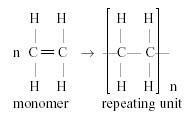
- 41What is the general formula for polymerisation?
- 42What is the chemical test for alkenes?Add bromine water; It turns from orange to colourless (is decolourised).
- 43What is the name given to the small molecules that join together to form polymers?Monomers
- 44How can the oil from plants be extracted?- By pressing (crushing) them
- Distillation - 45Vegetable oils contain ________ carbon-carbon bonds, so they are ______________.Double
Unsaturated - 46What is the name given to the process that raises the melting point of an oil by removing some of/all of its carbon-carbon bonds?Hydrogenation
- 47What happens during this process?1. The unsaturated fat (oil) is heated with hydrogen at about 60°C, in the presence of a nickel catalyst.
2. A reaction takes place that removes the double carbon-carbon bonds to produce a saturated fat (hydrogenated oil). Removing more double bonds makes the saturated fat harder. - 48Oils don't dissolve in water, but an oil can be mixed with water to produce an...emulsion.
- 49What is an emulsifier? What do emulsifier molecules have?A substance that helps to stabilise an emulsion.
Hydrophilic head, that mixes with water molecules.
Hydrophobic tail that mixes with oil molecules - 50What are the three main layers of the Earth?- A thin crust
- A mantle
- A core (made of nickel and iron) - 51What did scientists once believe that features on the earth's surface, such as mountain ranges, caused by?The shrinkage of the crust when the Earth cooled down, following its formation.
- 52However, this theory was rejected, when evidence showed scientists, that the east coast of South America and the west coast of Africa have... (TWO things)- Closely matching coastlines
- Similar patterns of rocks, which contains fossils of the same plants and animals - 53What is the Earth's lithosphere (the crust and the upper part of the mantle) 'cracked' into?Tectonic Plates
- 54What creates convection currents in the mantle?Intense heat, released my radioactive decay deep in the Earth.
- 55Describe what happens during a convection current (in the Earth)?1. Hot molten rock rises to the surface, creating new crust.
2. The older, cooler crust, then sinks down where the convection current starts to fall.
3. The land masses on these plates move slowly. - 56Describe how Miller and Urey tested one possible theory for how life began? (Don't describe the outcomes for the moment.)They mixed together the chemicals thought to be present in the earth's early atmosphere - water, methane and ammonia. The mixture was heated and sparks (electrical discharges) to represent ultraviolet radiation from the sun were passed through it. The mixture was cooled and the cycle was repeated many times.
- 57What did the mixture contain after many cycles?Simple amino acids, that are the building blocks of living organisms
- 58What theory does this experiment support?Primordial Soup Theory
(Which is one of many that offers an explanation for how life began) - 59What gas did the atmosphere mostly consist of around 4.6 billion years ago?Carbon Dioxide (CO2)
- 604.6 billion years ago, what did intense volcanic activity release?- Mainly carbon dioxide
- Water vapour (Which condenses to form the oceans)
- Small proportions of methane and ammonia - 61What were the 3 main gases in our atmosphere around 2.5 billion years ago? (1st, 2nd and 3rd)1st: CO2
2nd: N2
3rd: O2 - 62Around 2.5 billion years ago, green plants and algae evolved and... (5 things)- Carbon dioxide is reduced, as the plants take it in and give out oxygen.
- Microorganisms that can't tolerate oxygen are killed off.
- Carbon from CO2 becomes locked up in sedimentary rocks formed from the shells and skeletons of marine organisms.
- Other gases react with oxygen to release nitrogen.
- Nitrogen is also produced by bacteria removing nitrates from decaying plant material. - 63Fill in the missing gaps: There is now about __% oxygen and about __% nitrogen in the atmosphere.20% Oxygen
80% Nitrogen - 64Why is the level of Carbon Dioxide in the atmosphere today increasing? (DESCRIBE the two reasons)- Volcanic activity - geological activity moves carbonate rocks deep into the earth and during volcanic activity they may release carbon dioxide back into the atmosphere.
- The burning of fossil fuels - Burning carbon, which has been locking up in fossil fuels for millions of years, releases CO2 into the atmosphere. - 65How can the different parts of air be collected?By cooling air to a liquid and then heating it. This is the fractional distillation of liquid air.