
Karteikarten
Final week
Karten in diesem Stapel (39)
- 1What is a balanced scorecard?A management system (not a measurement system) that allows organisations to clarify their vision and strategy and translate them into action. Then align their organisation with the strategy.
Provides feedback around the business process and the external outcomes in order to continuously improve strategic performance and results. - 2What does a BSC use as the ultimate outcome measure for company success?Financial metrics but supplements these metrics with additional perspectives - customer, internal process and learning and growth proposed as drivers for long term shareholder value.
- 3Which 4 perspectives is a BSC viewed from?Learning and growth,
Business process
Customer perspective
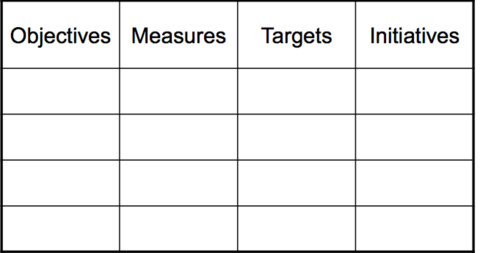
Financial perspective - 4What does a BSC look like? (separate BSC for each of the perspectives)
- 5What does learning and growth perspective entail?Employee training and corporate cultural attitudes related to both individual and corporate self improvement. People are the main resource.
In a rapidly developing tech climate, learning is a continuous process. - 6What is the difference between learning and training?Learning includes things like mentors and tutors within the organisation, as well as the ease of communication among workers that allows them to readily get help on a problem.
- 7What does the internal business process perspective entail?Allows managers to know how well their business is running and whether products and services conform to customer requirements.
Metrics designed by people who know the process intimately. - 8Customer perspective entails what?The importance of customer focus and satisfaction.
Poor performance in this perspective leads to future decline, even though current financial picture may look good. - 9What does the financial perspective include?Timely and accurate funding data will always be priority. With implementation of corporate database, it is hoped that more of the processing can be centralised and automated.
Emphasis on financials leads to 'unbalanced' situation with regards to other perspectives.
Also a need to include additional financial data such as risk assessment and cost benefit data. - 10What do organisations need to have in order not to just be a group of people?Organisational Structure
- 11What structural decisions are there?- Deciding allocation of tasks and responsibilities to individuals and defining their jobs.
- Deciding whom to report to, thus how many levels of management & how many people each manager is responsible for.
- Deciding how authority is to be delegated and results monitored & evaluated.
- Deciding organisations activités are to be shared between divisions and how sections are formed within divisions.
-Deciding how to integrate the efforts of different groups and ensure effective comms of necessary information to decision makers. - 12What does centralisation/ decentralisation do?Centralisation makes control easier
Decentralisation encourages initiative. - 13How does span of control effect control?The wider your span (people to manage) as a manager/leader the less control
- 14How does a simple/entrepreneurial structure differ to an organisational one?It can be thought of as having formal structure. Common in very small businesses. There may be an owner who undertakes responsibilities along with one other partner.
- 15What is the issue with a simple structure?Only operate effectively until a certain size. Beyond this it becomes to complex for one individual to control
- 16What are the pros and cons of a simple structure?pros:
- Flexible, responding quickly to changes
- Direct comms and control.
-Very focused on primary objective
Cons:
- Single person/small group with all management responsibilities.
- Only effective until a certain size
- Could be insular - unable to change. - 17What is the functional structure?Focuses on the primary tasks that have been carried out, such as production, finance, marketing and personnel.
Usually used be smaller companies or those with narrow rather than diverse product ranges.
Within a multidivisional structure, these tasks themselves are likely to be split up further. - 18What are the pros and cons of a functional structure?Pros:
- Chief exec. in touch with all routine matters
- Clear definition of responsibilities
- Economies of scale (cost advantage to change in scale of production)
-Specialists at senior and middle management levels.
Cons:
- Senior managers overburdened with all operations
- Barriers between functions
- Slow to adapt to market change
- Difficult to cope with diversity. - 19What is the divisional structure and what is it used for?Found outside private sector in higher education (multiversities). and health care (groups of specialised hospitals).
Divisions are created to serve particular markets and then given control of the operating functions needed to serve them. - 20What are the pros and cons of the divisional system?Pros:
- Facilitates measurement of unit performance
- Facilitates senior management attention to strategy.
- Closer to customer.
Cons:
- Lack of economies of scale/costly
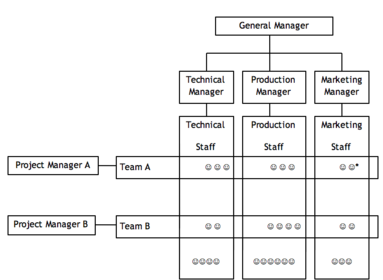
- Complexity of co-ordination if too many divisions. - 21What is the matrix structure?Essentially a way of forming temporary product or project teams by cutting across a number of specialist departments and taking members from each.
Its a combination of structures which usually takes the form of product & geographical divisions or functional and divisional structures. - 22Give an example case of oneIf a company expands its operations to multinational scale and develops new products it may regard geographically defined devisions as the operating unit for the purpose of local marketing and product divisions as responsible for the central worldwide co-ordination of product development, manufacturing and distribution to geographical divisions.
- 23Why use a matrix structure?Claimed they improve decision making in situations where there is a risk of one vital interest of the enterprise (e.g. a geographical area) dominating strategy at the expense of others (e.g. worldwide co-ordination of manufacturing).
Also meant to increase managerial motivation and development due to wider involvement in strategies.
Adopted because there is more than one factor to build the structure around so that pure divisional structures would be inappropriate. - 24Where are they used?In both large and small organisations and are very common in professional service organisations (both public and private)
- 25What are the problems with matrix structures?- High risk of 'dilution of priorities'
- Decision time is much longer
- Responsibility can sometimes be unclear.
- Organisations with matrix structure may have to deal with a vast amount of conflict because of the lack of clarity of role definition and responsibility. - 26—Who would the person with the asterisk next to them report to? Who is responsible for their work in this matrix structure? Project manager A or Marketing manager?
Answer: Likely to report to both, project manager responsible for project contribution and department manager for his general career, development, pay and promotion prospects. - 27What are the pros and cons of a matrix structure?Pros:
-team has access to excellence of the functional organisation
- Resources can be used efficiently
- Focus on the customer needs
Cons:
- Conflict inevitable when working for two managers
- Unclear priorities
- Co-ordination can be difficult - 28What is a culture?"Pattern of shared basic assumptions learned by a group as it solves problems of external adaption and internal integration, that work well enough to be considered valid and therefore are taught to new members as the correct way to perceive, think, and feel in relation to these problems."
- 29What are Mckinsey's 7S's for effective organisational performance?Structure
Skill
Style
Staff
Shared values
Strategy
Systems
These are all interconnected and ignoring one will affect another - 30What is skill?Innovation capacity, product management capability, logistical prowess, etc...
Attributes or capabilities...
Often difficult to get rid of old skills and the structures and systems they had created. - 31What is strategy?Relates to the actions that a company takes in plan to anticipate changes in its external environment.
Way a company aims to improve relative position in competition. - 32What is a system?Procedures that an organisation of through day by day, year by year.
- 33What is style representing?Not words, but patterns of actions are decisive. People may listen to what a manager may say, but they believe what managers do.
For example if more people are on board for a particular expertise, this demonstrates the organisations value of this aspect of their business as does what they choose to fund easily or not. - 34What is staff representing?Treated in one of two ways. At the hard end there is appraisal systems, pay scale, formal training programs and at the soft end there is morale, attitude, motivation and behaviour.
Companies who use people best, rapidly move their managers into positions of responsibility, often by the early-to mid thirties. Various active support devices like mentors are hallmarks of their management of people. - 35What are shared values?Set of values, often written that goes beyond conventional formal statement of corporate objectives.
Not present on all/most organisations. They are however evident in the superior performers. To be readily communicated shared values need to be succinct.
Typically, therefore, they are expressed at high levels of abstraction and may mean very little to those who don't - 36What are the 3 guiding principles?Build trust
encourage change
Measure what matters - 37What themes does strategy comprise of?• Building The Enterprise (Long – Term)
• Increasing Customer Value (Medium – Term)
• Achieving Operational Excellence (Short – Term)
• Be A Good Corporate Citizen (In the moment) - 38What are the key elements of structure design?• Specialization
• Definition
• Span of control
• Layers of hierarchy
• Authority / Responsibility / Accountability - 39How do cultures form?• What leaders pay most attention to
• How leaders react to crises & critical incidents
• Role modeling, teaching and coaching by leaders • Criteria for allocating rewards & determining status • Criteria for selection, promotion and termination
Informationen
- Beschreibung
- Degree Aerospace Engineering Karteikarten am Final week, erstellt von Luke Hansford am 05/01/2016.
- Erstellt von
- Luke Hansford
- Aufrufe
- 203
- Bewertung