
Karteikarten
Communication and Homoeostasis Booklet
Karten in diesem Stapel (34)
- 1Define HomeostasisThe ability to maintain constant internal conditions regardless of the fluctuations in the external environment
(dynamic equilibrium) - 2What are some examples of factors inside the body that need to be kept at a fairly constant rate?Water, temperature, toxins, PH, blood glucose, CO2, O2, blood pressure.
- 3Explain Negative FeedbackNegative feedback means that it reverses the initial stimulus. For example, receptors detect that our blood glucose has dropped, so we have negative feedback causing the pancreas to release glucagon to raise the glucose again.
- 4What is Positive Feedback?Positive feedback amplifies the change in the internal environment that it detects. For example, if the body detects a cut where platelets are clotting to stop the bleeding, more platelets are sent to that area.
- 5What is thermoregulation?The regulation of a constant internal core body temperature. It is very important because internal temperature effects the way enzymes work.
- 6What is an ectotherm?An organism which cannot control its core body temperature internally. Their temperature relies on their external temperature.
- 7What is an endotherm?An endotherm is an organism that can control its own internal body temperature due to homeostasis. Their internal temperature is less effected by their external temperature.
- 8What relationship do endotherms and ectotherms have with their metabolism?Endothermic organisms have a constantly high metabolic rate as they use this to generate heat. Ectotherms have a variable metabolic rate as they can't generate much heat from their metabolic reactions.
- 9What relationship do Endotherms and Ectotherms have with activity level?An ectotherm's activity depends on its external temperature- they're more active at high temperatures. Endotherms can be active at any reasonable temperature.
- 10What behavioural ways do ectotherms use to control their body temperature?They bask in the sun, orientate their bodies so the biggest Surface Area is facing the sun, extend their bodies for greater SA, use conduction to get heat by pressing their bodies to warm/cool things, contract and vibrate bodies to speed metabolism, hide in crags.
- 11What physiological ways do ectotherms use to maintain their temperature?They have dark colours to absorb more radiation, alter their heart rate, change metabolic rate and require less food.
- 12Where are thermoreceptors found?The hypothalamus (detects inner changes in temperature) and the skin (external changes)
- 13What is the normal core temperature of the body?37 degrees Celsius (give or take 1 degree)
- 14What are an endotherms reactions when it gets too cold?Vasiconstriction of arterioles, shivering, raised hair and increased metabolic rate
- 15What are an endotherms reactions when it gets too warm?Vasodilation, sweating, hair lowered, decreased metabolic rate.
- 16Which hormones help in thermoregulation?Adrenaline provides a short term increase in metabolic rate, thyroxine provides a long term increase in metabolism.
- 17Which physiological mechanisms do endotherms use to maintain body temperature?Wallowing in mud, homes to separate us from harsh environments, heating, fans, shade, sun, clothing.
- 18Can our internal temperature exceed 37/38 degrees?Yes, we raise our temperature to fight infection. The temperature raise can go to 40 degrees Celsius. It can also plummet as low as 33 degrees.
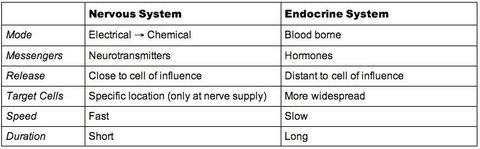
- 19Differences between the nervous system and the endocrine system?
- 20What are exocrine glands?They take hormones to ducts that secrete hormones externally to the blood, such as pepsin being secreted into the stomach directly.
- 21What is an endocrine gland?A gland that secretes hormones into the blood to make internal changes.
- 22Define a hormone?A sterol or protein based molecule released by endocrine or exocrine glands into the blood or tissues. Works as a chemical messenger. Binds to specific receptors/ target cells.
- 23List some of the well known bodily glands?Salivary glands, pituitary, thyroid, adrenal, pancreas, liver, digestive glands, ovaries, testes
- 24Why are Sterol hormones quicker than protein enzymes?They can cross the phospholipid bilayer without going through any other process to get into the cell.
- 25Explain how a steroid hormone worksThe steroid hormone binds to the internal receptors inside the cell, forming a 'hormone-receptor complex'. This then acts as a transcription factor and can switch genes on or off, directly effecting the DNA of the cell. This results in the production of proteins or inhibition.
- 26An example of a steroid hormone?The sex hormones- oestrogen, progesterone, testosterone.
- 27How do protein hormones work?The hormone (1st messenger) arrives at the cell. It attaches to a specific protein receptor on the plasma membrane, but cannot enter cell. It then activates a molecule inside the cell known as a G Protein. The G Protein activates an enzyme (adenyl cyclase) which catalyses the production of cAMP from ATP. cAMP is the 2nd messenger and brings around the cell response.
- 28So, specifically, what does adenyl cyclase do?cAMP (cyclic AMP) catalyses the conversion of ATP into cAMP which is the second messenger in protein hormone binding.
- 29What are the adrenal glands?Two small glands that sit on top of the kidneys and are approximately 3cm in height and 5cm in length. They consist of an adrenal cortex and an adrenal medulla.
- 30Which hormones do each part of the adrenal gland produce?The adrenal cortex secretes hormones such as cortisol and aldosterone whereas the medulla secretes stress hormones.
- 31How is the adrenal gland activated?The hypothalamus controls the pituitary gland which controls the adrenal glands to secrete hormones.
- 32What, specifically, does the adrenal cortex release?Glucocorticoids that regulate metabolic rate and energy release from respiration. Also helps regulate blood pressure and release glucose.
Mineralcorticoids that regulate water and salt balance
Androgens- Small qualities of female and male sex hormones. - 33Which hormones, specifically, does the adrenal medulla release?The adrenal medulla releases adrenaline and noradrenaline. They prepare the body for 'fight or flight' in stressful situations. Both are non-steroid hormones.
- 34How do adrenaline and noradrenaline prepare us for the fight or flight response?Relax muscles in bronchioles, increase stroke volume and heart rate, vasoconstriction to increase blood pressure, converting glycogen to glucose, dilating pupils, increasing mental awareness, inhibiting gut action and making hair stand erect.
Informationen
- Beschreibung
- A level Biology (Module 5 ) Karteikarten am Communication and Homoeostasis Booklet, erstellt von Emma Lloyd am 09/11/2016.
- Erstellt von
- Emma Lloyd
- Aufrufe
- 17
- Tags
- Bewertung