
Karteikarten
Innate Immunity I
Karten in diesem Stapel (60)
- 1Innate Immunity Mechanisms1) Mechanical Barriers
2) Soluble Mediators
3) Cellular Defense Mechanisms - 2Innate Immunity Mechanisms Mechanical Barriers/surface secretion:skin, acidic pH in stomach, cilia
- 3Innate Immunity Mechanisms Soluble MediatorsLysozymes, basic proteins, complement, cytokines
- 4Innate Immunity Mechanisms Cellular Defense Mechanismsnatural killer (NK) cells, neutrophils (PMNs), macrophages, mast cells, basophils, eosinophils
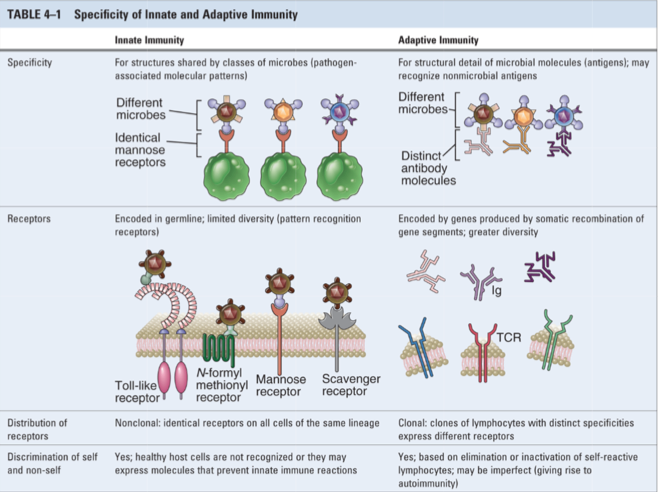
- 5Compare and contrast: Innate and Adaptive immunityInnate immunity: not as specific, more broad
-coded germ line (the genes code for what is made - no change)
-nonclonal: identical receptors on ALL cells
Adaptive immunity: more specific, more diversity (somatic gene rearrangements)
-clonal: clones of lymphocytes w/distinct specificities express different receptors
Both:
distinguish between self and non-self peptides
-have similar effector mechanisms for killing pathogens - 6Inflammationan innate response that involves response that involves cellular & physiological elements
Can be:
1) Localized: Infection or wounding can trigger:
Capillary vasodilation – redness (erythrema)
Capillary vasopermeation – swelling (edema)
Cellular influx
2) ‘Vasoactive molecules’ (pro-inflammatory) released by white blood cells (WBC)
3) Systemic - Infection ONLY
Fever
Increase in WBC
Changes in serum proteins (e.g., Acute
phase proteins)
Diagnostic for infection
**Excessive inflammation causes immunopathogies
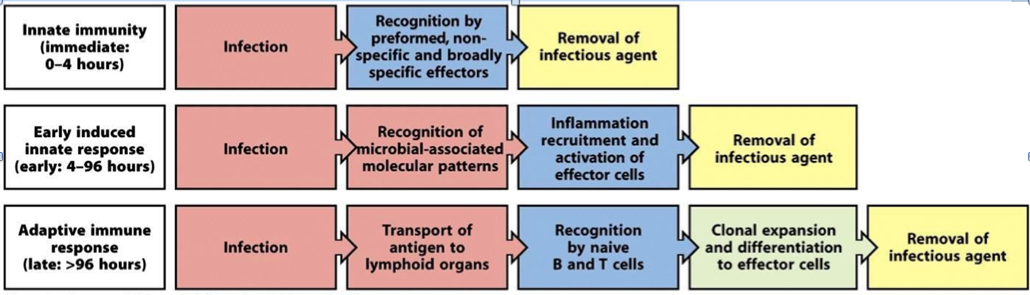
-->Critical to the start of the immune response, but if you cannot turn it off then it becomes pathogenic - 7Buildup of Immunity
- 8The Acute Phase Response Black Bile & Medieval BleedingSystemic inflammatory response
Fever, Changes in “Acute Phase Proteins”
e.g., CRP, Complement proteins, plasminogen, fibrinogen, etc.
Fibrinogen causes RBCs to stick together to form a Rouleaux (“Ru-Lo”)
= “Black bile”
Fast sedimentation rate (indicates some kind of septic response)
Was bled to cure illness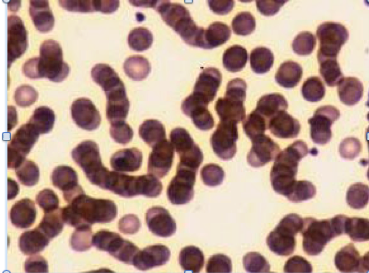
- 9"Danger Signals" activate innate cells“Danger signals” = PAMPs
“Pathogen-associated molecular patterns”
-Molecules of pathogens or wounding
-General structure/widespread occurrence
-Conserved in evolution - 10PAMPS bind to Receptors called PRRs “Pattern Recognition Receptor”“Pattern Recognition Receptor” (PRRs):
Toll-like receptors (TLR)
NOD-like receptors (NLR)
RIG-like receptors (RLR)
Caspase Recruitment Domain (CARD)-containing proteins
**Very important to DC (dendritic cell) activation
-Upregulates major histocompatibility complex (MHC) (HLA) expression
-Allows T-cell activation - 11Some Danger Signals IncludeViral dsRNA
Viral ssRNA
Bacterial LPS, flagellin, pili
Bacteral and fungal cell wall components
Microbial polysaccharides
Reactive oxygen molecules:
H202, OH-, O2-
Certain cellular molecules - 12TLR4 (Toll-like Receptor 4) recognizes:EXTRACELLULAR
things like LPS (can recognize conserved areas of pathogens) - 13Location of pathogen-associated molecular patterns (PAMPs)NLR (nod-like) and RLR's (rig-like receptors) are intracellular
TLR's (toll-like receptors) are extracellular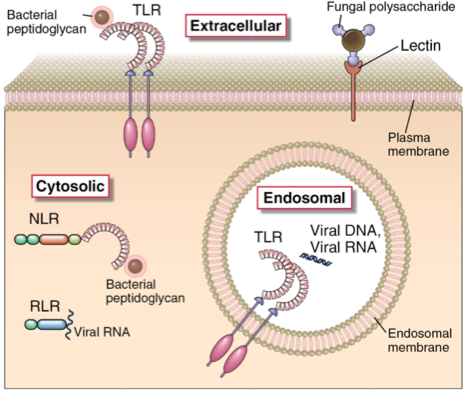
- 14TLR (toll-like receptor) Ligands-Contain leucine-rich repeats
-Toll/IL-1 receptor (TIR) homology domain in their cytoplasmic tails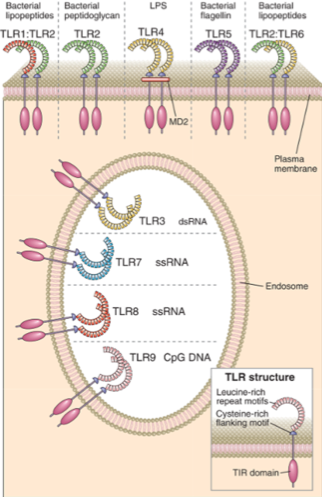
- 15TL4 recognizesLPS
- 16TLR5 recognizesbacterial flagellin
- 17TLR3 recognizesdsRNA
- 18TLR7 & TLR8 recognizessRNA
- 19TLR9 recognizesCpG DNA
short interspersed DNA sequences that deviate significantly from the average genomic pattern by being GC-rich, CpG-rich, and predominantly non-methylated - 20TLR Signaling Two Core signaling proteins:MyD88 and TRIF
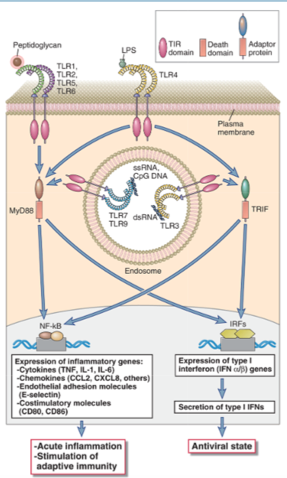
- 21MyD88 and TRIF (core TLR signaling proteins)Lead to acute inflammation and stimulation of adaptive immune responses
-downstream mediators of the TLR's
-activate BOTH (not smart enough to to do one or the other in innate immunity) - 22TLRs in the pathogenesis of Human DiseaseCDs: surface markers on cells (allow to distinguish)
*Know the 5 Genetic mutations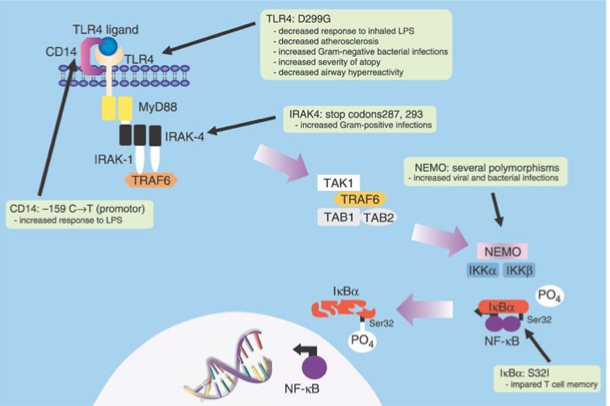
- 23TLR4: D299G Mutation Results indecreased response to inhaled LPS
- 24NEMO Mutation: (several polymorphisms) results inincreased bacterial and viral infections
- 25IkBa: S321 Mutation results inimpaired T cell memory
- 26IRAK4: stop codons 287, 293 Mutation results inincreased gram-positive infections
- 27CARDs (Caspase Recruitment Domain- containing proteins) in human disease: CARD9 deficiency mutationReduced DC (dendritic cell) activation of specific T cell subsets
-Leads to increased susceptibility of Candida albicans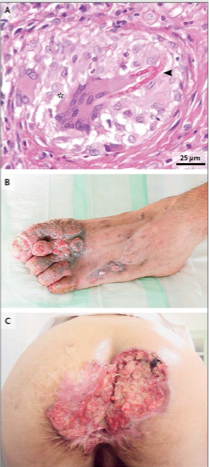
- 28Cytokines**COMMUNICATION network for cells (recruited to different sites of infection)
-Small soluble proteins
-Important for development and immune system maturation/function
*specific functions!! - 29The cytokines of innate immunity:IL10
TNF
TNF1alpha and TNF1beta - 30Cytokine IL10anti-inflammatory
(targets macrophages and dendritic cells) - 31Cytokine TNFpro-inflammatory
(many targets-neutrophils, endothelia, etc.) - 32Cytokines TNF1alpha and TNF2betaVIRAL response
(targets every cell because anybody could be infected by a virus) - 33Chemokines and Chemokine ReceptorsLow molecular weight proteins
Highly conserved secondary structure
Two types: CC or CXC
REGULATE:
1) Inflammation
2) Leukocyte trafficking (indicates where the lymphocyte should go in the lymph node)
3) Immune cell differentiation - 34Chemokine Subfamily: HIV Co-receptors Main receptor?CCR5 and CXCR4
(main receptor = CDR4) - 35What is complement? Four principles of complement activation1) Lysis of the target cell
2) Opsonization (deposit proteins that enhance uptake of the bacteria)
3) Activation of inflammatory response
4) Clearance of Immune Complexes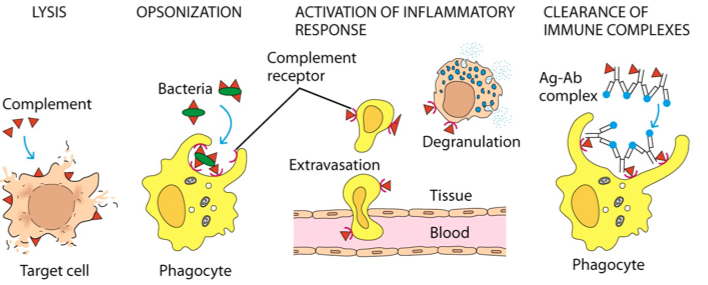
- 36Complement involves a “proteolytic activation cascade”
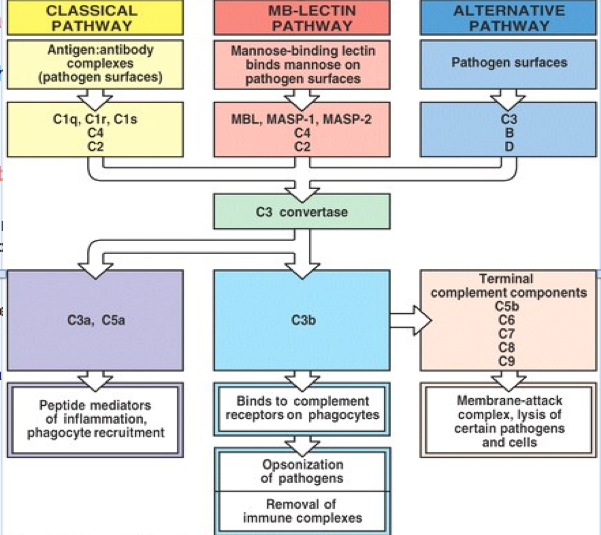
- 37What are the 3 pathways of initiation? Classical (antibody required) Alternative (innate) Lectin (innate)1) Classical (antibody required)
-- initiated by Ab bound to AG (antibody:antigen complexes)
2) Alternative (innate)
-- does not involve Ab binding
3) Lectin (innate)
-- activated by mannose-binding lectin - 38All three pathways of complement converge at?C3 Convertase
- 39C3 Convertase can split into:C3a and 5a
and C3b - 40C3a and C5aanaphylatoxins
INFLAMMATORY
recruit phagocytes - 41C3bOPSONIZATION
(deposit proteins that enhance uptake of the bacteria)
AND can split into C5b-C9 - 42C5b, C6, C7, C8, and C9 or C5b-C9forms the "MAC" (Membrane Attack Complex) complex
-lysis of pathogens and cells by forming pores - 43The Classical Pathway involves 3 Stages Stage 1:Initiation begins with C1 binding
to Ab bound to Ag (antigen:antibody complex)
Bind to Fc part of Ab
(antigen binds to Fc part of Ab)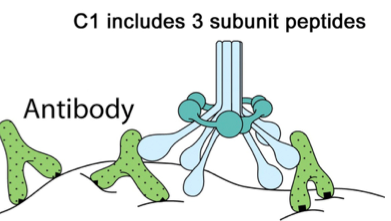
- 44The Classical Pathway involves 3 Stages Stage 2:Activated C1 triggers activation of C4 and then C2
-- to form C3 Convertase
**Activation of C3 is an important AMPLIFICATION step
-C3 convertase C3b (for opsonization) - 45The Classical Pathway involves 3 Stages Stage 3:C3 Convertase also activates:
anaphylatoxins – C3a & C5a
C5a is the MOST potent and dominant anaphylatoxin - 46What do C5a and C3a do?1) increase vascular permeability
-allowing increased fluid leakage and inflammatory runs
-also increases migration of PMNs from blood to tissue and vice versa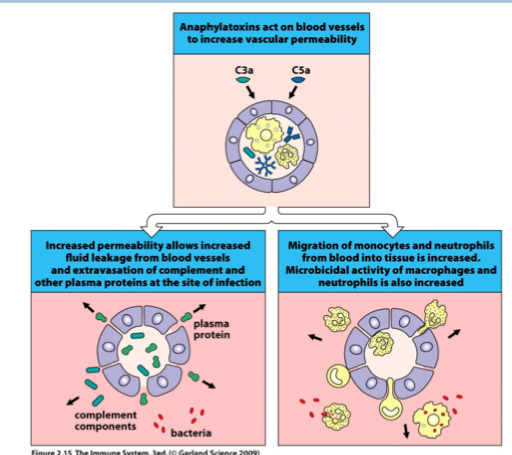
- 47C5b triggers formation of the Membrane Attack ComplexC5b triggers formation
-C5b678 = center and C9 surrounds it to form the MAC (membrane attack complex)
-pore lyses target cells
- 48MAC (Membrane attack complex) is MOST effective against:Gram-negative bateria
Enveloped Viruses - 49The Alternative pathwayC3 spontaneously turns over C3a and C3b
-Pathogens and Immune complexes
--Binding to other protein "factors"
creates alternative C3 and C5 Covertases
leading to MAC formation
*Factor D, Factor B, Properdin - 50Alternative Pathway *Factor D, Factor B, Properdin*
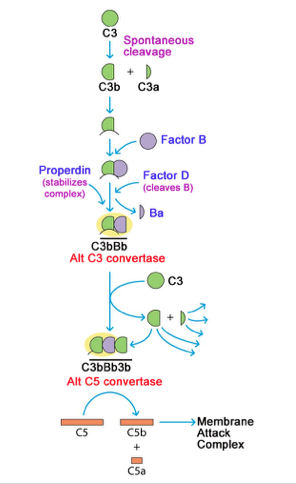
- 51The Lectin Pathway (MB Lectin)*Mannose Binding Lectin*
-binds to bacterial glycoproteins
-Creates C1-like activator (activating C4, C2 --> C3 convertase) - 52Complement RegualtionNegative regulatory step of complement: prevents you from getting affected by complement "attack"
- 53Complement Regulation (1) liability of? (2) Sialic acid inactivates? (3) Regulatory proteins?1) Lability of protein fragments
-rapid, spontaneous inactivation
2) Sialic acid in glycoproteins
inactivates C3b on body cells
3) Regulatory proteins
e.g., C1 inhibitor
Consequence of problems w/regulation of complement: Hereditary Angiodema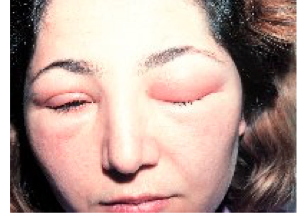
- 54Complement receptors mediate other functions: -- immune complex clearing -- chemotaxis -- opsonization
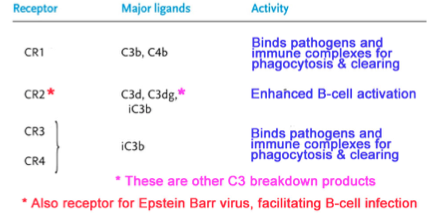
- 55How does C3b cause opsonization by phagocytic cells?Roles for both Fc (binds IgG) and Complement receptors
C3b is primary opsonin binds to CR1 receptor
Coating of viruses blocks
receptors and enhances opsonization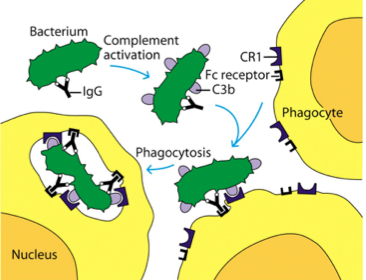
- 56RBCs and CR1 play major role in immune complex clearanceImmune complexes generate C3b
-- via classical or alternative pathways
Transport to spleen & liver
for Phagocytosis
Deficiencies in complement-mediated
immune-complex clearing are major cause of Systemic Lupus Erythromatosus (SLE) (C2 deficiency)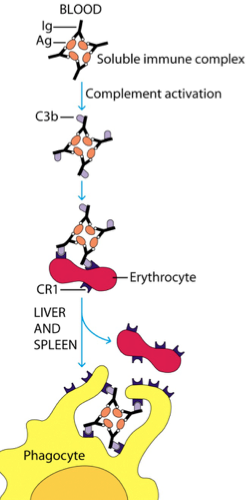
- 57Complement and MedicineTargeted biologics
Eculizumab
(1) Humanize monoclonal
binds to complement component C5, inhibiting its cleavage and preventing activation of the lytic pathway
--Approved to treat paroxysmal nocturnal hemoglobinuria (PNH)
---Acquired complement deficiency – lack regulatory proteins
BLACK BOX WARNING: Increased risk of N. meningitidis infection - 58BUILDUP OF IMMUNITY
- 59Macrophage Killing Mechanisms(1) External: Mediator secretion
(2) Internal: requires phagocytosis
Receptor mediated, or not
Antibody Fc receptors, PRR, etc.
(3) O2 dependent: “respiratory burst” O2 Independent: Enzymes (TNF)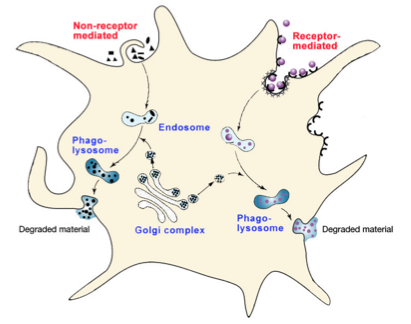
- 60Neutrophil (PMNs) Mechanisms(1) Rapid responders FIRST responders!
(2) Degranulation & phagocytosis
(3) Extracellular Traps:
Chromatin & antimicrobial enzymes (non-inflammatory, explodes and forms web to inhibit growth of bacteria)