
Mindmap
VICTIMS
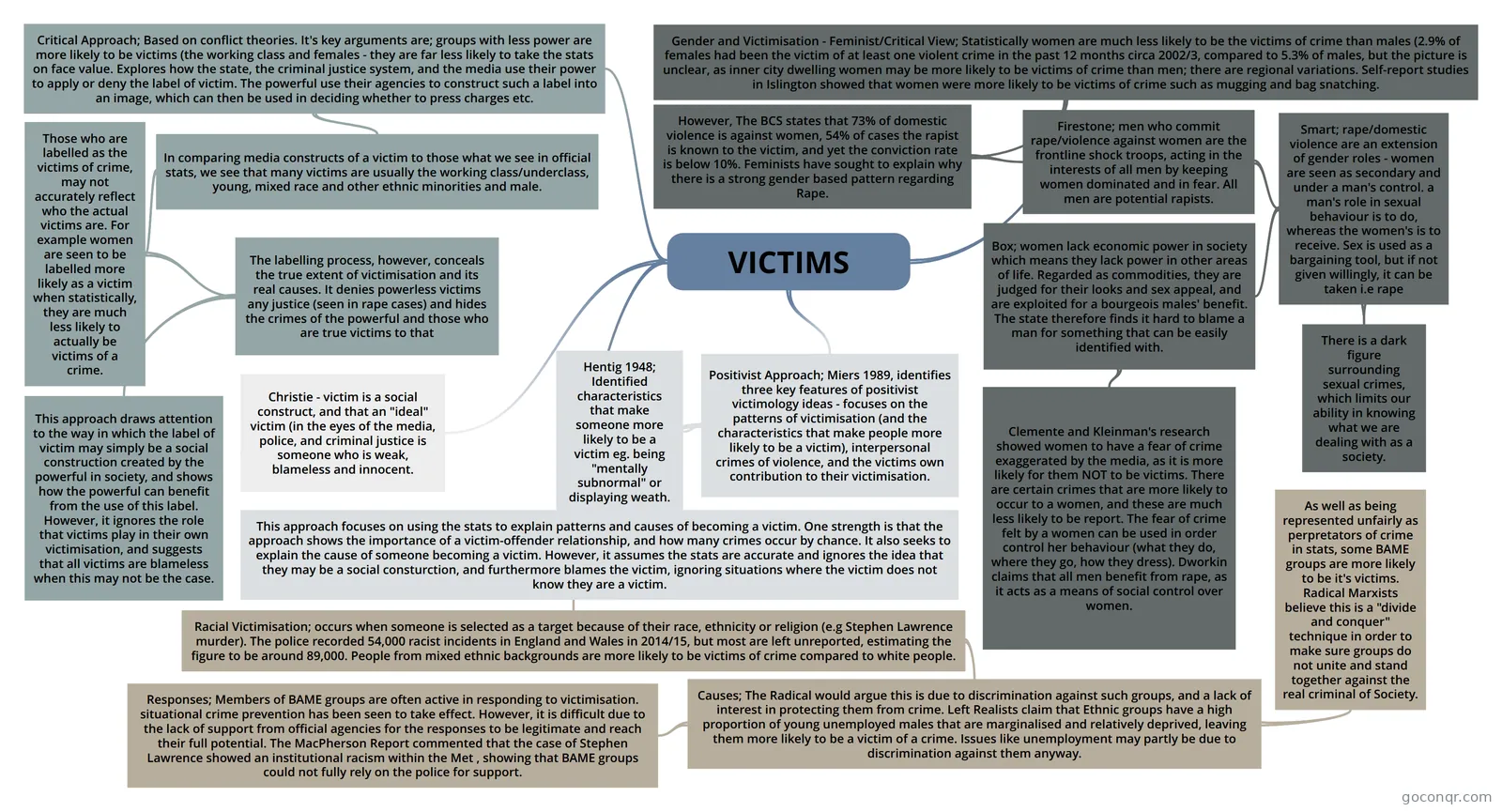
Mind map: Victims
Inhalt der Mindmap
VICTIMS
Christie - victim is a social construct, and that an "ideal" victim (in the eyes of the media, police, and criminal justice is someone who is weak, blameless and innocent.
Positivist Approach; Miers 1989, identifies three key features of positivist victimology ideas - focuses on the patterns of victimisation (and the characteristics that make people more likely to be a victim), interpersonal crimes of violence, and the victims own contribution to their victimisation.
- Hentig 1948; Identified characteristics that make someone more likely to be a victim eg. being "mentally subnormal" or displaying weath.
- This approach focuses on using the stats to explain patterns and causes of becoming a victim. One strength is that the approach shows the importance of a victim-offender relationship, and how many crimes occur by chance. It also seeks to explain the cause of someone becoming a victim. However, it assumes the stats are accurate and ignores the idea that they may be a social consturction, and furthermore blames the victim, ignoring situations where the victim does not know they are a victim.
Critical Approach; Based on conflict theories. It's key arguments are; groups with less power are more likely to be victims (the working class and females - they are far less likely to take the stats on face value. Explores how the state, the criminal justice system, and the media use their power to apply or deny the label of victim. The powerful use their agencies to construct such a label into an image, which can then be used in deciding whether to press charges etc.
- In comparing media constructs of a victim to those what we see in official stats, we see that many victims are usually the working class/underclass, young, mixed race and other ethnic minorities and male.
- Those who are labelled as the victims of crime, may not accurately reflect who the actual victims are. For example women are seen to be labelled more likely as a victim when statistically, they are much less likely to actually be victims of a crime.
- The labelling process, however, conceals the true extent of victimisation and its real causes. It denies powerless victims any justice (seen in rape cases) and hides the crimes of the powerful and those who are true victims to that
- This approach draws attention to the way in which the label of victim may simply be a social construction created by the powerful in society, and shows how the powerful can benefit from the use of this label. However, it ignores the role that victims play in their own victimisation, and suggests that all victims are blameless when this may not be the case.
- The labelling process, however, conceals the true extent of victimisation and its real causes. It denies powerless victims any justice (seen in rape cases) and hides the crimes of the powerful and those who are true victims to that
- Those who are labelled as the victims of crime, may not accurately reflect who the actual victims are. For example women are seen to be labelled more likely as a victim when statistically, they are much less likely to actually be victims of a crime.
- In comparing media constructs of a victim to those what we see in official stats, we see that many victims are usually the working class/underclass, young, mixed race and other ethnic minorities and male.
Gender and Victimisation - Feminist/Critical View; Statistically women are much less likely to be the victims of crime than males (2.9% of females had been the victim of at least one violent crime in the past 12 months circa 2002/3, compared to 5.3% of males, but the picture is unclear, as inner city dwelling women may be more likely to be victims of crime than men; there are regional variations. Self-report studies in Islington showed that women were more likely to be victims of crime such as mugging and bag snatching.
- However, The BCS states that 73% of domestic violence is against women, 54% of cases the rapist is known to the victim, and yet the conviction rate is below 10%. Feminists have sought to explain why there is a strong gender based pattern regarding Rape.
- Firestone; men who commit rape/violence against women are the frontline shock troops, acting in the interests of all men by keeping women dominated and in fear. All men are potential rapists.
- Smart; rape/domestic violence are an extension of gender roles - women are seen as secondary and under a man's control. a man's role in sexual behaviour is to do, whereas the women's is to receive. Sex is used as a bargaining tool, but if not given willingly, it can be taken i.e rape
- Box; women lack economic power in society which means they lack power in other areas of life. Regarded as commodities, they are judged for their looks and sex appeal, and are exploited for a bourgeois males' benefit. The state therefore finds it hard to blame a man for something that can be easily identified with.
- Clemente and Kleinman's research showed women to have a fear of crime exaggerated by the media, as it is more likely for them NOT to be victims. There are certain crimes that are more likely to occur to a women, and these are much less likely to be report. The fear of crime felt by a women can be used in order control her behaviour (what they do, where they go, how they dress). Dworkin claims that all men benefit from rape, as it acts as a means of social control over women.
- There is a dark figure surrounding sexual crimes, which limits our ability in knowing what we are dealing with as a society.
- Box; women lack economic power in society which means they lack power in other areas of life. Regarded as commodities, they are judged for their looks and sex appeal, and are exploited for a bourgeois males' benefit. The state therefore finds it hard to blame a man for something that can be easily identified with.
- Smart; rape/domestic violence are an extension of gender roles - women are seen as secondary and under a man's control. a man's role in sexual behaviour is to do, whereas the women's is to receive. Sex is used as a bargaining tool, but if not given willingly, it can be taken i.e rape
- Firestone; men who commit rape/violence against women are the frontline shock troops, acting in the interests of all men by keeping women dominated and in fear. All men are potential rapists.
- However, The BCS states that 73% of domestic violence is against women, 54% of cases the rapist is known to the victim, and yet the conviction rate is below 10%. Feminists have sought to explain why there is a strong gender based pattern regarding Rape.
Racial Victimisation; occurs when someone is selected as a target because of their race, ethnicity or religion (e.g Stephen Lawrence murder). The police recorded 54,000 racist incidents in England and Wales in 2014/15, but most are left unreported, estimating the figure to be around 89,000. People from mixed ethnic backgrounds are more likely to be victims of crime compared to white people.
- Causes; The Radical would argue this is due to discrimination against such groups, and a lack of interest in protecting them from crime. Left Realists claim that Ethnic groups have a high proportion of young unemployed males that are marginalised and relatively deprived, leaving them more likely to be a victim of a crime. Issues like unemployment may partly be due to discrimination against them anyway.
- As well as being represented unfairly as perpretators of crime in stats, some BAME groups are more likely to be it's victims. Radical Marxists believe this is a "divide and conquer" technique in order to make sure groups do not unite and stand together against the real criminal of Society.
- Responses; Members of BAME groups are often active in responding to victimisation. situational crime prevention has been seen to take effect. However, it is difficult due to the lack of support from official agencies for the responses to be legitimate and reach their full potential. The MacPherson Report commented that the case of Stephen Lawrence showed an institutional racism within the Met , showing that BAME groups could not fully rely on the police for support.
- Causes; The Radical would argue this is due to discrimination against such groups, and a lack of interest in protecting them from crime. Left Realists claim that Ethnic groups have a high proportion of young unemployed males that are marginalised and relatively deprived, leaving them more likely to be a victim of a crime. Issues like unemployment may partly be due to discrimination against them anyway.
Informationen
- Beschreibung
- A level Sociology Mindmap am VICTIMS, erstellt von Evie Gretton am 09/11/2017.
- Erstellt von
- Evie Gretton
- Aufrufe
- 3
- Bewertung