
Mindmap
Excretion
Inhalt der Mindmap
Excretion
Substances which need to be excreted
- Carbon dioxide produced from respiration
- The majority of carbon dioxide is carried in the blood by hydrogencarbonate ions. These ions also form hydrogen ions, which are used to carry oxygen around the body. Therefore, if there is too much carbon dioxide, there isn't enough space for the oxygen
- Carbon dioxide combines with haemoglobin to form carbaminohaemoglobin, which has a lower affinity for oxygen than haemoglobin
- Excess carbon dioxide causes respiratory acidosis as it can dissolve in the blood plasma to produce carbonic acid which dissociates to form hydrogen ions. This lowers the pH of the blood, making it more acidic, and to regulate this, breathing rate increases to remove the carbon dioxide. However, if the blood pH drops lower that 7.35, it results in headaches, confusion, etc
- Nitrogen containing compounds such as urea
- The body cannot store proteins or amino acids, and they contain a lot of energy, so it would be wasteful to just excrete them
- Amino acids are transported to the liver and the potentially toxic amino group is removed by deamination, which initially forms ammonia but is then converted into urea, so it can be transported to the kidneys and be excreted
- The remaining keto acid can be used in respiration to release energy or converted into a carbohydrate or storage fat
- Carbon dioxide produced from respiration
The liver
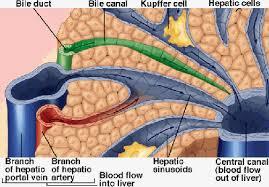
- Blood flow to and from the liver
- Oxygenated blood is supplied from the heart through the aorta via the hepatic artery into the liver. This goes to the liver cells, where aerobic respiration happens
- Deoxygenated blood enters from the digestive system via the hepatic portal vein. This blood will be full of toxic compounds from the intestines
- Blood leaves the liver via the hepatic vein which rejoins the vena cava. A 4th vessel is not a blood vessel, but is a bile duct and transports bile to the gall bladder
- Liver cells
- Hepatocytes appear to be unspecialised, but have a cuboidal shape with many microvilli on the surface
- They are used for protein synthesis, transformation and storage of carbohydrate. synthesis of cholesterol and bile salts, detoxification, etc
- Their cytoplasm is very dense and is specialised in the amount of organelles it has
- Kupffer cells
- Specialised macrophages which move within the sinusoids and break down and recycle old RBCs
- Functions
- Control of blood glucose levels, amino acid levels, and lipid levels
- Storage of vitamins A,B,D and iron, glycogen
- Synthesis of RBCs in fetus, bile, plasma proteins, cholesterol
- Detoxification of alcohol and drugs
- Breakdown of hormones
- Destruction of RBCs
- Blood flow to and from the liver
Formation of urea
- Deamination
- This produces ammonia, which is very toxic, but soluble, so it shouldn't accumulate
- The amino acid reacts with oxygen to form a keto acid and ammonia
- The keto acid produced can be used directly for respiration to release energy
- Ornithine cycle
- The ammonia produced is highly toxic so it must be converted into a less toxic substance quickly.
- The ammonia combines with carbon dioxide to produce urea
- Urea is less toxic and less soluble, so it can be passed into the blood and then filtered out in the kidneys
- The urea will be concentrated in the urine, which can be stored in the bladder until it is excreted
- Urea is made up of excess amino acids which have been treated to be excreted
- Deamination
Detoxification
- Alcohol
- Alcohol, or ethanol depresses nerve activity, but also contains a chemical potential energy which can be used for respiration
- Alcohol is broken down by hepatocytes by the action of the enzyme ethanol dehydrogenase to create ethanal
- Ethanal is then dehydrogenated further by ethanol dehydrogenase to produce ethanoate, which is combined with coenzyme A to form acetyl coenzyme A, which is used in respiration
- The hydrogen atoms used in this process are combined with another enzyme, NAD to created reduced NAD. This is also used to oxidise and breakdown fatty acids
- If there is too much alcohol and insufficient NAD, the fatty acids are converted back to lipids and are stored in hepatocytes, causing the liver to enlarge. This causes a condition called "fatty liver" which can lead to alcohol related hepatitis or cirrhosis
- The hydrogen atoms used in this process are combined with another enzyme, NAD to created reduced NAD. This is also used to oxidise and breakdown fatty acids
- Ethanal is then dehydrogenated further by ethanol dehydrogenase to produce ethanoate, which is combined with coenzyme A to form acetyl coenzyme A, which is used in respiration
- The liver detoxifies compounds in the body such as hydrogen peroxide and alcohol
- The liver contains many enzymes, such as catalase which can render certain toxins harmless
- Alcohol
Bilder und Dateien der Mindmap
Informationen
- Beschreibung
- AS Biology A2 Mindmap am Excretion, erstellt von singn014 am 11/09/2014.
- Erstellt von
- singn014
- Aufrufe
- 11
- Bewertung