
Mindmap
Language theorists (part 2)
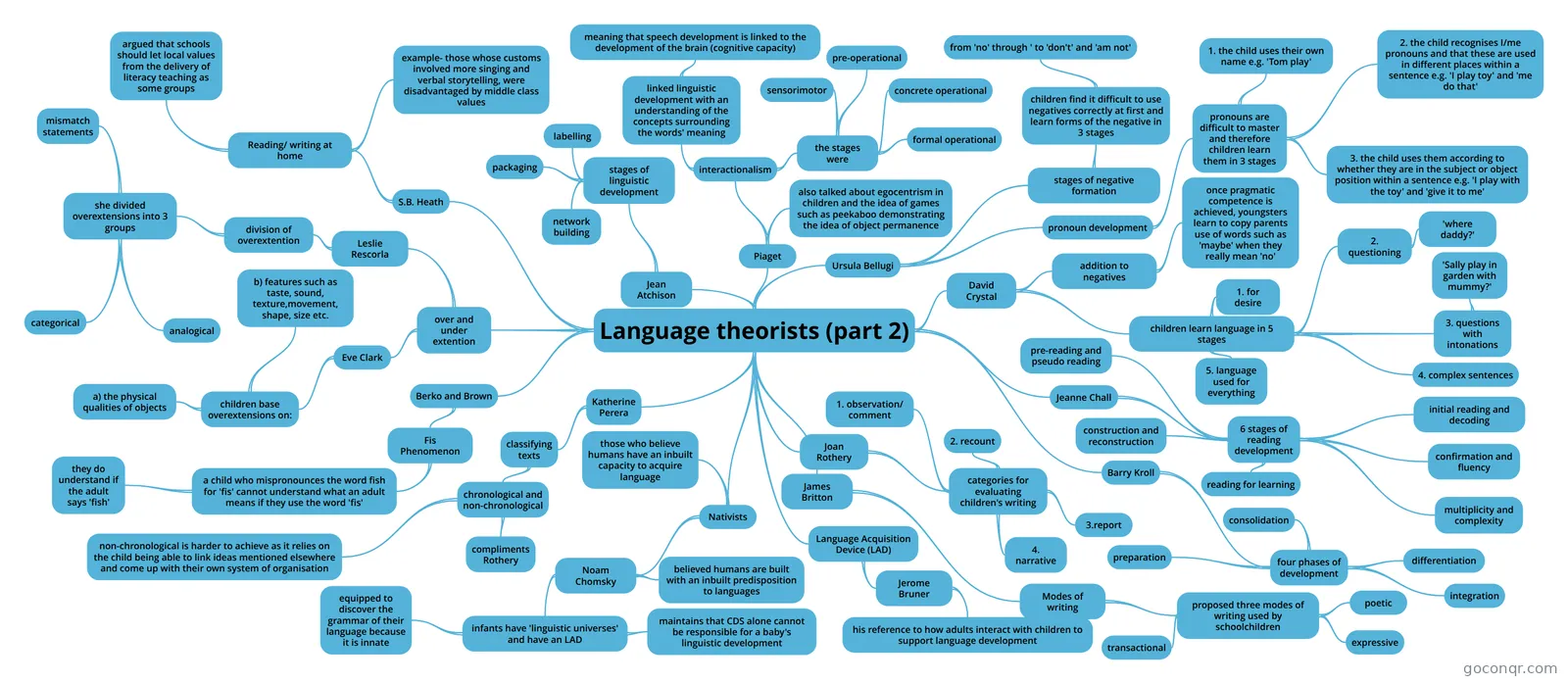
Mind map: language theorists part 2
Inhalt der Mindmap
Language theorists (part 2)
S.B. Heath
- Reading/ writing at home
- argued that schools should let local values from the delivery of literacy teaching as some groups
- example- those whose customs involved more singing and verbal storytelling, were disadvantaged by middle class values
- Reading/ writing at home
Jeanne Chall
- 6 stages of reading development
- pre-reading and pseudo reading
- initial reading and decoding
- confirmation and fluency
- reading for learning
- multiplicity and complexity
- construction and reconstruction
- 6 stages of reading development
Barry Kroll
- four phases of development
- preparation
- consolidation
- differentiation
- integration
- four phases of development
Joan Rothery
- categories for evaluating children's writing
- 1. observation/ comment
- 2. recount
- 3.report
- 4. narrative
- categories for evaluating children's writing
James Britton
- Modes of writing
- proposed three modes of writing used by schoolchildren
- expressive
- poetic
- transactional
- proposed three modes of writing used by schoolchildren
- Modes of writing
Language Acquisition Device (LAD)
- Jerome Bruner
- his reference to how adults interact with children to support language development
- Jerome Bruner
Nativists
- those who believe humans have an inbuilt capacity to acquire language
- Noam Chomsky
- believed humans are built with an inbuilt predisposition to languages
- infants have 'linguistic universes' and have an LAD
- equipped to discover the grammar of their language because it is innate
- maintains that CDS alone cannot be responsible for a baby's linguistic development
Katherine Perera
- classifying texts
- chronological and non-chronological
- non-chronological is harder to achieve as it relies on the child being able to link ideas mentioned elsewhere and come up with their own system of organisation
- compliments Rothery
- chronological and non-chronological
- classifying texts
Berko and Brown
- Fis Phenomenon
- a child who mispronounces the word fish for 'fis' cannot understand what an adult means if they use the word 'fis'
- they do understand if the adult says 'fish'
- a child who mispronounces the word fish for 'fis' cannot understand what an adult means if they use the word 'fis'
- Fis Phenomenon
over and under extention
- Eve Clark
- children base overextensions on:
- a) the physical qualities of objects
- b) features such as taste, sound, texture,movement, shape, size etc.
- children base overextensions on:
- Leslie Rescorla
- division of overextention
- she divided overextensions into 3 groups
- categorical
- analogical
- mismatch statements
- she divided overextensions into 3 groups
- division of overextention
- Eve Clark
Jean Atchison
- stages of linguistic development
- labelling
- packaging
- network building
- stages of linguistic development
Piaget
- interactionalism
- linked linguistic development with an understanding of the concepts surrounding the words' meaning
- meaning that speech development is linked to the development of the brain (cognitive capacity)
- the stages were
- sensorimotor
- pre-operational
- concrete operational
- formal operational
- linked linguistic development with an understanding of the concepts surrounding the words' meaning
- also talked about egocentrism in children and the idea of games such as peekaboo demonstrating the idea of object permanence
- interactionalism
Ursula Bellugi
- stages of negative formation
- children find it difficult to use negatives correctly at first and learn forms of the negative in 3 stages
- from 'no' through ' to 'don't' and 'am not'
- children find it difficult to use negatives correctly at first and learn forms of the negative in 3 stages
- pronoun development
- pronouns are difficult to master and therefore children learn them in 3 stages
- 1. the child uses their own name e.g. 'Tom play'
- 2. the child recognises I/me pronouns and that these are used in different places within a sentence e.g. 'I play toy' and 'me do that'
- 3. the child uses them according to whether they are in the subject or object position within a sentence e.g. 'I play with the toy' and 'give it to me'
- pronouns are difficult to master and therefore children learn them in 3 stages
- stages of negative formation
David Crystal
- addition to negatives
- once pragmatic competence is achieved, youngsters learn to copy parents use of words such as 'maybe' when they really mean 'no'
- children learn language in 5 stages
- 1. for desire
- 2. questioning
- 'where daddy?'
- 3. questions with intonations
- 'Sally play in garden with mummy?'
- 4. complex sentences
- 5. language used for everything
- addition to negatives
Informationen
- Beschreibung
- A2 Language Mindmap am Language theorists (part 2), erstellt von BethanMayStevenson am 22/10/2014.
- Erstellt von
- BethanMayStevenson
- Aufrufe
- 6
- Bewertung