
Mindmap
RELATIONSHIPS
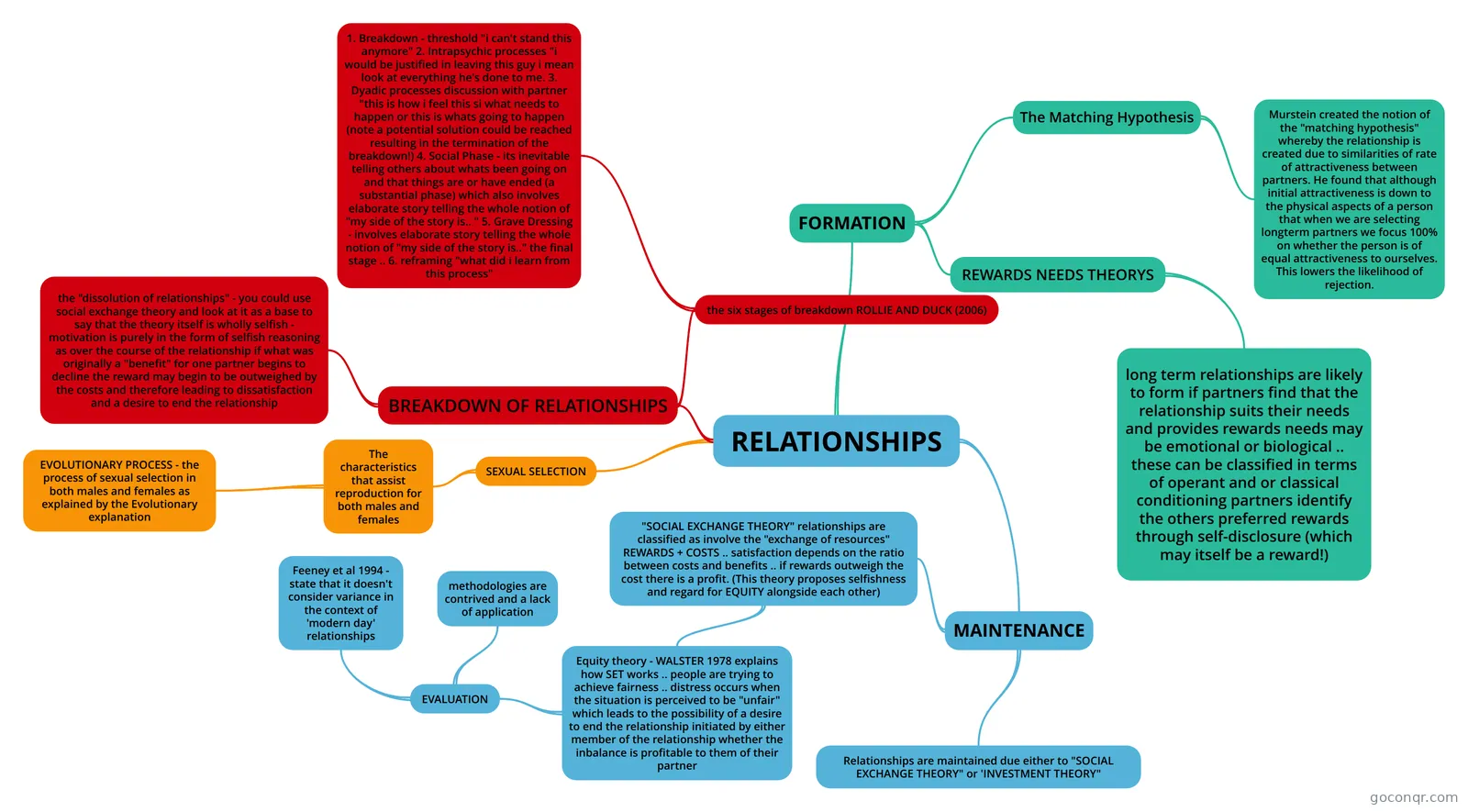
Mind map: relationships
Inhalt der Mindmap
RELATIONSHIPS
FORMATION
- The Matching Hypothesis
- Murstein created the notion of the "matching hypothesis" whereby the relationship is created due to similarities of rate of attractiveness between partners. He found that although initial attractiveness is down to the physical aspects of a person that when we are selecting longterm partners we focus 100% on whether the person is of equal attractiveness to ourselves. This lowers the likelihood of rejection.
- REWARDS NEEDS THEORYS
- long term relationships are likely to form if partners find that the relationship suits their needs and provides rewards needs may be emotional or biological .. these can be classified in terms of operant and or classical conditioning partners identify the others preferred rewards through self-disclosure (which may itself be a reward!)
- The Matching Hypothesis
MAINTENANCE
- Relationships are maintained due either to "SOCIAL EXCHANGE THEORY" or 'INVESTMENT THEORY"
- social exchange - the notion of maximise rewards and minimising costs investment theory - investments made contribute to stability e.g.; the greater the investment the greater the likelihood of maintaining the relationship
- "SOCIAL EXCHANGE THEORY" relationships are classified as involve the "exchange of resources" REWARDS + COSTS .. satisfaction depends on the ratio between costs and benefits .. if rewards outweigh the cost there is a profit. (This theory proposes selfishness and regard for EQUITY alongside each other)
- Equity theory - WALSTER 1978 explains how SET works .. people are trying to achieve fairness .. distress occurs when the situation is perceived to be "unfair" which leads to the possibility of a desire to end the relationship initiated by either member of the relationship whether the inbalance is profitable to them of their partner
- EVALUATION
- methodologies are contrived and a lack of application
- Feeney et al 1994 - state that it doesn't consider variance in the context of 'modern day' relationships
- EVALUATION
- Equity theory - WALSTER 1978 explains how SET works .. people are trying to achieve fairness .. distress occurs when the situation is perceived to be "unfair" which leads to the possibility of a desire to end the relationship initiated by either member of the relationship whether the inbalance is profitable to them of their partner
- Relationships are maintained due either to "SOCIAL EXCHANGE THEORY" or 'INVESTMENT THEORY"
BREAKDOWN OF RELATIONSHIPS
- the six stages of breakdown ROLLIE AND DUCK (2006)
- 1. Breakdown - threshold "i can't stand this anymore" 2. Intrapsychic processes "i would be justified in leaving this guy i mean look at everything he's done to me. 3. Dyadic processes discussion with partner "this is how i feel this si what needs to happen or this is whats going to happen (note a potential solution could be reached resulting in the termination of the breakdown!) 4. Social Phase - its inevitable telling others about whats been going on and that things are or have ended (a substantial phase) which also involves elaborate story telling the whole notion of "my side of the story is.. " 5. Grave Dressing - involves elaborate story telling the whole notion of "my side of the story is.." the final stage .. 6. reframing "what did i learn from this process"
- the "dissolution of relationships" - you could use social exchange theory and look at it as a base to say that the theory itself is wholly selfish - motivation is purely in the form of selfish reasoning as over the course of the relationship if what was originally a "benefit" for one partner begins to decline the reward may begin to be outweighed by the costs and therefore leading to dissatisfaction and a desire to end the relationship
- the six stages of breakdown ROLLIE AND DUCK (2006)
SEXUAL SELECTION
- The characteristics that assist reproduction for both males and females
- EVOLUTIONARY PROCESS - the process of sexual selection in both males and females as explained by the Evolutionary explanation
- The characteristics that assist reproduction for both males and females
Informationen
- Beschreibung
- A2 PSYCHOLOGY Mindmap am RELATIONSHIPS, erstellt von savmyers am 07/01/2015.
- Erstellt von
- savmyers
- Aufrufe
- 10
- Bewertung