
Mindmap
Evolution
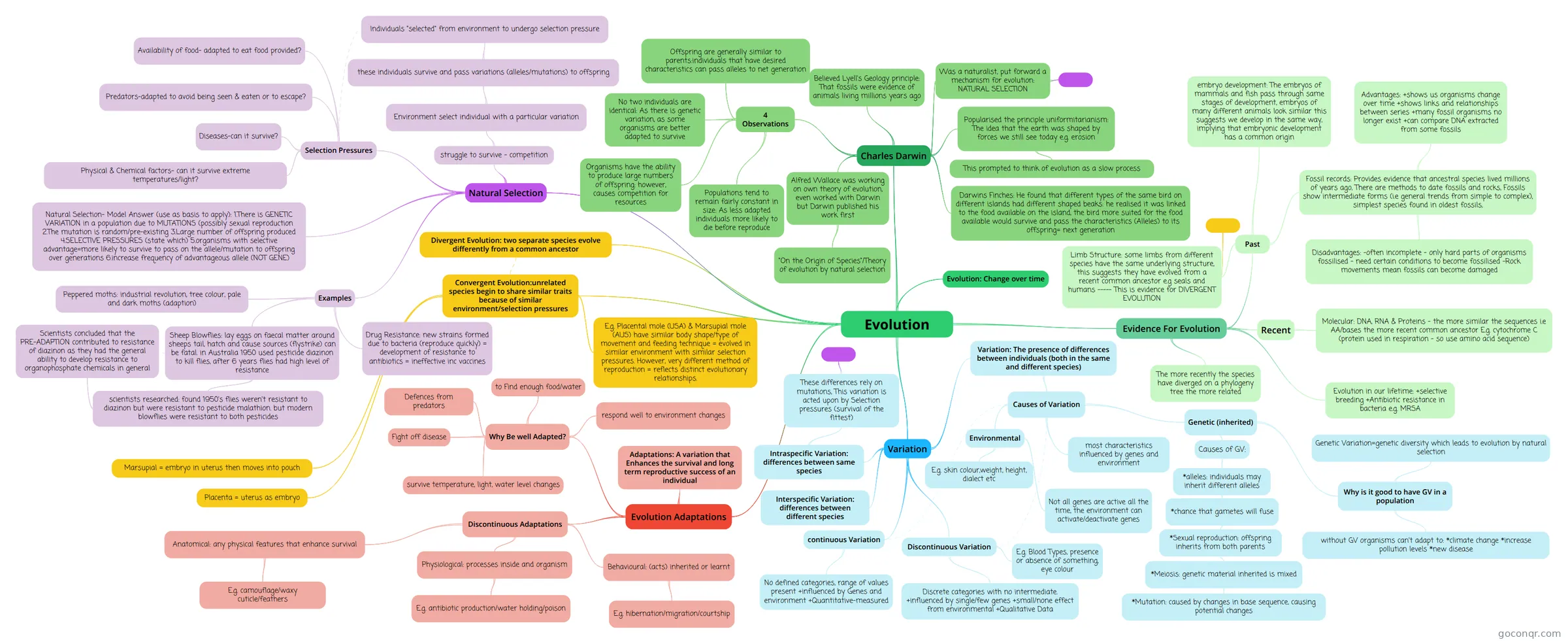
Mind map: Evolution
Inhalt der Mindmap
Evolution
Evolution: Change over time
Charles Darwin
- Was a naturalist, put forward a mechanism for evolution: NATURAL SELECTION
- Popularised the principle uniformitarianism: The idea that the earth was shaped by forces we still see today e.g. erosion
- This prompted to think of evolution as a slow process
- Believed Lyell's Geology principle: That fossils were evidence of animals living millions years ago
- Darwins Finches: He found that different types of the same bird on different islands had different shaped beaks: he realised it was linked to the food available on the island, the bird more suited for the food available would survive and pass the characteristics (Alleles) to its offspring= next generation
- Alfred Wallace was working on own theory of evolution, even worked with Darwin but Darwin published his work first
- "On the Origin of Species"/Theory of evolution by natural selection
- 4 Observations
- Offspring are generally similar to parents:individuals that have desired characteristics can pass alleles to net generation
- No two individuals are identical: As there is genetic variation, as some organisms are better adapted to survive
- Organisms have the ability to produce large numbers of offspring: however, causes competition for resources
- Populations tend to remain fairly constant in size: As less adapted individuals more likely to die before reproduce
- Was a naturalist, put forward a mechanism for evolution: NATURAL SELECTION
Evidence For Evolution
- Past
- Limb Structure: some limbs from different species have the same underlying structure, this suggests they have evolved from a recent common ancestor e.g seals and humans ----- This is evidence for DIVERGENT EVOLUTION
- embryo development: The embryos of mammals and fish pass through same stages of development, embryos of many different animals look similar this suggests we develop in the same way, implying that embryonic development has a common origin
- Fossil records: Provides evidence that ancestral species lived millions of years ago, There are methods to date fossils and rocks, Fossils show intermediate forms (i.e general trends from simple to complex), simplest species found in oldest fossils,
- Advantages: +shows us organisms change over time +shows links and relationships between series +many fossil organisms no longer exist +can compare DNA extracted from some fossils
- Disadvantages: -often incomplete - only hard parts of organisms fossilised - need certain conditions to become fossilised -Rock movements mean fossils can become damaged
- Limb Structure: some limbs from different species have the same underlying structure, this suggests they have evolved from a recent common ancestor e.g seals and humans ----- This is evidence for DIVERGENT EVOLUTION
- Recent
- Molecular: DNA, RNA & Proteins - the more similar the sequences i.e AA/bases the more recent common ancestor E.g. cytochrome C (protein used in respiration - so use amino acid sequence)
- The more recently the species have diverged on a phylogeny tree the more related
- Evolution in our lifetime: +selective breeding +Antibiotic resistance in bacteria e.g. MRSA
- Past
Variation
- continuous Variation
- No defined categories, range of values present +influenced by Genes and environment +Quantitative-measured
- Discontinuous Variation
- Discrete categories with no intermediate. +influenced by single/few genes +small/none effect from environmental +Qualitative Data
- E.g. Blood Types, presence or absence of something, eye colour
- Intraspecific Variation: differences between same species
- These differences rely on mutations, This variation is acted upon by Selection pressures (survival of the fittest)
- These differences rely on mutations, This variation is acted upon by Selection pressures (survival of the fittest)
- Interspecific Variation: differences between different species
- Variation: The presence of differences between individuals (both in the same and different species)
- Causes of Variation
- Genetic (inherited)
- Why is it good to have GV in a population
- Genetic Variation=genetic diversity which leads to evolution by natural selection
- without GV organisms can't adapt to: *climate change *increase pollution levels *new disease
- Causes of GV:
- *alleles: individuals may inherit different alleles
- *chance that gametes will fuse
- *Sexual reproduction: offspring inherits from both parents
- *Meiosis: genetic material inherited is mixed
- *Mutation: caused by changes in base sequence, causing potential changes
- *Meiosis: genetic material inherited is mixed
- *Sexual reproduction: offspring inherits from both parents
- *chance that gametes will fuse
- *alleles: individuals may inherit different alleles
- Why is it good to have GV in a population
- Environmental
- E.g. skin colour,weight, height, dialect etc
- Not all genes are active all the time, the environment can activate/deactivate genes
- most characteristics influenced by genes and environment
- Genetic (inherited)
- Causes of Variation
- continuous Variation
Evolution Adaptations
- Discontinuous Adaptations
- Anatomical: any physical features that enhance survival
- E.g. camouflage/waxy cuticle/feathers
- Physiological: processes inside and organism
- E.g. antibiotic production/water holding/poison
- Behavioural: (acts) inherited or learnt
- E.g. hibernation/migration/courtship
- Anatomical: any physical features that enhance survival
- Adaptations: A variation that Enhances the survival and long term reproductive success of an individual
- Why Be well Adapted?
- to Find enough food/water
- Defences from predators
- Fight off disease
- survive temperature, light, water level changes
- respond well to environment changes
- Discontinuous Adaptations
Natural Selection
- Natural Selection- Model Answer (use as basis to apply): 1.There is GENETIC VARIATION in a population due to MUTATIONS (possibly sexual reproduction 2.The mutation is random/pre-existing 3.Large number of offspring produced 4.SELECTIVE PRESSURES (state which) 5.organisms with selective advantage=more likely to survive to pass on the allele/mutation to offspring over generations 6.increase frequency of advantageous allele (NOT GENE)
- Examples
- Peppered moths: industrial revolution, tree colour, pale and dark moths (adaption)
- Sheep Blowflies: lay eggs on faecal matter around sheeps tail, hatch and cause sources (flystrike) can be fatal. in Australia 1950 used pesticide diazinon to kill flies, after 6 years flies had high level of resistance
- scientists researched: found 1950's flies weren't resistant to diazinon but were resistant to pesticide malathion. but modern blowflies were resistant to both pesticides
- Scientists concluded that the PRE-ADAPTION contributed to resistance of diazinon as they had the general ability to develop resistance to organophosphate chemicals in general
- scientists researched: found 1950's flies weren't resistant to diazinon but were resistant to pesticide malathion. but modern blowflies were resistant to both pesticides
- Drug Resistance: new strains formed due to bacteria (reproduce quickly) = development of resistance to antibiotics = ineffective inc vaccines
- struggle to survive - competition
- Environment select individual with a particular variation
- these individuals survive and pass variations (alleles/mutations) to offspring
- Individuals "selected" from environment to undergo selection pressure
- these individuals survive and pass variations (alleles/mutations) to offspring
- Environment select individual with a particular variation
- Selection Pressures
- Availability of food- adapted to eat food provided?
- Predators-adapted to avoid being seen & eaten or to escape?
- Diseases-can it survive?
- Physical & Chemical factors- can it survive extreme temperatures/light?
Convergent Evolution:unrelated species begin to share similar traits because of similar environment/selection pressures
- E.g. Placental mole (USA) & Marsupial mole (AUS) have similar body shape/type of movement and feeding technique = evolved in similar environment with similar selection pressures. However, very different method of reproduction = reflects distinct evolutionary relationships.
- Placenta = uterus as embryo
- Marsupial = embryo in uterus then moves into pouch
Divergent Evolution: two separate species evolve differently from a common ancestor
Informationen
- Beschreibung
- A level Biology (Module 4) Mindmap am Evolution, erstellt von Amy Cornwell am 23/06/2019.
- Erstellt von
- Amy Cornwell
- Aufrufe
- 1
- Bewertung