
Mindmap
Organisational Groupings
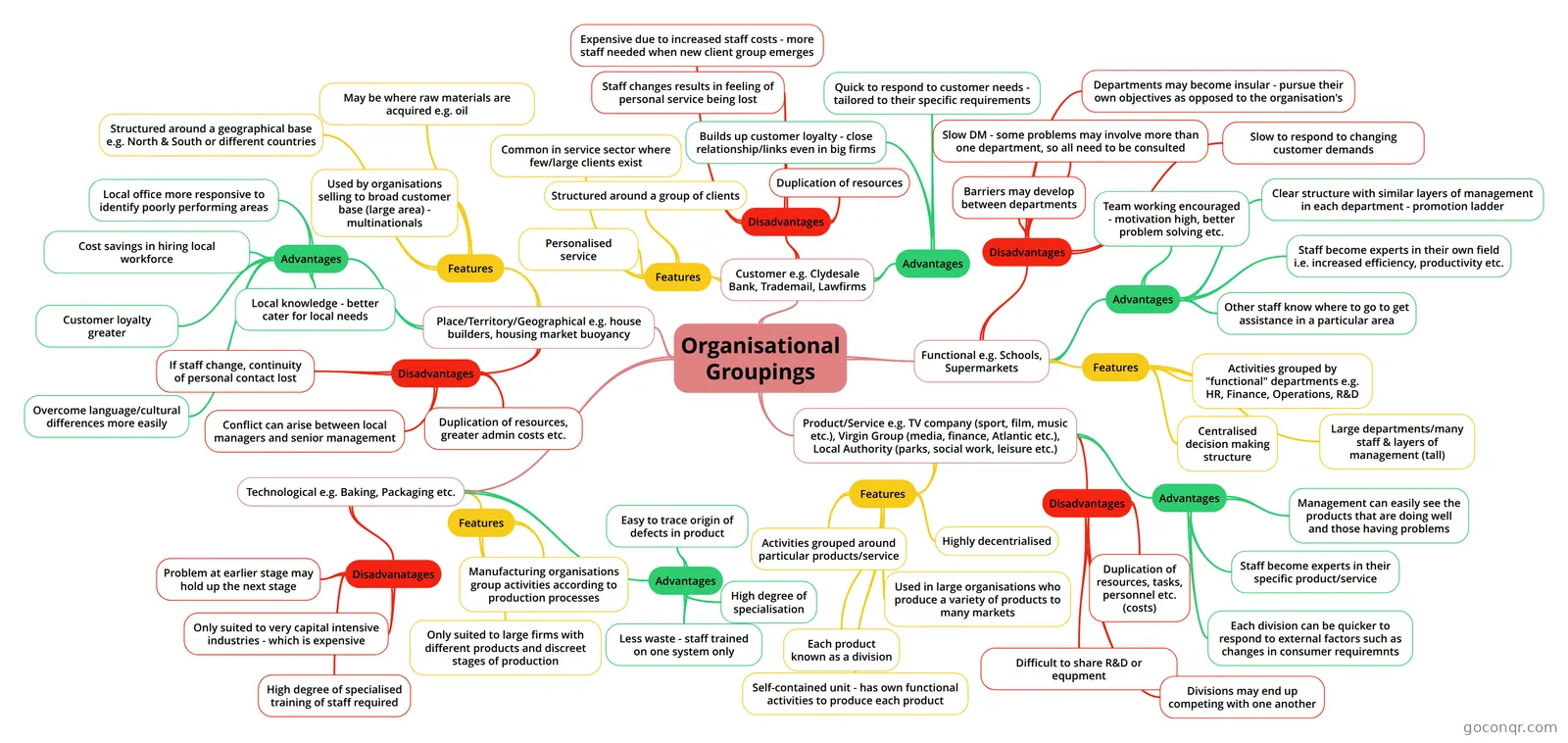
Mind map: organisational groupings
Inhalt der Mindmap
Organisational Groupings
Functional e.g. Schools, Supermarkets
- Features
- Centralised decision making structure
- Activities grouped by "functional" departments e.g. HR, Finance, Operations, R&D
- Large departments/many staff & layers of management (tall)
- Advantages
- Other staff know where to go to get assistance in a particular area
- Staff become experts in their own field i.e. increased efficiency, productivity etc.
- Clear structure with similar layers of management in each department - promotion ladder
- Team working encouraged - motivation high, better problem solving etc.
- Disadvantages
- Slow to respond to changing customer demands
- Barriers may develop between departments
- Departments may become insular - pursue their own objectives as opposed to the organisation's
- Slow DM - some problems may involve more than one department, so all need to be consulted
- Features
Product/Service e.g. TV company (sport, film, music etc.), Virgin Group (media, finance, Atlantic etc.), Local Authority (parks, social work, leisure etc.)
- Advantages
- Management can easily see the products that are doing well and those having problems
- Staff become experts in their specific product/service
- Each division can be quicker to respond to external factors such as changes in consumer requiremnts
- Features
- Activities grouped around particular products/service
- Each product known as a division
- Highly decentrialised
- Self-contained unit - has own functional activities to produce each product
- Used in large organisations who produce a variety of products to many markets
- Disadvantages
- Difficult to share R&D or equpment
- Divisions may end up competing with one another
- Duplication of resources, tasks, personnel etc. (costs)
- Advantages
Customer e.g. Clydesale Bank, Trademail, Lawfirms
- Advantages
- Builds up customer loyalty - close relationship/links even in big firms
- Quick to respond to customer needs - tailored to their specific requirements
- Disadvantages
- Duplication of resources
- Expensive due to increased staff costs - more staff needed when new client group emerges
- Staff changes results in feeling of personal service being lost
- Features
- Structured around a group of clients
- Personalised service
- Common in service sector where few/large clients exist
- Advantages
Technological e.g. Baking, Packaging etc.
- Advantages
- High degree of specialisation
- Less waste - staff trained on one system only
- Easy to trace origin of defects in product
- Features
- Manufacturing organisations group activities according to production processes
- Only suited to large firms with different products and discreet stages of production
- Disadvanatages
- Problem at earlier stage may hold up the next stage
- High degree of specialised training of staff required
- Only suited to very capital intensive industries - which is expensive
- Advantages
Place/Territory/Geographical e.g. house builders, housing market buoyancy
- Disadvantages
- Duplication of resources, greater admin costs etc.
- If staff change, continuity of personal contact lost
- Conflict can arise between local managers and senior management
- Advantages
- Local knowledge - better cater for local needs
- Overcome language/cultural differences more easily
- Customer loyalty greater
- Cost savings in hiring local workforce
- Local office more responsive to identify poorly performing areas
- Features
- Used by organisations selling to broad customer base (large area) - multinationals
- May be where raw materials are acquired e.g. oil
- Structured around a geographical base e.g. North & South or different countries
- Disadvantages
Informationen
- Beschreibung
- Nationals Business (Unit 1: Understanding Business) Mindmap am Organisational Groupings, erstellt von hiyakirstin am 21/01/2015.
- Erstellt von
- hiyakirstin
- Aufrufe
- 1
- Bewertung