
Mindmap
Chapter 7
Inhalt der Mindmap
Chapter 7
Essential nutrients of a bacterial cell
- CHNOPS
- carbon, oxygen, nitrogen,hydrogen,phosphorus,sulfur
Macronutrient
- required in large quantities, important role in cell structure and metabolism
Micronutrient
- trace elements, present in smaller amounts and sometimes necessary to make proper proteins
Organisms energy sources
- Heterotrophs: obtain carbon in organic form
- Autotrophs: use inorganic CO2 as carbon source. Able to convert CO2 into organic compounds. Not dependent of others
- Photoautotrophs: photosynthetic, convert solar energy into chemical energy
- Chemoautotrophs: use organic compounds for energy and inorganic compounds as a carbon source.
- Lithoautotrophs: rely only on inorganic minerals and NO sunlight
- Methanogens: produce methane from CO2 and H2
Saprobe:
- free living microorganisms that feed primarily on organic detritus from dead organisms. They are heterotrophs
Parasites:
- derive nutrients from the cells or tissues of a living host
- symbiotic( org. live in close nutritional relationships req by one or both members) associations microbes can have with host
- commensialism: the member called the 'commensal' recieves all of the benefits while the other party is not benefitting or hurting
- mutualistic:(++) organisms live in a obligatory but mutually beneficial relationship.
- parasitism: host organism provides the microbe with nutrients and habitat
- nonsymbiotic (free living relationships not required for survival) relationships microbes can have with host
- synergism: members cooperate and share nutrients
- antagonism: some members are inhibited or destroyed by others
Diffusion
- when atoms/molecules move in a gradient from high to low concentration
Osmosis
- diffusion of water through a selectively permeable membrane
Isotonic/hypotonic/hypertonic
- isotonic: environment is = in solute conc. to the cells internal environment
- hypotonic: solute concentration of the external environment is lower than that of the cells internal environment
- hypertonic: environment has a higher solute concentration that that of the cytoplasm, brings h2o out
Passive transport: energy is not required
- diffusion
- facilitated diffusion
Active transport: energy required
- Bulk transport
- mass transport of large particles or cells through phagocytosis
- carrier mediated active transport
- atoms/molecules are pumped into or out of the cell by specialized receptors. Driven by ATP
- group translocation
- molecule is moved across membrane and simultaneously made into a metabolically useful molecule
- Bulk transport
5 bacteria types with temp pref
- Psychrophiles
- optimum temp below 15 degrees C
- mesophiles
- optimum growth between 20-40 degrees C
- Thermophiles
- optimum temp between 45 degrees C to 80 degrees C
- Hyperthermophiles
- 80 to 120 degrees C
- Psychrophiles
3 physical factors microbes must contend with
- Capnophiles: organisms that need a higher CO2 tension
- Barophiles: deep sea microbes that exist under hydrostatic pressures ranging from 1000 times Atm pressure
- Alkalinophiles: found in basic conditions
- halophiles: prefer to live in salty conditions
Biofilms
- antibiotics do not cure them
- single bacteria attaches to a surface, stimulated to release chemicals.
- can monitor the cell population size
- microbes in a biofilm are not free floating like planktonic bact.
BINARY FISSION
- The major way bacteria divide. Meaning one cell becomes two.
- Parent cell enlarges, duplicates its chromosomes, and then starts to pull its cell envelope together in the center or the cell using a band of proteins. Cell wall forms a septum and this process divides the cell into two daughter cells.
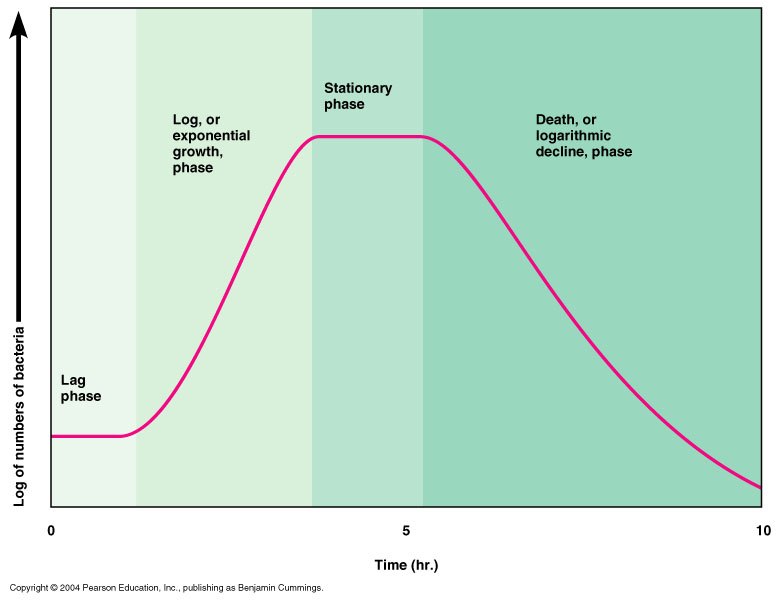
BACTERIAL GROWTH CURVE
- doubling time:the time required for a complete fission cycle, from parent to two new daughter cells.
- exponential growth: 2 raised to the power of the generation, to figure out the cell pop. 2^2
- 4 phases
- 1. Lag Phase
- cells are freshly inoculated and are adjusting, growing, and synthesizing
- 2. Exp. growth phase
- the curve increases geometrically. will continue with proper nutrients and good environ.
- 3. Stationary phase
- pop enters a survival mode where cells stop growing or grow slowly.
- 4.Death phase
- conditions are toxic and most cells die off but some are still viable
- 1. Lag Phase
- can also count bac. with turbidity, colony counts, and direct cell counts
Bilder und Dateien der Mindmap
Informationen
- Beschreibung
- Microbiology Mindmap am Chapter 7, erstellt von Kayla Boose am 15/10/2013.
- Erstellt von
- Kayla Boose
- Aufrufe
- 24
- Tags
- Bewertung