
Mindmap
Carbon Cycling
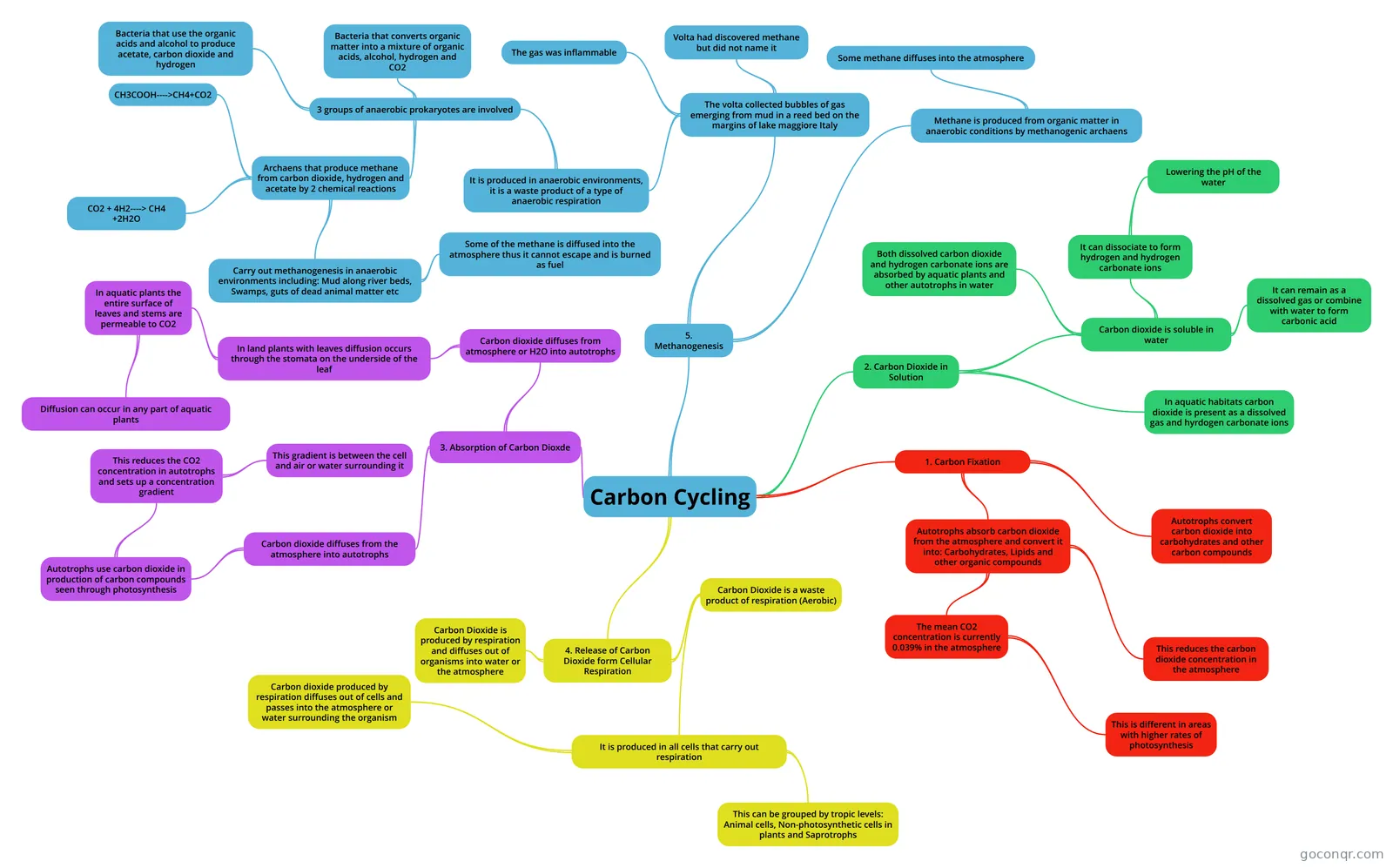
Mind map: Carbon cycling
Inhalt der Mindmap
Carbon Cycling
1. Carbon Fixation
- Autotrophs convert carbon dioxide into carbohydrates and other carbon compounds
- Autotrophs absorb carbon dioxide from the atmosphere and convert it into: Carbohydrates, Lipids and other organic compounds
- This reduces the carbon dioxide concentration in the atmosphere
- The mean CO2 concentration is currently 0.039% in the atmosphere
- This is different in areas with higher rates of photosynthesis
2. Carbon Dioxide in Solution
- In aquatic habitats carbon dioxide is present as a dissolved gas and hyrdogen carbonate ions
- Carbon dioxide is soluble in water
- It can remain as a dissolved gas or combine with water to form carbonic acid
- It can dissociate to form hydrogen and hydrogen carbonate ions
- Lowering the pH of the water
- Both dissolved carbon dioxide and hydrogen carbonate ions are absorbed by aquatic plants and other autotrophs in water
3. Absorption of Carbon Dioxde
- Carbon dioxide diffuses from the atmosphere into autotrophs
- Autotrophs use carbon dioxide in production of carbon compounds seen through photosynthesis
- This reduces the CO2 concentration in autotrophs and sets up a concentration gradient
- This gradient is between the cell and air or water surrounding it
- This reduces the CO2 concentration in autotrophs and sets up a concentration gradient
- Autotrophs use carbon dioxide in production of carbon compounds seen through photosynthesis
- Carbon dioxide diffuses from atmosphere or H2O into autotrophs
- In land plants with leaves diffusion occurs through the stomata on the underside of the leaf
- In aquatic plants the entire surface of leaves and stems are permeable to CO2
- Diffusion can occur in any part of aquatic plants
- In aquatic plants the entire surface of leaves and stems are permeable to CO2
- In land plants with leaves diffusion occurs through the stomata on the underside of the leaf
- Carbon dioxide diffuses from the atmosphere into autotrophs
4. Release of Carbon Dioxide form Cellular Respiration
- Carbon Dioxide is produced by respiration and diffuses out of organisms into water or the atmosphere
- Carbon Dioxide is a waste product of respiration (Aerobic)
- It is produced in all cells that carry out respiration
- This can be grouped by tropic levels: Animal cells, Non-photosynthetic cells in plants and Saprotrophs
- Carbon dioxide produced by respiration diffuses out of cells and passes into the atmosphere or water surrounding the organism
- It is produced in all cells that carry out respiration
5. Methanogenesis
- Methane is produced from organic matter in anaerobic conditions by methanogenic archaens
- Some methane diffuses into the atmosphere
- The volta collected bubbles of gas emerging from mud in a reed bed on the margins of lake maggiore Italy
- The gas was inflammable
- Volta had discovered methane but did not name it
- It is produced in anaerobic environments, it is a waste product of a type of anaerobic respiration
- 3 groups of anaerobic prokaryotes are involved
- Bacteria that converts organic matter into a mixture of organic acids, alcohol, hydrogen and CO2
- Bacteria that use the organic acids and alcohol to produce acetate, carbon dioxide and hydrogen
- Archaens that produce methane from carbon dioxide, hydrogen and acetate by 2 chemical reactions
- CO2 + 4H2----> CH4 +2H2O
- CH3COOH---->CH4+CO2
- Carry out methanogenesis in anaerobic environments including: Mud along river beds, Swamps, guts of dead animal matter etc
- Some of the methane is diffused into the atmosphere thus it cannot escape and is burned as fuel
- 3 groups of anaerobic prokaryotes are involved
- Methane is produced from organic matter in anaerobic conditions by methanogenic archaens