
Mindmap
MEDIA INFLUENCE
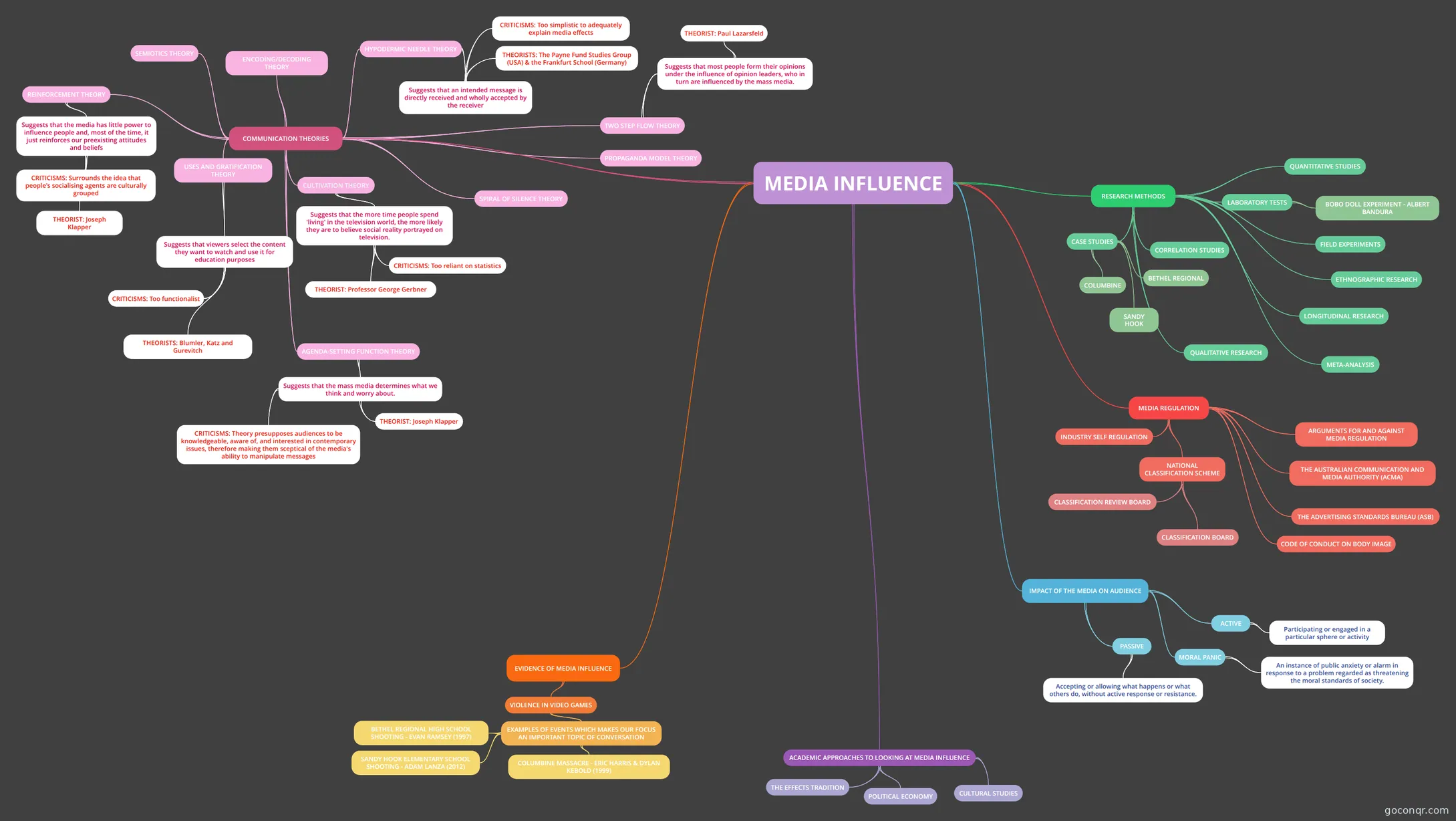
Mind map: media influence
Inhalt der Mindmap
MEDIA INFLUENCE
COMMUNICATION THEORIES
- HYPODERMIC NEEDLE THEORY
- Suggests that an intended message is directly received and wholly accepted by the receiver
- THEORISTS: The Payne Fund Studies Group (USA) & the Frankfurt School (Germany)
- CRITICISMS: Too simplistic to adequately explain media effects
- Suggests that an intended message is directly received and wholly accepted by the receiver
- AGENDA-SETTING FUNCTION THEORY
- Suggests that the mass media determines what we think and worry about.
- CRITICISMS: Theory presupposes audiences to be knowledgeable, aware of, and interested in contemporary issues, therefore making them sceptical of the media's ability to manipulate messages
- THEORIST: Joseph Klapper
- Suggests that the mass media determines what we think and worry about.
- CULTIVATION THEORY
- Suggests that the more time people spend 'living' in the television world, the more likely they are to believe social reality portrayed on television.
- THEORIST: Professor George Gerbner
- CRITICISMS: Too reliant on statistics
- Suggests that the more time people spend 'living' in the television world, the more likely they are to believe social reality portrayed on television.
- SPIRAL OF SILENCE THEORY
- PROPAGANDA MODEL THEORY
- REINFORCEMENT THEORY
- Suggests that the media has little power to influence people and, most of the time, it just reinforces our preexisting attitudes and beliefs
- THEORIST: Joseph Klapper
- CRITICISMS: Surrounds the idea that people's socialising agents are culturally grouped
- Suggests that the media has little power to influence people and, most of the time, it just reinforces our preexisting attitudes and beliefs
- TWO STEP FLOW THEORY
- Suggests that most people form their opinions under the influence of opinion leaders, who in turn are influenced by the mass media.
- THEORIST: Paul Lazarsfeld
- Suggests that most people form their opinions under the influence of opinion leaders, who in turn are influenced by the mass media.
- USES AND GRATIFICATION THEORY
- Suggests that viewers select the content they want to watch and use it for education purposes
- THEORISTS: Blumler, Katz and Gurevitch
- CRITICISMS: Too functionalist
- Suggests that viewers select the content they want to watch and use it for education purposes
- SEMIOTICS THEORY
- ENCODING/DECODING THEORY
- HYPODERMIC NEEDLE THEORY
IMPACT OF THE MEDIA ON AUDIENCE
- ACTIVE
- Participating or engaged in a particular sphere or activity
- PASSIVE
- Accepting or allowing what happens or what others do, without active response or resistance.
- MORAL PANIC
- An instance of public anxiety or alarm in response to a problem regarded as threatening the moral standards of society.
- ACTIVE
RESEARCH METHODS
- CASE STUDIES
- COLUMBINE
- SANDY HOOK
- BETHEL REGIONAL
- LABORATORY TESTS
- BOBO DOLL EXPERIMENT - ALBERT BANDURA
- LONGITUDINAL RESEARCH
- CORRELATION STUDIES
- QUALITATIVE RESEARCH
- QUANTITATIVE STUDIES
- META-ANALYSIS
- ETHNOGRAPHIC RESEARCH
- FIELD EXPERIMENTS
- CASE STUDIES
MEDIA REGULATION
- ARGUMENTS FOR AND AGAINST MEDIA REGULATION
- NATIONAL CLASSIFICATION SCHEME
- CLASSIFICATION BOARD
- CLASSIFICATION REVIEW BOARD
- THE AUSTRALIAN COMMUNICATION AND MEDIA AUTHORITY (ACMA)
- THE ADVERTISING STANDARDS BUREAU (ASB)
- CODE OF CONDUCT ON BODY IMAGE
- INDUSTRY SELF REGULATION
EVIDENCE OF MEDIA INFLUENCE
- VIOLENCE IN VIDEO GAMES
- EXAMPLES OF EVENTS WHICH MAKES OUR FOCUS AN IMPORTANT TOPIC OF CONVERSATION
- COLUMBINE MASSACRE - ERIC HARRIS & DYLAN KEBOLD (1999)
- SANDY HOOK ELEMENTARY SCHOOL SHOOTING - ADAM LANZA (2012)
- BETHEL REGIONAL HIGH SCHOOL SHOOTING - EVAN RAMSEY (1997)
- EXAMPLES OF EVENTS WHICH MAKES OUR FOCUS AN IMPORTANT TOPIC OF CONVERSATION
- VIOLENCE IN VIDEO GAMES
ACADEMIC APPROACHES TO LOOKING AT MEDIA INFLUENCE
- THE EFFECTS TRADITION
- CULTURAL STUDIES
- POLITICAL ECONOMY