
Mindmap
Biology
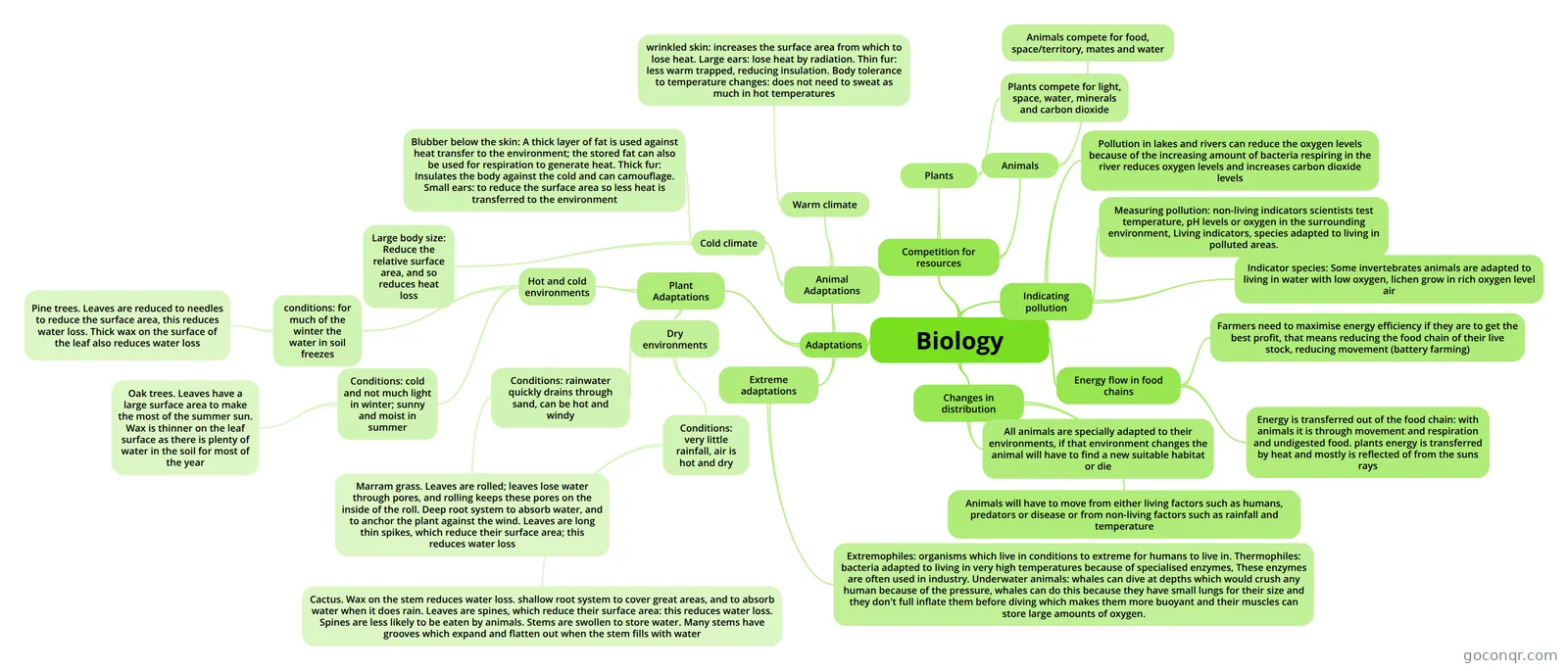
Mind map: Biology adaptations and food chains
Inhalt der Mindmap
Biology
Competition for resources
- Plants
- Plants compete for light, space, water, minerals and carbon dioxide
- Animals
- Animals compete for food, space/territory, mates and water
- Plants
Changes in distribution
- All animals are specially adapted to their environments, if that environment changes the animal will have to find a new suitable habitat or die
- Animals will have to move from either living factors such as humans, predators or disease or from non-living factors such as rainfall and temperature
Indicating pollution
- Measuring pollution: non-living indicators scientists test temperature, pH levels or oxygen in the surrounding environment, Living indicators, species adapted to living in polluted areas.
- Pollution in lakes and rivers can reduce the oxygen levels because of the increasing amount of bacteria respiring in the river reduces oxygen levels and increases carbon dioxide levels
- Indicator species: Some invertebrates animals are adapted to living in water with low oxygen, lichen grow in rich oxygen level air
Energy flow in food chains
- Energy is transferred out of the food chain: with animals it is through movement and respiration and undigested food. plants energy is transferred by heat and mostly is reflected of from the suns rays
- Farmers need to maximise energy efficiency if they are to get the best profit, that means reducing the food chain of their live stock, reducing movement (battery farming)
Adaptations
- Animal Adaptations
- Cold climate
- Blubber below the skin: A thick layer of fat is used against heat transfer to the environment; the stored fat can also be used for respiration to generate heat. Thick fur: Insulates the body against the cold and can camouflage. Small ears: to reduce the surface area so less heat is transferred to the environment
- Large body size: Reduce the relative surface area, and so reduces heat loss
- Warm climate
- wrinkled skin: increases the surface area from which to lose heat. Large ears: lose heat by radiation. Thin fur: less warm trapped, reducing insulation. Body tolerance to temperature changes: does not need to sweat as much in hot temperatures
- Cold climate
- Plant Adaptations
- Hot and cold environments
- conditions: for much of the winter the water in soil freezes
- Pine trees. Leaves are reduced to needles to reduce the surface area, this reduces water loss. Thick wax on the surface of the leaf also reduces water loss
- Conditions: cold and not much light in winter; sunny and moist in summer
- Oak trees. Leaves have a large surface area to make the most of the summer sun. Wax is thinner on the leaf surface as there is plenty of water in the soil for most of the year
- conditions: for much of the winter the water in soil freezes
- Dry environments
- Conditions: rainwater quickly drains through sand, can be hot and windy
- Marram grass. Leaves are rolled; leaves lose water through pores, and rolling keeps these pores on the inside of the roll. Deep root system to absorb water, and to anchor the plant against the wind. Leaves are long thin spikes, which reduce their surface area; this reduces water loss
- Conditions: very little rainfall, air is hot and dry
- Cactus. Wax on the stem reduces water loss. shallow root system to cover great areas, and to absorb water when it does rain. Leaves are spines, which reduce their surface area: this reduces water loss. Spines are less likely to be eaten by animals. Stems are swollen to store water. Many stems have grooves which expand and flatten out when the stem fills with water
- Conditions: rainwater quickly drains through sand, can be hot and windy
- Hot and cold environments
- Extreme adaptations
- Extremophiles: organisms which live in conditions to extreme for humans to live in. Thermophiles: bacteria adapted to living in very high temperatures because of specialised enzymes, These enzymes are often used in industry. Underwater animals: whales can dive at depths which would crush any human because of the pressure, whales can do this because they have small lungs for their size and they don't full inflate them before diving which makes them more buoyant and their muscles can store large amounts of oxygen.
- Animal Adaptations
Informationen
- Beschreibung
- Mindmap am Biology, erstellt von matt3957 am 19/11/2013.
- Erstellt von
- matt3957
- Aufrufe
- 31
- Bewertung