
Mindmap
Conformity
Inhalt der Mindmap
Conformity
Asch's baseline procedure
- Asch wanted to asses to what extent people will conform to the opinion of others, even in a situation where the answer is certain (unanimous).
- The procedure of his original study is called the baseline study as it is the one that similar experiments are compared to.
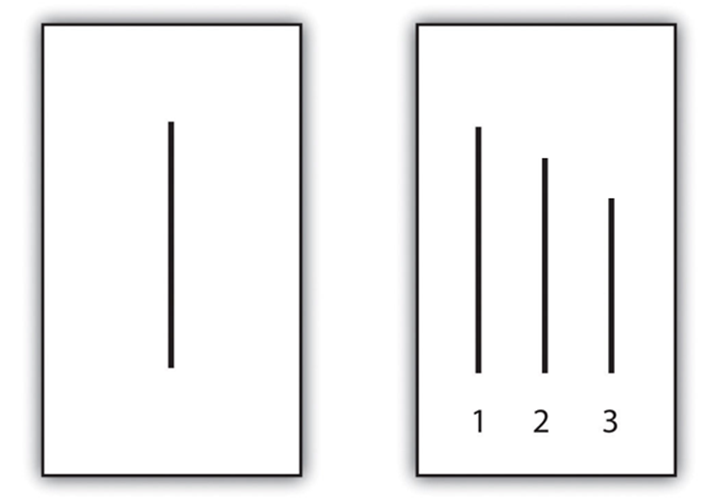
- 123 American men were tested, each in a group with other pp. Each pp saw two large cards the second card had 3 lines and pp were asked which of the three line was most similar to the original line.
- Pps were tested in groups of 6-8. Only one was a genuine pp, always seated last or second last. The others were all confederates, they all gave the same incorrect answers.
- On average the genuine pp agreed with confederates incorrect answers 36.8% of the time.
- Pps were tested in groups of 6-8. Only one was a genuine pp, always seated last or second last. The others were all confederates, they all gave the same incorrect answers.
Variables investigated by Asch
- Group size
- Asch wanted to know whether the size of the group would be more important than the agreement of the group.
- To test this he varied the number of confederates from one to 15
- Asch found a curvilinear relationship between group size and and conformity rate
- Conformity increased with group size but only to a certain point.
- With three confederates, conformity rose to 32.8%. But the presence of more confederates made little difference.
- Conformity increased with group size but only to a certain point.
- Asch found a curvilinear relationship between group size and and conformity rate
- To test this he varied the number of confederates from one to 15
- This suggests that most people are very sensitive to the views of others, becasue just one or two confedrates was enough to sway opinion.
- Asch wanted to know whether the size of the group would be more important than the agreement of the group.
- Unanimity
- Asch wondered if the presence of a non-conforming person would affect the pp's conformity.
- He introduced a confederate that disagreed with the other confederates.
- In one variation he gave the correct answer and in another he gave a different wrong answer
- The pp conformed less in the presence of a dissenter.
- The rate decreased to less than a quater of the level that it was when the majority is unanimous.
- The presence of a dissenter appeared to free the pp to behave more independently. This was true even when the dissenter disagreed with the pp.
- This suggests that the influence of the majority depends to a large extent on it being unanimous, and that non-conformity is more likely when cracks are perceived in the majority's unanimous view.
- The presence of a dissenter appeared to free the pp to behave more independently. This was true even when the dissenter disagreed with the pp.
- The rate decreased to less than a quater of the level that it was when the majority is unanimous.
- The pp conformed less in the presence of a dissenter.
- In one variation he gave the correct answer and in another he gave a different wrong answer
- He introduced a confederate that disagreed with the other confederates.
- Asch wondered if the presence of a non-conforming person would affect the pp's conformity.
- Task difficulty
- Asch wanted to know whether making the task harder would affect the degree of conformity.
- He increased the difficulty of the line-judgement task by making the stimulus line and the comparison lines more similar in length, this mean it became harder for pp's to see the differences between the lines.
- Asch found that conformity increased. It may be that the situation is moreambigous when the task becomes harder. It is natural to look to other people and for guidence and to assume they are right (ISI)
- He increased the difficulty of the line-judgement task by making the stimulus line and the comparison lines more similar in length, this mean it became harder for pp's to see the differences between the lines.
- Asch wanted to know whether making the task harder would affect the degree of conformity.
- Group size
Evaluation
- Artificial situation
- One limitation of Asch's research is that the task and situation were artificial.
- Limited application
- Research support.
- Artificial situation
Bilder und Dateien der Mindmap
Informationen
- Beschreibung
- Paper 1 Social influence (conformity) revision
- Erstellt von
- Dhiaan Tatlah
- Aufrufe
- 22
- Tags
- Bewertung