
Mindmap
Speciation
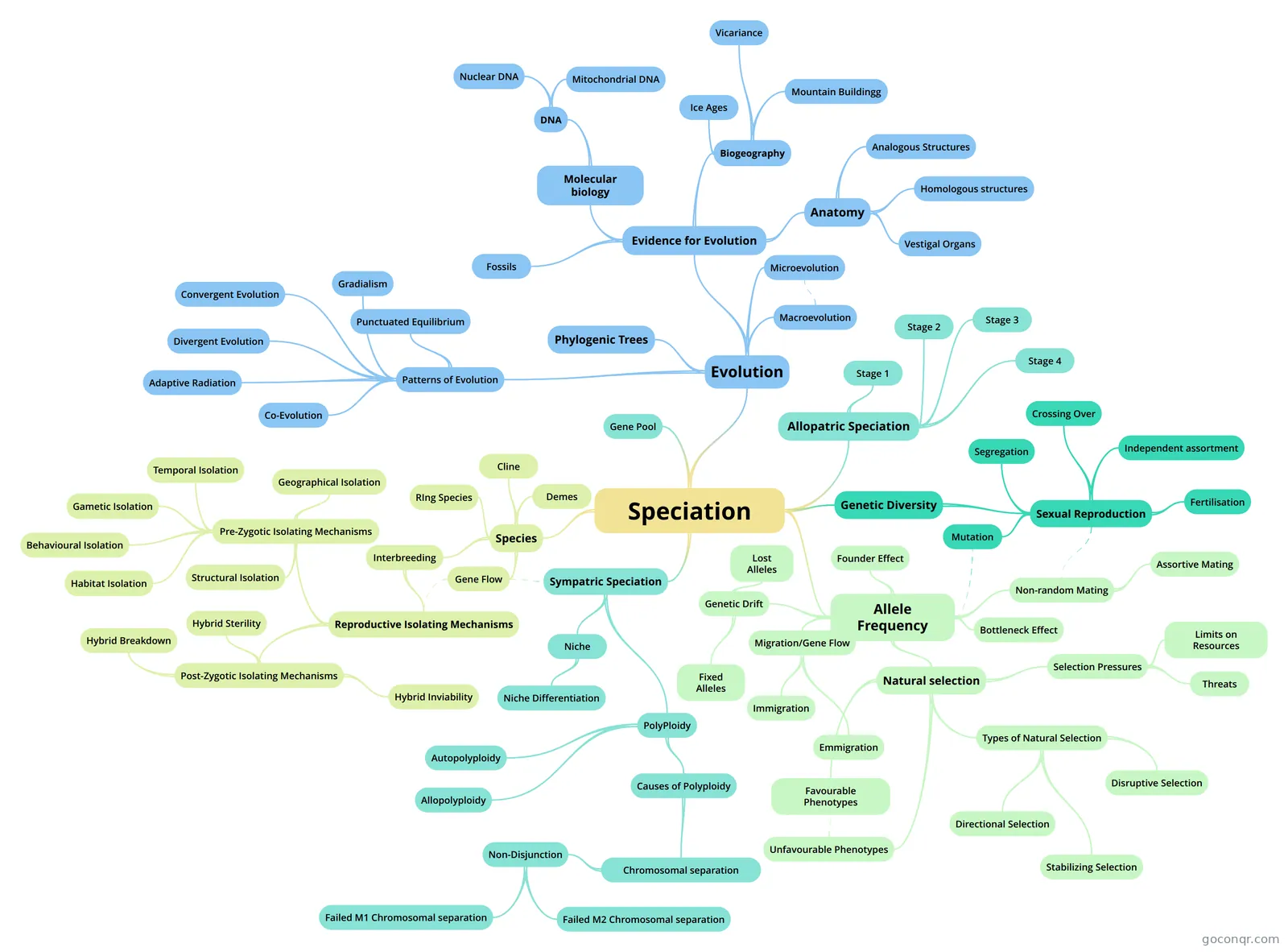
Mind map: Speciation
Inhalt der Mindmap
Speciation
- Definition: The process by which new species form
Species
- Definition: A group of organisms that can potentially interbreed with one another to produce viable, fertile offspring
- Demes
- A species usually exists as distinct populations may be separated geographically. These local interbreeding populations are called demes. Organisms mostly interbreed within the deme rather than with members of other populations, therefore, demes often develop slightly different allele frequencies, giving each different characteristics.
- Cline
- A gradual change in phenotypic characters from one part of a species range to another Usually associated with environmental factors such as temperature or altitude and latitude
- Example: The alpine buttercup (Ranunculus insignis) grows on most mountain ranges between south Canterbury and the East Cape. It typically occurs on south-facing slopes between 1200 and 1800m, though it may be found at lower levels on cliffs. Several characteristics show variation with latitude including Stem height, number of lobes on the leaf margin.
- RIng Species
- Occurs when two apparently different species in one area are joined by a series of geographical and structural intermediates.
- Ensatina is a ring species, with different subspecies living at different locations. One set of Ensatina live in the Sierra Nevada Mountains. The other set live in the Coast Range. Their ranges make a horseshoe around the Central Valley. The subspecies at the ends of the horseshoe are very different from one another.
- Interbreeding
- Different species do not interbreed because there is some kind of barrier to gene flow between them.
- Reproductive Isolating Mechanisms
- A reproductive isolating mechanism is a barrier that prevents two organisms from differing species from mating and producing fertile offspring. They prevent gene flow. Isolation can occur before fertilisation (pre-zygotic barriers) or after fertilisation (post-zygotic barriers).
- Pre-Zygotic Isolating Mechanisms
- These act before fertilization to prevent successful reproduction
- Geographical Isolation
- Results from physical barriers such as mountains, rivers and oceans.
- Habitat Isolation
- Different species may occupy different habitats with the same geographical area
- Temporal Isolation
- Differences in activity or breeding times (day, season, year) For example, closely related species may have quite different breeding seasons or species may never meet. e.g. one may have become nocturnal and the other diurnal
- Structural Isolation
- Structural differences in the anatomy of reproductive organs prevent the delivery or acceptance of gametes
- Gametic Isolation
- The sperm and egg are not compatible – they can’t fuse and form a viable zygote
- Behavioural Isolation
- Courtship rituals and behaviour signals are species specific. These behaviours ensure mating within species.
- Post-Zygotic Isolating Mechanisms
- These act after fertilisation to prevent successful reproduction.
- Hybrid Inviability
- A zygote is formed but fails to develop properly. For example - Tigers and leopards can mate but the fetus is miscarried or stillborn.
- Hybrid Sterility
- Even if two species mate and produce offspring, the offspring may be sterile. One cause of this sterility is the failure of meiosis to produce normal gametes. This can occur if parents are different in chromosome number.
- Hybrid Breakdown
- The first generation offspring (F1) are fertile, but the second generation (F2) are infertile or inviable.
- Gene Flow
- The transfer of genetic material (genes) from one population to another
Evolution
- Definition: A change in the gene pool from population to population
- Microevolution
- Definition: Small scale changes within gene pool over populations
- To Note: Microevolutionary processes occuring over thousands or millions of years can add up to large-scale changes that define a new species or group
- Macroevolution
- Definition: Evolutionary changes on a large scale that occur over extended periods of time involving whole groups of species
- Evidence for Evolution
- Fossils
- Fossils are the preserved remains of previously living organisms or their traces, dating from the distant past. Fossils document the existence of now-extinct past species that are related to present-day species. For many different types of organisms, the fossil record shows how the organism has changed over time through the process of evolution
- Fossils are often contained in rocks that build up in layers called strata. The strata provide a sort of timeline, with layers near the top being newer and layers near the bottom being older. Fossils found in different strata at the same site can be ordered by their positions, and "reference" strata with unique features can be used to compare the ages of fossils across locations. In addition, scientists can roughly date fossils using radiometric dating, a process that measures the radioactive decay of certain elements.
- Anatomy
- Species may share similar physical features because the feature was present in a common ancestor (homologous structures).
- Homologous structures
- Show similarity in characteristics resulting from a common ancestry but different functions Same structure but different functions, e.g. forelimbs in mammals and birds.
- Analogous Structures
- Analogous structures are similar features that have evolved independently in unrelated species due to similar environmental pressures
- Vestigal Organs
- Vestigial organs are structures present in an organism that have no clear function. E.g., tail bones in humans, leg bones in a snake, wing bones in a kiwi
- Biogeography
- The study of the geographical distribution of species. Some groups of organisms are similar but are found on landmasses that are geographically separated.The global distribution of organisms and the unique features of island species reflect evolution and geological change.
- Mountain Buildingg
- Effect = populations of organisms on either side of the Alps geographically isolated Effect = new alpine environment = lots of vacant niches = speciation
- Ice Ages
- Effect = Species formerly separated by geographical barrier of sea were now not separated allowing gene flow Effect = Some rivers that previously ran into the sea separately, now joined before reaching the sea allowing populations to mix Effect = Some populations would become geographically isolated by glaciation
- Vicariance
- Vicariance = the geographical separation of a population, typically by a physical barrier such as a mountain range or river, resulting in a pair of closely related species.
- Molecular biology
- DNA and the genetic code reflect the shared ancestry of life. DNA comparisons can show how related species are. As the organisms evolve, their DNA sequences accumulate mutations: - A larger number of differences corresponds to less related species. - A smaller number of differences corresponds to more related species
- The genetic code is ‘universal’- the same for all species. At the most basic level, all livingorganisms share:- The same genetic material (DNA) - The same basic process of gene expression (transcription and translation)- The same molecular building blocks, such as amino acids. If two organisms have evolved from a common ancestor a long time ago, we would expect their DNA to be quite different as there has been lots of time for differences (mutations) to accumulate
- DNA
- The molecule containing all of the genetic information of an organism.
- Mitochondrial DNA
- Mitochondrial DNA (mtDNA) found in the mitochondria can also be analysed to determine relatedness and when species diverged. mtDNA:- Never undergoes recombination - Is passed down the maternal lineage - Acquires mutations at a constant rate, so the presence of mutations in mtDNA can be compared to determine when species diverged.
- Nuclear DNA
- Nuclear DNA refers to the genetic material found in the nucleus of a cell Two species have the "same" gene because they inherited it from a common ancestor The more DNA differences in homologous genes (or amino acid differences in the proteins they encode) between two species, the more distantly the species are related.
- Fossils
- Phylogenic Trees
- Phylogeny is the study of evolutionary relationships. A phylogenetic tree is a diagram that represents evolutionary relationships among organisms. The pattern of branching in a phylogenetic tree reflects how species or other groups evolved from a series of common ancestors.Can be constructed using physical morphology, behaviours, fossils or molecular information (DNA, mtDNA, amino acid sequences)
- When a lineage splits, it is represented as branching on a phylogeny. The tips of the tree represent groups of descendants (often species) and the nodes (points where lines meet) on the tree represent the common ancestors of those descendants. Two species are more related if they have a more recent common ancestor, and less related if they have a less recent common ancestor.
- The length of a branch in a phylogenetic tree represents the amount of change or difference that has occurred in that part of the tree. i.e. the longer a branch the larger the amount of change.
- A clade (also known as a monophyletic group) is a group of organisms that includes a single ancestor and all of its descendants. It’s easy to identify a clade using a phylogenetic tree. Just imagine clipping any single branch off the tree. All the lineages on that branch form a clade. If you have to make more than one cut to separate a group of organisms from the rest of the tree, that group does not form a clade
- Patterns of Evolution
- Convergent Evolution
- Divergent Evolution
- Adaptive Radiation
- Co-Evolution
- Gradialism
- Punctuated Equilibrium
Gene Pool
- The total of all the alleles present in a population at any one time
Genetic Diversity
- The differences in genetic make-up of a gene pool. Having many different combinations of alleles (i.e. large population) may offer a survival advantage to a species if conditions change.
- Mutations and immigration increase genetic diversity. Natural selection, emigration, non-random mating and genetic drift decrease genetic diversity
- Sexual Reproduction
- Sexual reproduction occurs when the sperm from the male parent fertilizes an egg from the female parent, producing an offspring that is genetically different.
- Mutation
- A permanent change to the DNA base sequence of an organism. Mutations create new alleles in a gene pool Mutations are rare and random A mutation must occur in gamete, and that gamete be fertilised and grow to an individual to enter the gene pool of the population Any mutation that enters a gene pool is acted upon by natural selection
- Mutations increase genetic diversity
- Independent assortment
- The alleles of two (or more) different genes get sorted into gametes independently of one another. In other words, the allele a gamete receives for one gene does not influence the allele received for another gene.
- Crossing Over
- The exchange of DNA between paired homologous chromosomes (one from each parent) that occurs during the development of egg and sperm cells (meiosis).
- Segregation
- The separation of paired alleles (versions of a gene) during gamete formation (meiosis) so that each gamete (sperm or egg) carries only one allele of each pair.
- Fertilisation
- Fertilisation is the process in which the nucleus of a sperm cell fuses with the nucleus of an egg cell to produce a zygote.
Allele Frequency
- The percentage of each allele in a gene pool
- Migration/Gene Flow
- Gene flow is the movement of alleles between populations
- Immigration
- Immigration is the entracnce of an organism/group of organisms into a population, resilting in new allele combinations.
- Immigration increases genetic diversity
- Emmigration
- Emmigration is when an organism/group of organisms leave a population, resulting in a loss of alleles from the original population.
- Emigration decreases genetic diversity
- Genetic Drift
- Not all individuals contribute their genes to the next generation. As a result, random changes occur in allele frequencies in all populations. Genetic drift is the random changes in allele frequencies due to chance. Drift tends to increase variation between populations – potentially leading to speciation
- Lost Alleles
- Lost from the gene pool (frequency = 0%)
- Fixed Alleles
- Fixed as the only allele present in the gene pool (frequency = 100%)
- Founder Effect
- Founder effect is when a new population is established by a small number of individuals from an original larger population The new population will have a small and probably non-representative sample of alleles from the parent population’s gene pool. Likely to be less genetic diversity in the founder population The founder population will not have the full range of alleles as the main population, which may lead to differences between them increasing over time
- Bottleneck Effect
- Population bottleneck is a significant reduction in the size of a population often due to a catastrophic event or human impact (e.g. hunting, volcanic eruption) The small sample that survives are unlikely to be representative of the original gene pool By chance alleles may be overrepresented among survivors, some may be lost completely
- Natural selection
- Natural selection is the process where individuals best adapted to their environment will survive AND reproduce and pass these favourable alleles to their offspring Natural selection decreases genetic diversity. Populations typically produce more offspring than environmental resources can maintain – there is a competition for survival. Individuals with the best adaptations/ phenotypes to a particular environment will survive and reproduce – natural selection These “fitter” survivors will pass of their alleles to their offspring
- Selection Pressures
- Selection pressures are factors which affect an organism’s fitness or ability to survive and reproduce in an environment.
- Limits on Resources
- Threats
- Favourable Phenotypes
- A phenotype that is favourable will be selected for and the alleles become established in the gene pool as the individual’s chance of survival AND successful reproduction are increased.
- Unfavourable Phenotypes
- A phenotype that is harmful is unlikely to become established, as it will be selected against, due to the individual’s chances of survival AND successful reproduction being reduced.
- Types of Natural Selection
- The direction of selection is dependent on how the environment changes over time. In stable conditions, natural selection mainly acts against change (stabilising selection) Directional selection is usually a consequence of rapid, human-induced environmental change.
- Stabilizing Selection
- Stabilising Selection favours the intermediate phenotype (have the highest fitness) and selects against two extreme phenotypes: •Predominates when environments are stable •Reduces genetic diversity
- In stable conditions, natural selection mainly acts against change – stabilising selection. Stabilising selection reduces diversity by favouring intermediate phenotypes and selecting against extreme phenotypes.An example of this is seen in robins. Robins typically lay four eggs, an example of stabilising selection. A larger number of eggs may result in malnourished chicks, while a smaller number of eggs may result in no viable offspring.
- Directional Selection
- Directional Selection favours the phenotype of one extreme over the average or other extremes. •Consequence of changes in environmental conditions •Causes the allele frequency to shift over time in the direction of that phenotype.
- Directional selection occurs when a phenotype towards one end of the range is favoured over other phenotypes, causing the allele frequency to shift over time in the direction of that phenotype. the advantageous allele increases in frequency as a consequence of differences in fitness among different phenotypes and over time may become fixed. Directional selection has no effect on the amount of genetic variation in a population as it causes one extreme of a trait to be selected over the other extreme. This causes the distribution pattern of the trait to shift in the direction favoured by natural selection.
- Disruptive Selection
- Disruptive Selection favours both extremes at the expense of the average. May occur when environments are fluctuating. Increases diversity
- Disruptive selection increases diversity by favouring extreme phenotypes, which may then be further selected for. May lead to niche differentiation. This type of selection promotes further divergence and may eventually lead to speciation of the species, if gene flow between both populations are restricted long enough.
- Non-random Mating
- In non-random mating, organisms may prefer to mate with others of the same genotype or of different genotypes.
- Non random mating decreases genetc variation
- Assortive Mating
- Assortive mating is an individual’s preference to mate with partners who are phenotypically similar to themselves.
Allopatric Speciation
- Allopatric species: Closely related species still geographically separated. Allopatric speciation is the formation of new species from ancestral species when original gene flow was stopped by a geographical barrier. Allopatric speciation describes the formation of a new species when gene flow is stopped by a geographical barrier. Isolated populations are subjected to different selection pressures and over time become reproductively isolated and diverge into different species.Allo = different, patric = homeland
- STAGE 1: Moving into new environments The parent population expands its range and occupies new parts of the environment. The population has a common gene pool with regular gene flow STAGE 2: Geographical isolation Gradual formation of geological barriers (e.g. formation of rivers, mountains) may isolate parts of the population As a consequence, gene flow between these isolated populations is prevented STAGE 3: Formation of a subspecies The isolated populations may be subjected to quite different selection pressures. These selection pressures will favor those individuals with traits suited to each environment. Allele frequencies for certain genes change forming sub-species. STAGE 4: Reproductive isolation Each separated subspecies undergoes changes in its genetic makeup and behavior. This will prevent mating with individuals from other populations. Each subspecies’ gene pool becomes reproductively isolated from the others.
- Summary: A single species population | v A barrier physically isolates parts of a population. No gene flow. Isolated areas have different selection pressures| v Genetic differences accumulate because of natural selection, mutation and genetic drift| vThe gene pool changes to an extent that reproductive isolation occurs & separate species form
- 1.Gene flow stops due to the geographical isolation (individuals of the two regions don’t breed and share genetic material). 2.Each population experiences differences in selection pressures. Genetic drift and different random mutations occur in each population. 3.In time the populations will become genetically and phenotypically different. 4.Reproductive isolation occurs and they have formed two new species.
- Stage 2
- STAGE 2: Geographical Isolation Gradual formation of geological barriers (formation of rivers/mountains) may isolate parts of the population As a consequence, gene flow between these isolated populations is prevented.
- Stage 4
- STAGE 4: Reproductive isolation Each seperated sub-species undergoes changes in its genetic makeup and behaviour. This will prevent mating with individuals from other populations.
- Stage 1
- STAGE 1: Moving to new environments The parent population expands its range and occupies a new part of the environment. The population has a common gene pool with regular gene flow
- Stage 3
- STAGE 3: Formation of a sub-species The isolated population(s) may be subjected to quite different selection pressures. These selection pressures will favor those inddividuals with traits suited to each environment. Allele frequencies for certain sub-species change, forming sub-species.
Sympatric Speciation
- Sympatric speciation is where two populations are in the same area and gene flow is stopped by a non-geographical barrier. Sym = together Patra = homeland Sympatric species are species, which previously diverged from a common ancestor, and now exist in the same area but remain reproductively isolated
- Gene flow between the populations is interrupted due to niche differences or reproductive isolation
- Niche
- Niche includes •What it eats •Activity patterns •Exactly where in a habitat a species lives •Exactly where in a habitat a species feeds No two species can fill the same niche
- Niche Differentiation
- Niche differentiation (or resource partitioning) refers to the process by which natural selection drives competing populations into different patterns of resource use or different niches. Species can differentiate their niches in many ways, such as using different resource, occupying a different area of the habitat, or feeding during a different time of day.
- PolyPloidy
- Presence of 3 or more sets of chromosomes in a body cell Poly meaning multiple (>2)Ploidy meaning number of chromosome sets in a cell or organismPolyploidy = many (>2)sets of chromosomes in a cell or organism
- Example: Humans are diploid Di meaning 2 ploid meaning sets of chromosomes in a cell or organism Diploid meaning two sets of chromosomes in a cell or organism (one copy of each chromosome from each parent)
- The number of chromosome copies per cell is 'n' So, diploid organisms like humans have 2n In polyploidy individuals, they can have 3n, 4n, etc...
- Polyploidy can result in sympatric speciation as organisms with different chromosome counts typically cannot interbreed as they are usually sexually incompatible (incapable of producing viable offspring) Therefore, polyploidy creates a barrier to reproduction that can result in speciation.
- Causes of Polyploidy
- Polyploidy results from the failure of chromosomes to seperate during meiosis because the 'spindle' doesn't form properly. Polyploidy results in instant speciation as polyploids cannot reproduce with the parent species due to the difference in chromosome count. The resulting organism is therefore genetically and reproductively unique - making it a new species.
- Chromosomal separation
- The process of chromosomal separation during meiosis: 1. Spindle fibres (protein structures) form at each end of the cell and attach to the centromere (point of contact between sister chromatids in each chromosome) 2. Spindle fibres contract, pulling homologues (homologous chromosomes) apart and to each end of the cell. Sister chromatids stay together. 3. The cell divides, separating each end of the cell into a new gamete. These gametes are haploid cells because they have one chromosome (consisting of two chromatids) from each homologous pair. 4. New spindle fibres seperate sister chromatids, pulling sister chromatids apart and to each end of the cell. 5. The cell divides, separating each end of the cell into a haploid gamete with one sister chromatid for each chromosome (pair of chromatids). This produces a total of four gametes (haploid). 2n single-> n double -> n single
- Non-Disjunction
- a failure of homologous chromosomes or sister chromatids to separate properly during cell division, specifically during meiosis. This results in gametes with an abnormal number of chromosomes
- Failed M2 Chromosomal separation
- It is the cell division of n double to n single where things go wrong in M2 chromosomal separation failure. 4. New spindle fibres form which attach to the centromere and pull them apart, but some of the chromatids don't seperate, meaning that entire chromosomes (2 sister chromatids) are pulled to each end of the cell. 5. The cell divides, separating the ends of the cell into new gametes. Due to the failed separation of chromatids, some gametes end up as diploid cells (two sets of chromosomes) and some gametes have a complete absence of certain chromosomes.
- Failed M1 Chromosomal separation
- 1. Spindle fibres (protein structures) form at each end of the cell and attach to the centromere (point of contact between sister chromatids in each chromosome) 2. Spindle fibres contract, pulling some homologues to each end of the cell while other homologues remain connected - leading to entire homologous chromosome sets being pulled to each side of the cell rather than being evenly separated into homologues. 3. The cell divides, separating each end of the cell into a new gamete. Due to the abnormal separation (or lack thereof) the gametes don't contain the correct number of chromosomes, with some gametes containing three homologues - including one homologous pair - and other gametes containing only one homologue. 4. New spindle fibres seperate sister chromatids, pulling sister chromatids apart and to each end of the cell. Due to the abnormal separation of homologues in M1, the separation of sister chromatids in M2 results in an abnormal number of chromatids pulled to each end of the cell.
- Allopolyploidy
- Autopolyploidy
Informationen
- Beschreibung
- NCEA Level 3 Biology Mindmap am Speciation, erstellt von Emma van Schalkwyk am 28/03/2025.
- Erstellt von
- Emma van Schalkwyk
- Aufrufe
- 0
- Bewertung