
Mindmap
Weimar Republic
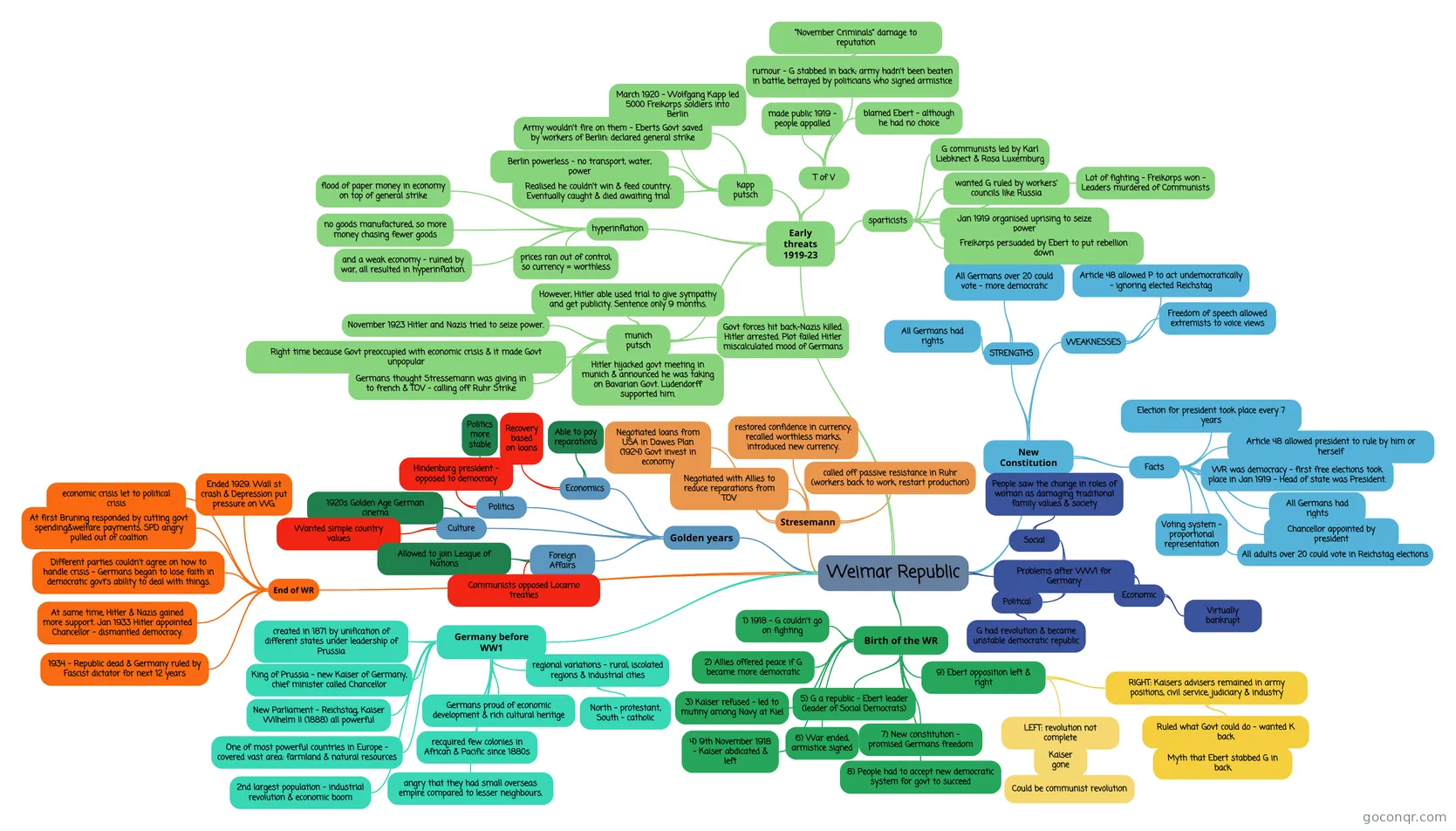
Mind map: Weimar Republic
Inhalt der Mindmap
Weimar Republic
Germany before WW1
- created in 1871 by unification of different states under leadership of Prussia
- King of Prussia - new Kaiser of Germany, chief minister called Chancellor
- New Parliament - Reichstag, Kaiser Wilhelm II (1888) all powerful
- One of most powerful countries in Europe - covered vast area: farmland & natural resources
- 2nd largest population - industrial revolution & economic boom
- Germans proud of economic development & rich cultural heritige
- recquired few colonies in African & Pacific since 1880s
- angry that they had small overseas empire compared to lesser neighbours.
- regional variations - rural, iscolated regions & industrial cities
- North - protestant, South - catholic
Birth of the WR
- 1) 1918 - G couldn't go on fighting
- 2) Allies offered peace if G became more democratic
- 3) Kaiser refused - led to mutiny among Navy at Kiel
- 4) 9th November 1918 - Kaiser abdicated & left
- 5) G a republic - Ebert leader (leader of Social Democrats)
- 6) War ended, armistice signed
- 7) New constitution - promised Germans freedom
- 8) People had to accept new democratic system for govt to succeed
- 9) Ebert opposition left & right
- LEFT: revolution not complete
- Kaiser gone
- Could be communist revolution
- Kaiser gone
- RIGHT: Kaisers advisers remained in army positions, civil service, judiciary & industry
- Ruled what Govt could do - wanted K back
- Myth that Ebert stabbed G in back
- Ruled what Govt could do - wanted K back
- LEFT: revolution not complete
Problems after WW1 for Germany
- Social
- People saw the change in roles of woman as damaging traditional family values & society
- Political
- G had revolution & became unstable democratic republic
- Economic
- Virtually bankrupt
- Social
New Constitution
- Facts
- WR was democracy - first free elections took place in Jan 1919 - Head of state was President.
- All Germans had rights
- Chancellor appointed by president
- All adults over 20 could vote in Reichstag elections
- Voting system - proportional representation
- Election for president took place every 7 years
- Article 48 allowed president to rule by him or herself
- STRENGTHS
- All Germans had rights
- All Germans over 20 could vote - more democratic
- WEAKNESSES
- Article 48 allowed P to act undemocratically - ignoring elected Reichstag
- Freedom of speech allowed extremists to voice views
- Facts
Early threats 1919-23
- sparticists
- G communists led by Karl Liebknect & Rosa Luxemburg
- wanted G ruled by workers' councils like Russia
- Jan 1919 organised uprising to seize power
- Freikorps persuaded by Ebert to put rebellion down
- Lot of fighting - Freikorps won - Leaders murdered of Communists
- T of V
- made public 1919 - people appalled
- blamed Ebert - although he had no choice
- rumour - G stabbed in back: army hadn't been beaten in battle, betrayed by politicians who signed armistice
- "November Criminals" damage to reputation
- kapp putsch
- March 1920 - Wolfgang Kapp led 5000 Freikorps soldiers into Berlin
- Army wouldn't fire on them - Eberts Govt saved by workers of Berlin: declared general strike
- Berlin powerless - no transport, water, power
- Realised he couldn't win & feed country. Eventually caught & died awaiting trial
- hyperinflation
- flood of paper money in economy on top of general strike
- no goods manufactured, so more money chasing fewer goods
- and a weak economy - ruined by war, all resulted in hyperinflation.
- prices ran out of control, so currency = worthless
- munich putsch
- November 1923 Hitler and Nazis tried to seize power.
- Right time because Govt preoccupied with economic crisis & it made Govt unpopular
- Germans thought Stressemann was giving in to french & TOV - calling off Ruhr Strike
- Hitler hijacked govt meeting in munich & announced he was taking on Bavarian Govt. Ludendorff supported him.
- Govt forces hit back-Nazis killed. Hitler arrested. Plot failed Hitler miscalculated mood of Germans
- However, Hitler able used trial to give sympathy and get publicity. Sentence only 9 months.
- sparticists
Stresemann
- called off passive resistance in Ruhr (workers back to work, restart production)
- restored confidence in currency, recalled worthless marks, introduced new currency.
- Negotiated loans from USA in Dawes Plan (1924) Govt invest in economy
- Negotiated with Allies to reduce reparations from TOV
Golden years
- Economics
- Able to pay reparations
- Recovery based on loans
- Politics
- Politics more stable
- Hindenburg president - opposed to democracy
- Culture
- 1920s Golden Age German cinema
- Wanted simple country values
- Foreign Affairs
- Allowed to join League of Nations
- Communists opposed Locarno treaties
- Economics
End of WR
- Ended 1929. Wall st crash & Depression put pressure on WG.
- economic crisis let to political crisis
- At first Bruning responded by cutting govt spending&welfare payments. SPD angry pulled out of coaltion
- Different parties couldn't agree on how to handle crisis - Germans began to lose faith in democratic govt's ability to deal with things.
- At same time, Hitler & Nazis gained more support. Jan 1933 Hitler appointed Chancellor - dismantled democracy.
- 1934 - Republic dead & Germany ruled by Fascist dictator for next 12 years
Informationen
- Beschreibung
- Mindmap am Weimar Republic, erstellt von storm.baron7 am 28/11/2015.
- Erstellt von
- storm.baron7
- Aufrufe
- 1
- Bewertung