
Mindmap
punctuation test part 1
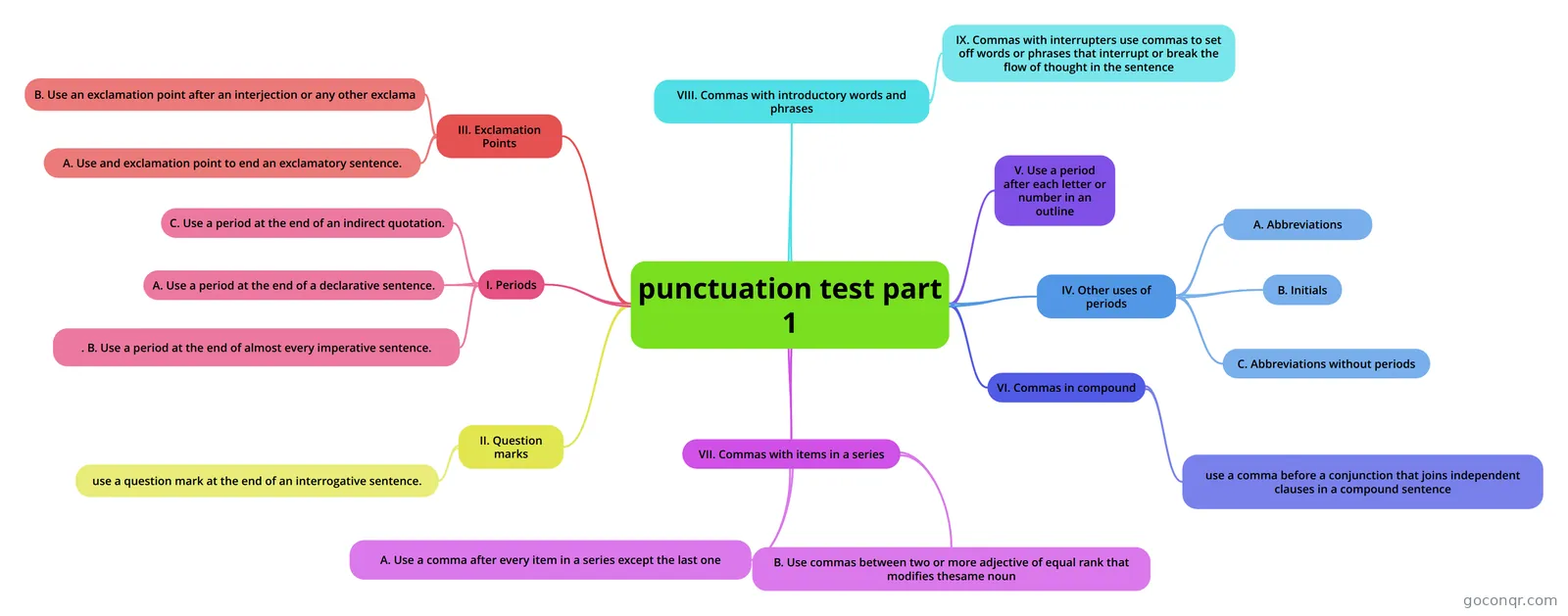
Mind map: punctuation test
Inhalt der Mindmap
punctuation test part 1
- PUNCTUATION I. Periods A. Use a period at the end of a declarative sentence. B. Use a period at the end of almost every imperative sentence. C. Use a period at the end of an indirect quotation. II. Question marks- use a question mark at the end of an interrogative sentence. III. Exclamation Points A. Use and exclamation point to end an exclamatory sentence. B. Use an exclamation point after an interjection or any other exclamatory expression. IV. Other uses of periods. A. Abbreviations B. Initials C. Abbreviations without periods V. Use a period after each letter or number in an outline VI. Commas in compound- use a comma before a conjunction that joins independent clauses in a compound sentence VII. Commas with items in a series A. Use a comma after every item in a series except the last one B. Use commas between two or more adjective of equal rank that modifies the same noun. VIII. Commas with introductory words and phrases – use a comma an introductory word or phrase to separate it from the rest of the sentence. IX. Commas with interrupters use commas to set off words or phrases that interrupt or break the flow of thought in the sentence X. Commas with nouns of direct address- use commas to set off nouns of direct address XII. Commas to avoid confusion- use a comma where it might be confusing XIII. Direct quotations A. Use quotation marks at the beginning and end of direct quotations. B. Use commas to set off explanatory words used with direct quotation (whether they occur at the beginning, in the middle, or at the end of the sentence) C. If a quotation or and exclamation point inside the closing quotation marks D. If quoted words are part of a question or exclamation, place the question mark or exclamation point outside the closing quotation marks XIX. Indirect quotation- do not use quotation marks to set off an indirect quotation XX. Divided Quotations A. Use quotation marks to enclose both parts of a divided quotation B. Do not capitalize the first word of the second part of a divided quotation unless it begins a new sentence. C. Use commas to set off the explanatory words used with divided quotation XXI. Quotation marks in dialogue-in dialogue a new paragraph and an new set of quotation marks signal a change in speakers XXII. Semicolons in compound sentences A. Use a semicolon to join parts of a compound sentence without a coordinating conjunction. B. Use a semicolon between parts of compound sentences when the clause are long and complex or when they contain commas XXIII. Semicolons with items in a series- when there are commas within parts of a series, use semicolons to separate the parts. XXIV. Colons A. Use a colon to introduce a list of items B. Use a colon for the formal greeting in a business letter C. Use colons between hours and minutes in expressions of time XXV. Hyphens A. Use a hyphen if part of a word must be carried from line to the next 1. The word must have at least two syllables 2. Separate the word between syllables 3. You must leave at least two letters on each line B. Use hyphens in certain compound words C. Use hyphens in compound numbers from twenty-one to ninety-nine D. Use hyphens in spelled out fractions XXVI. Dashes- uses dashes to show an abrupt break in thought XXVII. Parentheses- use parentheses to set off material that is loosely related to the rest of the sentence XXVIII. Apostrophes in possessives- use an apostrophe to form the possessive of any noun whether singular of plural XXIX. Apostrophes in contractions- use apostrophes in contractions XXX. Apostrophes in plural- use an apostrophe and s to form the plural of a letter, a numeral, or a word referred to as a word.
I. Periods
- A. Use a period at the end of a declarative sentence.
- . B. Use a period at the end of almost every imperative sentence.
- C. Use a period at the end of an indirect quotation.
II. Question marks
- use a question mark at the end of an interrogative sentence.
III. Exclamation Points
- A. Use and exclamation point to end an exclamatory sentence.
- B. Use an exclamation point after an interjection or any other exclama
IV. Other uses of periods
- A. Abbreviations
- B. Initials
- C. Abbreviations without periods
V. Use a period after each letter or number in an outline
VI. Commas in compound
- use a comma before a conjunction that joins independent clauses in a compound sentence
VII. Commas with items in a series
- A. Use a comma after every item in a series except the last one
- B. Use commas between two or more adjective of equal rank that modifies thesame noun
VIII. Commas with introductory words and phrases
- IX. Commas with interrupters use commas to set off words or phrases that interrupt or break the flow of thought in the sentence
Informationen
- Beschreibung
- language arts Mindmap am punctuation test part 1, erstellt von anjalipatel204 am 14/04/2013.
- Erstellt von
- anjalipatel204
- Aufrufe
- 206
- Tags
- Bewertung