
Mindmap
The Skeleton and Muscles
Inhalt der Mindmap
The Skeleton and Muscles
Functions of the skeleton
- Support: skeleton supports the body and keeps it upright
- Protection: skull protects the brain, backbone protects spinal cord, ribs protect the lungs
- Manufacture of blood cells: red cells, white cells and platelets are made in bone marrow of the long bones
- Movement: bones provide rigid levers against which the muscles can pull
The Axial Skeleton
- Composed of the skull (cranium), facial bones, vertebral column (spine), rib cage and sternum (breastbone)
- Spine
- A pad of fluid enclosed by cartilage, called a disk act as shock absorbers and protect the vertebrae from rubbing each other
The Appendicular Skeleton
- Consists of the pectoral and pelvic girdles, and their attached limbs
- Pectoral (shoulder) girdle
- Consists of scapula (shoulder blade) and clavicle (collar bone)
- Function is to give upper body mobility and strength
- Pelvic (hip) girdle
- Consists of the pelvis (made up of three fused bones called innominate bones)
- Gives strength and support to the body and allows mobility of lower limbs
Structure of a Long Bone
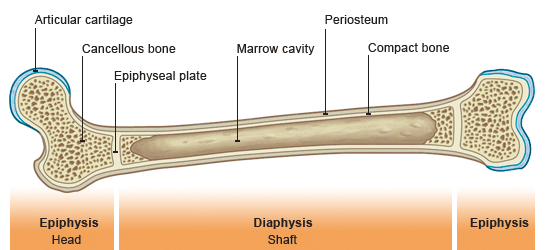
- Compact Bone
- The inorganic material gives strength to the bone
- The organic material gives the bone flexibility
- Contains blood vessels and nerve fibres
- Medullary Cavity
- Contains a soft material called bone marrow
- Red marrow is active in making blood cells
- Yellow marrow is inactive and contains numerous fat-storage cells
- Can convert to red marrow if needed
- Spongy Bone
- Consists of a mixture of compact bone with pockets of bone marrow
- Function is to give strength and rigidity to bones without making them too heavy
- Cartilage
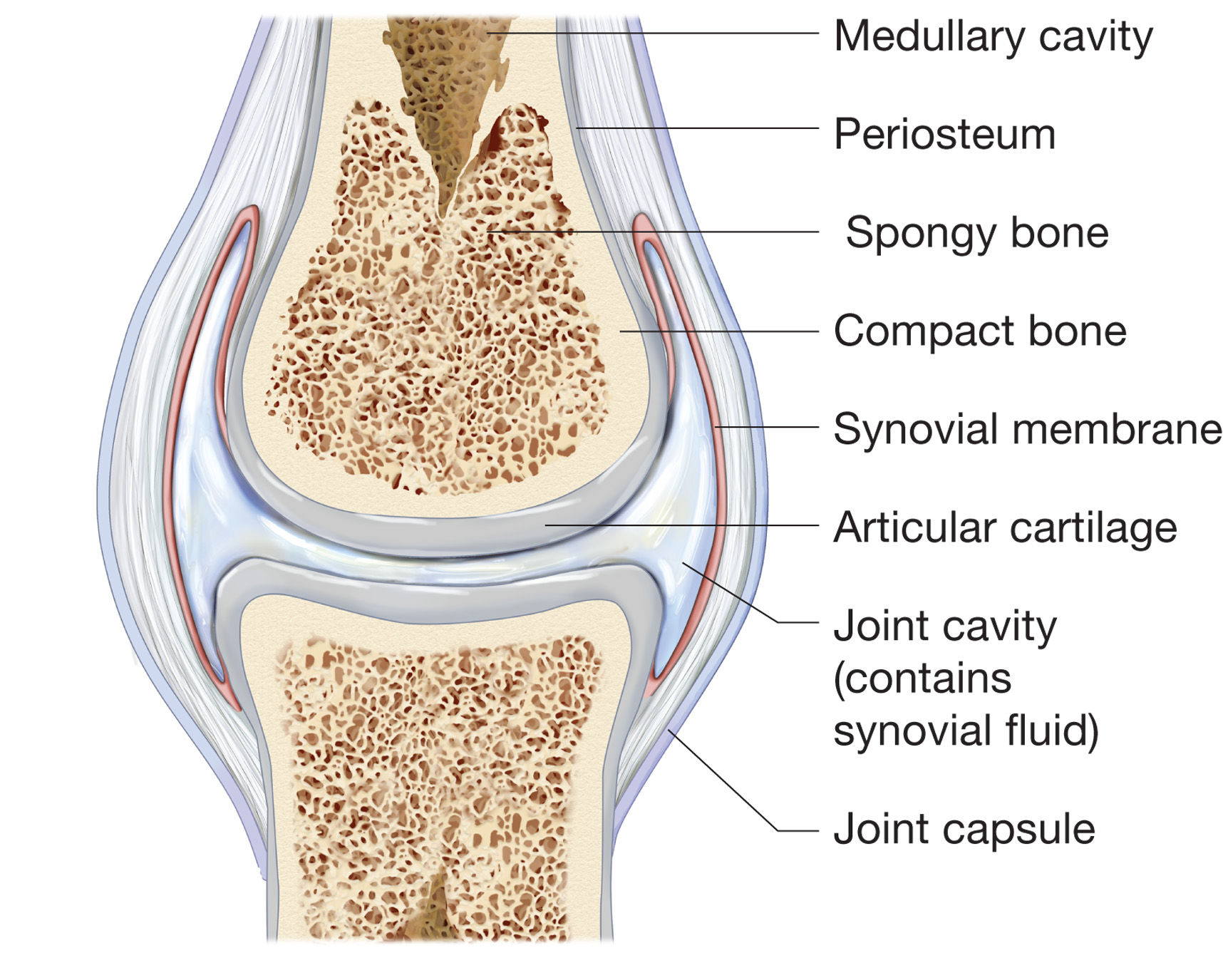
- It protects the end of long bones and acts as a shock absorber
- Made of collagen
- Compact Bone
Bone Growth
- Osteoblasts produce and lay down new bone
- Osteoclasts digest and remove old bone
- Cartilage slowly converted to bone (ossification)
- In growth plate, osteoblasts form bone matrix to extend the length of bones
Joints
- A joint is where two or more bone meet
- Immovable Joints: allow no movement between the bones. Their function is strength and protection
- Slightly Movable Joints: allow a small amount of movement between bones. e.g. joints between vertebrae
- Freely Movable Joints: contain synovial fluid in joint cavity which allows greater friction-free movement
- Hinge Joints: allow movement in one direction only
- Ball and Socket: allow movement in all direction
Muscles
- Cardiac muscle: located in the heart
- Voluntary (skeletal) is the muscle that cause body movement. They work as antagonistic pairs
- Antagonistic muscle pairs are composed of two muscles that have opposite effects to each other
- Involuntary (smooth) muscle is located in the intestines, bladder and blood vessels
- Muscles can only contract
Arthritis
- Caused by swelling of joints
- Prevention: reducing wear and tear
- Treatment: rest; surgery to repair damage in severe cases
Bilder und Dateien der Mindmap
Informationen
- Beschreibung
- Leaving Certificate Biology Mindmap am The Skeleton and Muscles, erstellt von james liew am 27/03/2016.
- Erstellt von
- james liew
- Aufrufe
- 498
- Tags
- Bewertung