
Mindmap
Insulin and Diabetes Part 2
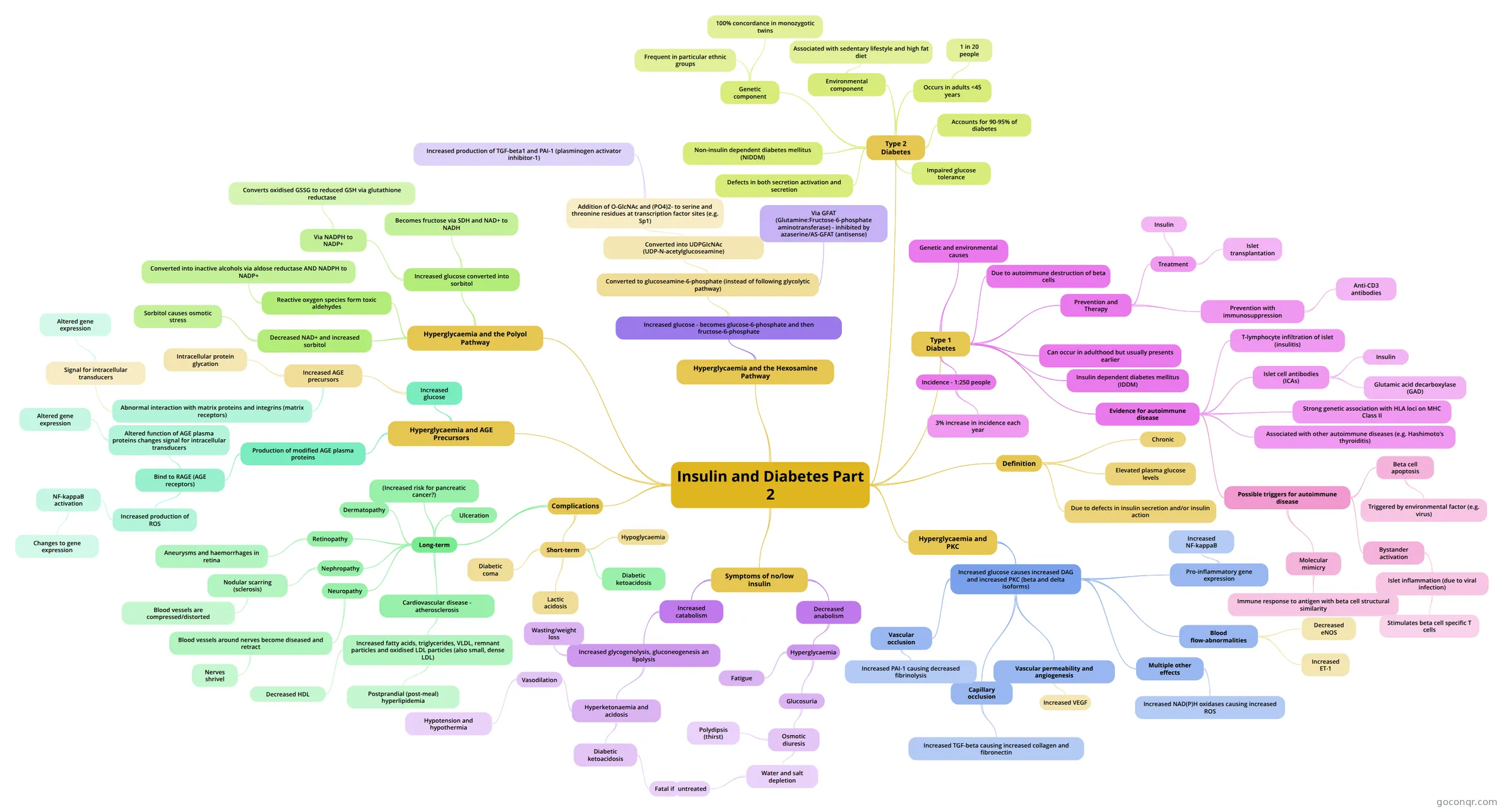
Mind map: Insulin and diabetes part 2
Inhalt der Mindmap
Insulin and Diabetes Part 2
Symptoms of no/low insulin
- Decreased anabolism
- Hyperglycaemia
- Fatigue
- Glucosuria
- Osmotic diuresis
- Polydipsis (thirst)
- Water and salt depletion
- untreated
- Osmotic diuresis
- Hyperglycaemia
- Increased catabolism
- Increased glycogenolysis, gluconeogenesis an lipolysis
- Wasting/weight loss
- Hyperketonaemia and acidosis
- Vasodilation
- Hypotension and hypothermia
- Diabetic ketoacidosis
- Fatal if
- Vasodilation
- Increased glycogenolysis, gluconeogenesis an lipolysis
- Decreased anabolism
Definition
- Chronic
- Elevated plasma glucose levels
- Due to defects in insulin secretion and/or insulin action
Complications
- Short-term
- Hypoglycaemia
- Diabetic ketoacidosis
- Lactic acidosis
- Diabetic coma
- Long-term
- Retinopathy
- Aneurysms and haemorrhages in retina
- Nephropathy
- Nodular scarring (sclerosis)
- Blood vessels are compressed/distorted
- Nodular scarring (sclerosis)
- Neuropathy
- Blood vessels around nerves become diseased and retract
- Nerves shrivel
- Blood vessels around nerves become diseased and retract
- Cardiovascular disease - atherosclerosis
- Increased fatty acids, triglycerides, VLDL, remnant particles and oxidised LDL particles (also small, dense LDL)
- Decreased HDL
- Postprandial (post-meal) hyperlipidemia
- Increased fatty acids, triglycerides, VLDL, remnant particles and oxidised LDL particles (also small, dense LDL)
- (Increased risk for pancreatic cancer?)
- Ulceration
- Dermatopathy
- Retinopathy
- Short-term
Type 1 Diabetes
- Insulin dependent diabetes mellitus (IDDM)
- Can occur in adulthood but usually presents earlier
- Incidence - 1:250 people
- 3% increase in incidence each year
- Due to autoimmune destruction of beta cells
- Genetic and environmental causes
- Evidence for autoimmune disease
- T-lymphocyte infiltration of islet (insulitis)
- Islet cell antibodies (ICAs)
- Insulin
- Glutamic acid decarboxylase (GAD)
- Strong genetic association with HLA loci on MHC Class II
- Associated with other autoimmune diseases (e.g. Hashimoto's thyroiditis)
- Possible triggers for autoimmune disease
- Beta cell apoptosis
- Triggered by environmental factor (e.g. virus)
- Molecular mimicry
- Immune response to antigen with beta cell structural similarity
- Bystander activation
- Islet inflammation (due to viral infection)
- Stimulates beta cell specific T cells
- Islet inflammation (due to viral infection)
- Beta cell apoptosis
- Prevention and Therapy
- Prevention with immunosuppression
- Anti-CD3 antibodies
- Treatment
- Insulin
- Islet transplantation
- Prevention with immunosuppression
Type 2 Diabetes
- Occurs in adults <45 years
- 1 in 20 people
- Accounts for 90-95% of diabetes
- Defects in both secretion activation and secretion
- Genetic component
- 100% concordance in monozygotic twins
- Frequent in particular ethnic groups
- Environmental component
- Associated with sedentary lifestyle and high fat diet
- Non-insulin dependent diabetes mellitus (NIDDM)
- Impaired glucose tolerance
- Occurs in adults <45 years
Hyperglycaemia and the Polyol Pathway
- Reactive oxygen species form toxic aldehydes
- Converted into inactive alcohols via aldose reductase AND NADPH to NADP+
- Increased glucose converted into sorbitol
- Becomes fructose via SDH and NAD+ to NADH
- Via NADPH to NADP+
- Converts oxidised GSSG to reduced GSH via glutathione reductase
- Decreased NAD+ and increased sorbitol
- Sorbitol causes osmotic stress
- Reactive oxygen species form toxic aldehydes
Hyperglycaemia and AGE Precursors
- Really good paper alert!! F. Giacco and M. Brownlee, Oxidative Stress and Diabetic Complications, 2010
- Increased glucose
- Increased AGE precursors
- Intracellular protein glycation
- Abnormal interaction with matrix proteins and integrins (matrix receptors)
- Signal for intracellular transducers
- Altered gene expression
- Signal for intracellular transducers
- Increased AGE precursors
- Production of modified AGE plasma proteins
- Bind to RAGE (AGE receptors)
- Increased production of ROS
- NF-kappaB activation
- Changes to gene expression
- NF-kappaB activation
- Altered function of AGE plasma proteins changes signal for intracellular transducers
- Altered gene expression
- Increased production of ROS
- Bind to RAGE (AGE receptors)
Hyperglycaemia and PKC
- Increased glucose causes increased DAG and increased PKC (beta and delta isoforms)
- Blood flow-abnormalities
- Decreased eNOS
- Increased ET-1
- Vascular permeability and angiogenesis
- Increased VEGF
- Capillary occlusion
- Increased TGF-beta causing increased collagen and fibronectin
- Pro-inflammatory gene expression
- Increased NF-kappaB
- Vascular occlusion
- Increased PAI-1 causing decreased fibrinolysis
- Multiple other effects
- Increased NAD(P)H oxidases causing increased ROS
- Blood flow-abnormalities
- Increased glucose causes increased DAG and increased PKC (beta and delta isoforms)
Hyperglycaemia and the Hexosamine Pathway
- Increased glucose - becomes glucose-6-phosphate and then fructose-6-phosphate
- Converted to glucoseamine-6-phosphate (instead of following glycolytic pathway)
- Converted into UDPGIcNAc (UDP-N-acetylglucoseamine)
- Addition of O-GlcNAc and (PO4)2- to serine and threonine residues at transcription factor sites (e.g. Sp1)
- Increased production of TGF-beta1 and PAI-1 (plasminogen activator inhibitor-1)
- Addition of O-GlcNAc and (PO4)2- to serine and threonine residues at transcription factor sites (e.g. Sp1)
- Via GFAT (Glutamine:Fructose-6-phosphate aminotransferase) - inhibited by azaserine/AS-GFAT (antisense)
- Converted into UDPGIcNAc (UDP-N-acetylglucoseamine)
- Converted to glucoseamine-6-phosphate (instead of following glycolytic pathway)
- Increased glucose - becomes glucose-6-phosphate and then fructose-6-phosphate
Informationen
- Beschreibung
- Endocrinology Mindmap am Insulin and Diabetes Part 2, erstellt von maisie_oj am 21/04/2013.
- Erstellt von
- maisie_oj
- Aufrufe
- 120
- Tags
- Bewertung