
Mindmap
10. 4 Evidence for evolution
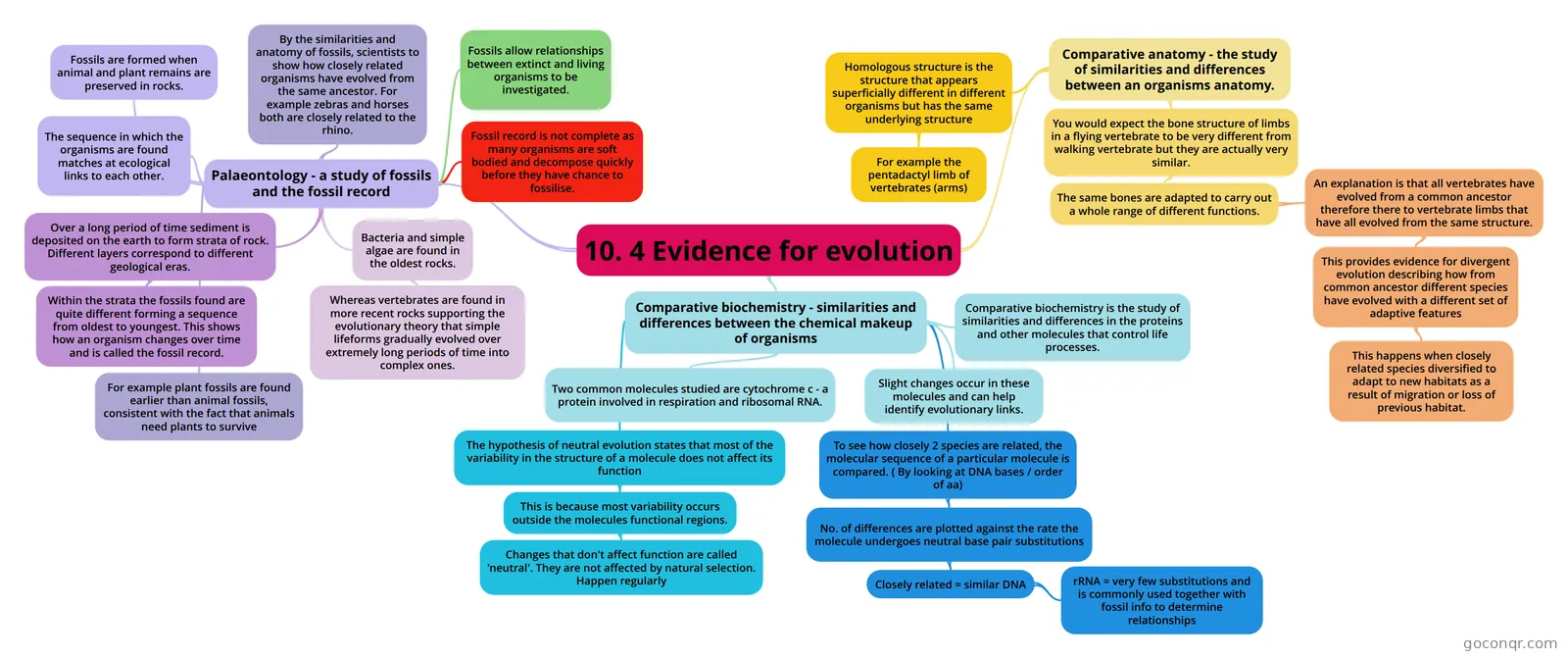
Mind map: Evidence for evolution
Inhalt der Mindmap
10. 4 Evidence for evolution
Palaeontology - a study of fossils and the fossil record
- Fossils are formed when animal and plant remains are preserved in rocks.
- Over a long period of time sediment is deposited on the earth to form strata of rock. Different layers correspond to different geological eras.
- Within the strata the fossils found are quite different forming a sequence from oldest to youngest. This shows how an organism changes over time and is called the fossil record.
- Bacteria and simple algae are found in the oldest rocks.
- Whereas vertebrates are found in more recent rocks supporting the evolutionary theory that simple lifeforms gradually evolved over extremely long periods of time into complex ones.
- The sequence in which the organisms are found matches at ecological links to each other.
- For example plant fossils are found earlier than animal fossils, consistent with the fact that animals need plants to survive
- By the similarities and anatomy of fossils, scientists to show how closely related organisms have evolved from the same ancestor. For example zebras and horses both are closely related to the rhino.
- Fossils allow relationships between extinct and living organisms to be investigated.
- Fossil record is not complete as many organisms are soft bodied and decompose quickly before they have chance to fossilise.
Comparative anatomy - the study of similarities and differences between an organisms anatomy.
- Homologous structure is the structure that appears superficially different in different organisms but has the same underlying structure
- For example the pentadactyl limb of vertebrates (arms)
- You would expect the bone structure of limbs in a flying vertebrate to be very different from walking vertebrate but they are actually very similar.
- The same bones are adapted to carry out a whole range of different functions.
- An explanation is that all vertebrates have evolved from a common ancestor therefore there to vertebrate limbs that have all evolved from the same structure.
- This provides evidence for divergent evolution describing how from common ancestor different species have evolved with a different set of adaptive features
- This happens when closely related species diversified to adapt to new habitats as a result of migration or loss of previous habitat.
- This provides evidence for divergent evolution describing how from common ancestor different species have evolved with a different set of adaptive features
- An explanation is that all vertebrates have evolved from a common ancestor therefore there to vertebrate limbs that have all evolved from the same structure.
- The same bones are adapted to carry out a whole range of different functions.
- Homologous structure is the structure that appears superficially different in different organisms but has the same underlying structure
Comparative biochemistry - similarities and differences between the chemical makeup of organisms
- Comparative biochemistry is the study of similarities and differences in the proteins and other molecules that control life processes.
- Slight changes occur in these molecules and can help identify evolutionary links.
- Two common molecules studied are cytochrome c - a protein involved in respiration and ribosomal RNA.
- The hypothesis of neutral evolution states that most of the variability in the structure of a molecule does not affect its function
- This is because most variability occurs outside the molecules functional regions.
- Changes that don't affect function are called 'neutral'. They are not affected by natural selection. Happen regularly
- This is because most variability occurs outside the molecules functional regions.
- To see how closely 2 species are related, the molecular sequence of a particular molecule is compared. ( By looking at DNA bases / order of aa)
- No. of differences are plotted against the rate the molecule undergoes neutral base pair substitutions
- Closely related = similar DNA
- rRNA = very few substitutions and is commonly used together with fossil info to determine relationships
- Closely related = similar DNA
- No. of differences are plotted against the rate the molecule undergoes neutral base pair substitutions
Informationen
- Beschreibung
- AS - Level Biology (Mrs Murray) Mindmap am 10. 4 Evidence for evolution, erstellt von Jess Hughes am 02/05/2016.
- Erstellt von
- Jess Hughes
- Aufrufe
- 0
- Bewertung
Mehr zu Evidence for Evolution