
Mindmap
Biology
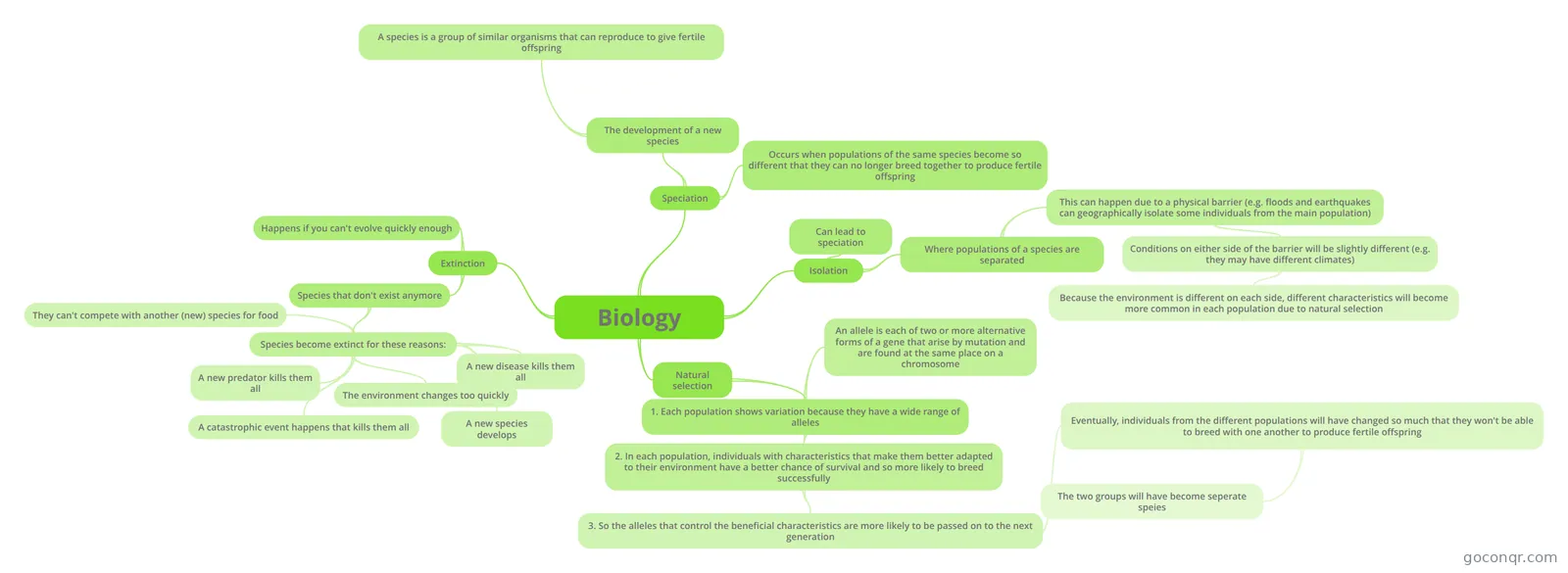
Mind map: Biology
Inhalt der Mindmap
Biology
Extinction
- Happens if you can't evolve quickly enough
- Species that don't exist anymore
- Species become extinct for these reasons:
- The environment changes too quickly
- A new predator kills them all
- A new disease kills them all
- They can't compete with another (new) species for food
- A catastrophic event happens that kills them all
- A new species develops
- Species become extinct for these reasons:
Speciation
- The development of a new species
- A species is a group of similar organisms that can reproduce to give fertile offspring
- Occurs when populations of the same species become so different that they can no longer breed together to produce fertile offspring
- The development of a new species
Isolation
- Can lead to speciation
- Where populations of a species are separated
- This can happen due to a physical barrier (e.g. floods and earthquakes can geographically isolate some individuals from the main population)
- Conditions on either side of the barrier will be slightly different (e.g. they may have different climates)
- Because the environment is different on each side, different characteristics will become more common in each population due to natural selection
- Conditions on either side of the barrier will be slightly different (e.g. they may have different climates)
- This can happen due to a physical barrier (e.g. floods and earthquakes can geographically isolate some individuals from the main population)
Natural selection
- 1. Each population shows variation because they have a wide range of alleles
- An allele is each of two or more alternative forms of a gene that arise by mutation and are found at the same place on a chromosome
- 2. In each population, individuals with characteristics that make them better adapted to their environment have a better chance of survival and so more likely to breed successfully
- 3. So the alleles that control the beneficial characteristics are more likely to be passed on to the next generation
- Eventually, individuals from the different populations will have changed so much that they won't be able to breed with one another to produce fertile offspring
- The two groups will have become seperate speies
- Eventually, individuals from the different populations will have changed so much that they won't be able to breed with one another to produce fertile offspring
- 3. So the alleles that control the beneficial characteristics are more likely to be passed on to the next generation
- 1. Each population shows variation because they have a wide range of alleles
Informationen
- Beschreibung
- Mindmap am Biology, erstellt von hannahgilmour am 16/03/2014.
- Erstellt von
- hannahgilmour
- Aufrufe
- 14
- Tags
- Bewertung