
Mindmap
Photosynthesis
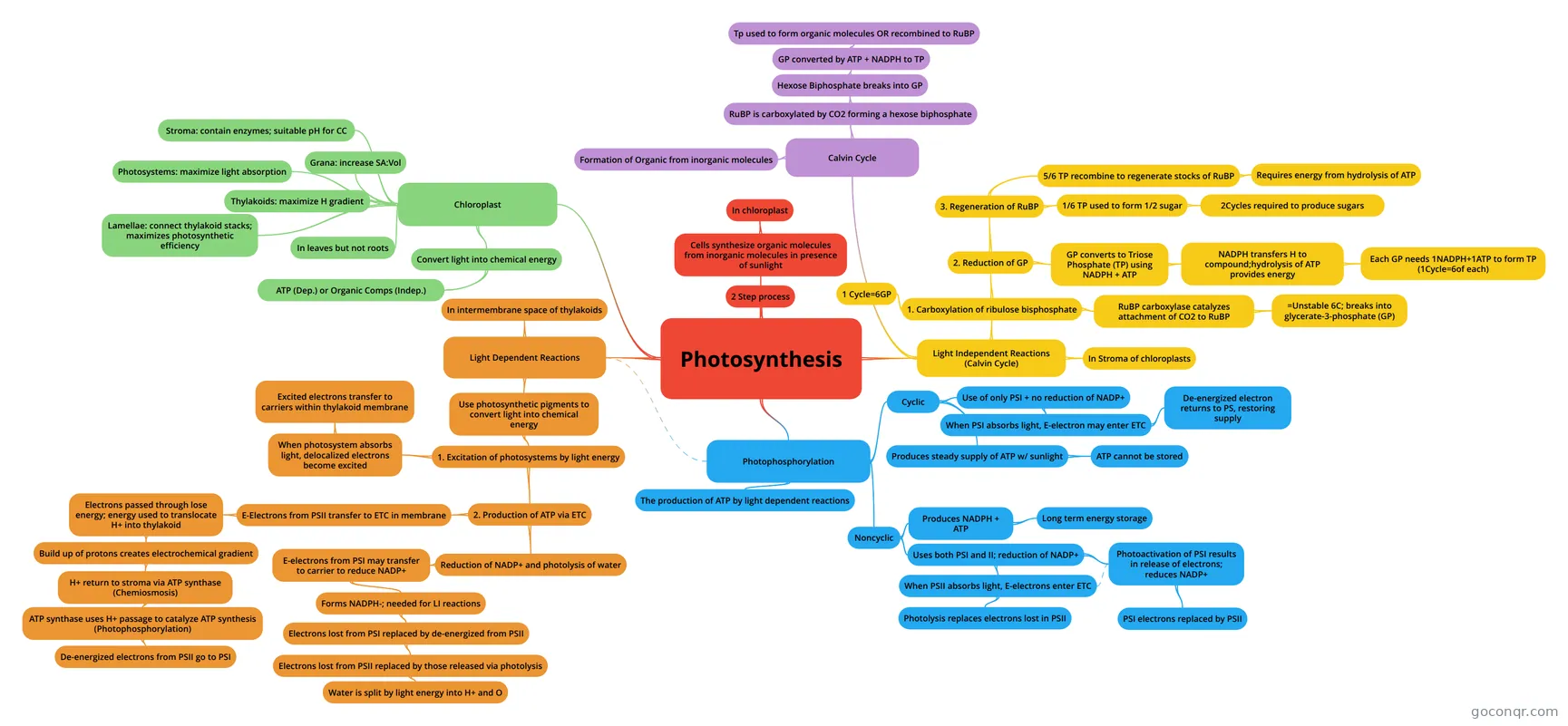
Mind map: Photosynthesis: Process and Components
Inhalt der Mindmap
Photosynthesis
2 Step process
Cells synthesize organic molecules from inorganic molecules in presence of sunlight
- In chloroplast
Light Dependent Reactions
- In intermembrane space of thylakoids
- Use photosynthetic pigments to convert light into chemical energy
- 1. Excitation of photosystems by light energy
- 2. Production of ATP via ETC
- Reduction of NADP+ and photolysis of water
- E-electrons from PSI may transfer to carrier to reduce NADP+
- Forms NADPH-; needed for LI reactions
- Electrons lost from PSI replaced by de-energized from PSII
- Electrons lost from PSII replaced by those released via photolysis
- Water is split by light energy into H+ and O
- Electrons lost from PSII replaced by those released via photolysis
- Electrons lost from PSI replaced by de-energized from PSII
- Forms NADPH-; needed for LI reactions
- E-electrons from PSI may transfer to carrier to reduce NADP+
- E-Electrons from PSII transfer to ETC in membrane
- Electrons passed through lose energy; energy used to translocate H+ into thylakoid
- Build up of protons creates electrochemical gradient
- H+ return to stroma via ATP synthase (Chemiosmosis)
- ATP synthase uses H+ passage to catalyze ATP synthesis (Photophosphorylation)
- De-energized electrons from PSII go to PSI
- ATP synthase uses H+ passage to catalyze ATP synthesis (Photophosphorylation)
- H+ return to stroma via ATP synthase (Chemiosmosis)
- Build up of protons creates electrochemical gradient
- Electrons passed through lose energy; energy used to translocate H+ into thylakoid
- Reduction of NADP+ and photolysis of water
- When photosystem absorbs light, delocalized electrons become excited
- Excited electrons transfer to carriers within thylakoid membrane
- 2. Production of ATP via ETC
- 1. Excitation of photosystems by light energy
Light Independent Reactions (Calvin Cycle)
- In Stroma of chloroplasts
- 1. Carboxylation of ribulose bisphosphate
- 2. Reduction of GP
- 3. Regeneration of RuBP
- 1/6 TP used to form 1/2 sugar
- 2Cycles required to produce sugars
- 5/6 TP recombine to regenerate stocks of RuBP
- Requires energy from hydrolysis of ATP
- 1/6 TP used to form 1/2 sugar
- GP converts to Triose Phosphate (TP) using NADPH + ATP
- NADPH transfers H to compound;hydrolysis of ATP provides energy
- Each GP needs 1NADPH+1ATP to form TP (1Cycle=6of each)
- NADPH transfers H to compound;hydrolysis of ATP provides energy
- 3. Regeneration of RuBP
- RuBP carboxylase catalyzes attachment of CO2 to RuBP
- =Unstable 6C; breaks into glycerate-3-phosphate (GP)
- 1 Cycle=6GP
- 2. Reduction of GP
- Calvin Cycle
- Formation of Organic from inorganic molecules
- RuBP is carboxylated by CO2 forming a hexose biphosphate
- Hexose Biphosphate breaks into GP
- GP converted by ATP + NADPH to TP
- Tp used to form organic molecules OR recombined to RuBP
- GP converted by ATP + NADPH to TP
- Hexose Biphosphate breaks into GP
Photophosphorylation
- The production of ATP by light dependent reactions
- Cyclic
- Use of only PSI + no reduction of NADP+
- When PSI absorbs light, E-electron may enter ETC
- De-energized electron returns to PS, restoring supply
- When PSI absorbs light, E-electron may enter ETC
- Produces steady supply of ATP w/ sunlight
- ATP cannot be stored
- Use of only PSI + no reduction of NADP+
- Noncyclic
- Uses both PSI and II; reduction of NADP+
- When PSII absorbs light, E-electrons enter ETC
- Photolysis replaces electrons lost in PSII
- Photoactivation of PSI results in release of electrons; reduces NADP+
- PSI electrons replaced by PSII
- When PSII absorbs light, E-electrons enter ETC
- Produces NADPH + ATP
- Long term energy storage
- Uses both PSI and II; reduction of NADP+
Chloroplast
- Convert light into chemical energy
- ATP (Dep.) or Organic Comps (Indep.)
- In leaves but not roots
- Thylakoids: maximize H gradient
- Grana: increase SA:Vol
- Photosystems: maximize light absorption
- Stroma: contain enzymes; suitable pH for CC
- Lamellae: connect thylakoid stacks; maximizes photosynthetic efficiency
- Convert light into chemical energy
Informationen
- Beschreibung
- 11th grade Biology Mindmap am Photosynthesis, erstellt von Kay Kennedy am 17/01/2017.
- Erstellt von
- Kay Kennedy
- Aufrufe
- 0
- Bewertung