
Mindmap
Past Climates
Inhalt der Mindmap
Past Climates
Today's Global climate
- 5 main climate zones
- Tropical - Equator
- Limestone/ Coal/ Sandstone, Reef, Coral and Marine fossils
- Arid - Below Tropical
- Red sandstone, Large scale cross beds, trace fossils
- Warm Temperate - Below Arid
- Sandstone/ Mudstone, Marine plants and animals
- Polar - Bottom, near the Poles
- Tiliite (boulder clay), Erratics/ Striations, Very few fossils
- Cold Temperate - above Polar
- Tropical - Equator
- 5 main climate zones
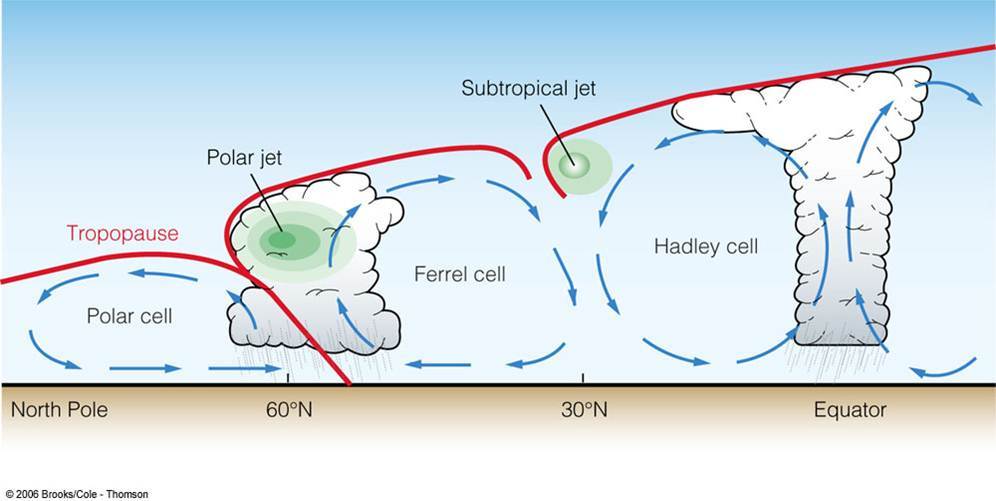
Atmospheric circulation
- Purpose: To distribute large scale air movements around the earths surface.
Greenhouse gases
- Carbon Dioxide (CO2)
- As CO2 increases Temperature increases but not perfectly
- CO2 has fluctuated over time
- Methane Hydrates (CH4)
- Gov interest: Potential energy source
- Formed via anaerobic decay of organic matter
- Released by burning/melting of the ice, once melted methane is released contributing to greenhouse gases
- Carbon Dioxide (CO2)
Tectonic and Volcanic Influences on the climate
- Tectonic processes changes the ocean circulatory patterns, This transfers oxygen around the glob and transfers heat energy around the globe
- the nature of the ocean influenced greenhouse/ icehouse times
- Icehouse- Restricted circulation between the Equator and the Poles
- Greenhouse- The movement and mixing of the oceans between the Equator and the Poles
- Volcanic eruptions influence the climate due to the ash and gas particles in the atmosphere, cools the earth by absorbing the Sunlight (insolation)
- Laki - 1783 - Basaltic - Iceland
- Sulphur dioxide released causing below average temps for 3 years
- Possible cause for warm summer in 1783
- Mount Pinatubo - 1991 - Andesitic - Philippines
- 20 million tons of sulphur dioxide, causing global temps to drop from 91-92
- The injection of sulphur reduced sunlight by 5%
- The Global Temp dropped 0.35 over the next few years.
- Laki - 1783 - Basaltic - Iceland
Milankovitch Cycle
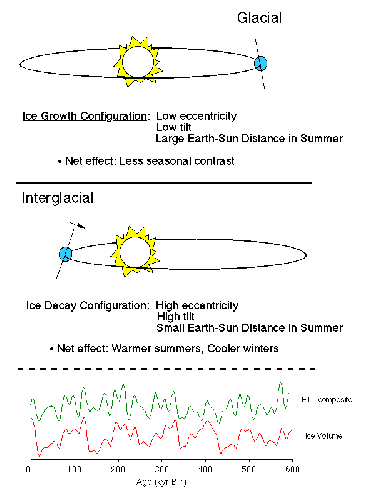
- Describes the effects of the earths movements on its climate
- This affects the climate by the Glacial periods occur when the orbit is almost circular and interglacial when it is more elliptical when the tilt increases summers will become hotter.
- This affects the climate by the Glacial periods occur when the orbit is almost circular and interglacial when it is more elliptical when the tilt increases summers will become hotter.
- Describes the effects of the earths movements on its climate
Oxygen Isotopes
- 1) Two oxygen isotopes; Heavier = O18 Lighter = O16. Movement is related to the water cycle.
- Ocean contains a set amount of O18 and O16, More O16 than O18
- 2) 16O prefered to be evaporated than 18O, Seawater becomes 'heavier' because there is more O18 present
- 3) 16O isotopes become locked in ice during glaciation due to temperature decrease
- Seawater becomes isotopically heavy & sea level drops, Causing the Ice caps to grow
- 4) If the temperature changes due to the change in the amount of Insolation recieved by the earth (Milankovitch Cycle) the ice caps will melt and retreat. This will cause the sea level to rise, by the rich O16 meltwater/rainwater. Adding O16 to the seawater makes it isotopically lighter.
- Advantages: More complete record and Global picture of continental glaciation
- 1) Two oxygen isotopes; Heavier = O18 Lighter = O16. Movement is related to the water cycle.
Bilder und Dateien der Mindmap
Informationen
- Beschreibung
- Geology Mindmap am Past Climates, erstellt von ruth.peaden am 30/05/2014.
- Erstellt von
- ruth.peaden
- Aufrufe
- 9
- Bewertung