
Mindmap
Conservation in situ
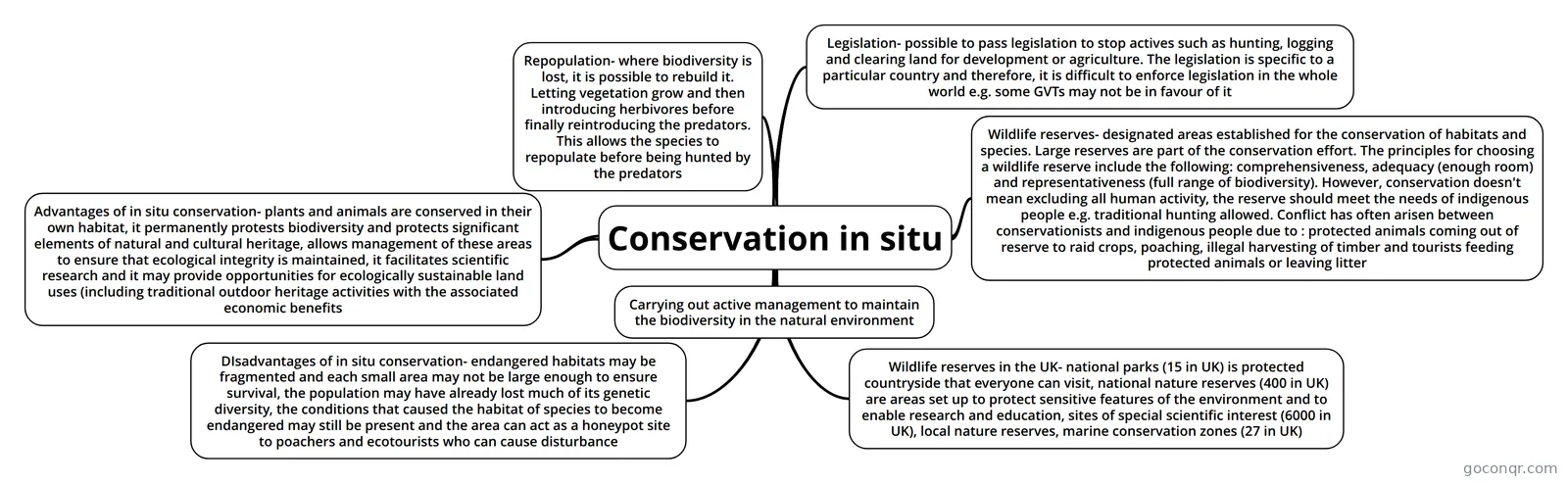
Mind map: Conservation in situ
Inhalt der Mindmap
Conservation in situ
Carrying out active management to maintain the biodiversity in the natural environment
Legislation- possible to pass legislation to stop actives such as hunting, logging and clearing land for development or agriculture. The legislation is specific to a particular country and therefore, it is difficult to enforce legislation in the whole world e.g. some GVTs may not be in favour of it
Wildlife reserves- designated areas established for the conservation of habitats and species. Large reserves are part of the conservation effort. The principles for choosing a wildlife reserve include the following: comprehensiveness, adequacy (enough room) and representativeness (full range of biodiversity). However, conservation doesn't mean excluding all human activity, the reserve should meet the needs of indigenous people e.g. traditional hunting allowed. Conflict has often arisen between conservationists and indigenous people due to : protected animals coming out of reserve to raid crops, poaching, illegal harvesting of timber and tourists feeding protected animals or leaving litter
Wildlife reserves in the UK- national parks (15 in UK) is protected countryside that everyone can visit, national nature reserves (400 in UK) are areas set up to protect sensitive features of the environment and to enable research and education, sites of special scientific interest (6000 in UK), local nature reserves, marine conservation zones (27 in UK)
Repopulation- where biodiversity is lost, it is possible to rebuild it. Letting vegetation grow and then introducing herbivores before finally reintroducing the predators. This allows the species to repopulate before being hunted by the predators
Advantages of in situ conservation- plants and animals are conserved in their own habitat, it permanently protests biodiversity and protects significant elements of natural and cultural heritage, allows management of these areas to ensure that ecological integrity is maintained, it facilitates scientific research and it may provide opportunities for ecologically sustainable land uses (including traditional outdoor heritage activities with the associated economic benefits
DIsadvantages of in situ conservation- endangered habitats may be fragmented and each small area may not be large enough to ensure survival, the population may have already lost much of its genetic diversity, the conditions that caused the habitat of species to become endangered may still be present and the area can act as a honeypot site to poachers and ecotourists who can cause disturbance
Informationen
- Beschreibung
- Biodiversity Mindmap am Conservation in situ, erstellt von Eva Durman am 09/01/2018.
- Erstellt von
- Eva Durman
- Aufrufe
- 0
- Bewertung