
Mindmap
Properties of Materials
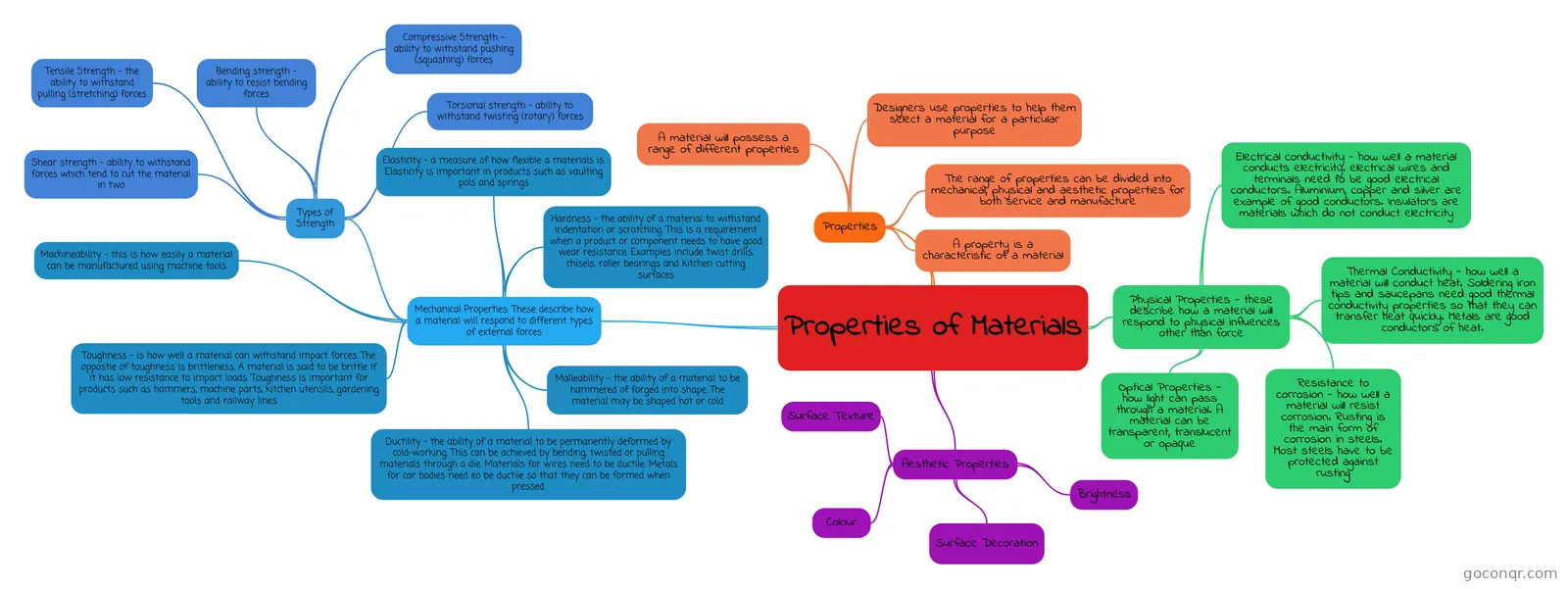
Mind map: Properties of materials
Inhalt der Mindmap
Properties of Materials
Mechanical Properties: These describe how a material will respond to different types of external forces
- Types of Strength
- Tensile Strength - the ability to withstand pulling (stretching) forces
- Compressive Strength - ability to withstand pushing (squashing) forces
- Shear strength - ability to withstand forces which tend to cut the material in two
- Torsional strength - ability to withstand twisting (rotary) forces
- Bending strength - ability to resist bending forces
- Hardness - the ability of a material to withstand indentation or scratching. This is a requirement when a product or component needs to have good wear resistance. Examples include twist drills, chisels, roller bearings and kitchen cutting surfaces
- Elasticity - a measure of how flexible a materials is. Elasticity is important in products such as vaulting pols and springs
- Malleability - the ability of a material to be hammered of forged into shape. The material may be shaped hot or cold
- Ductility - the ability of a material to be permanently deformed by cold-working. This can be achieved by bending, twisted or pulling materials through a die. Materials for wires need to be ductile. Metals for car bodies need eo be ductile so that they can be formed when pressed.
- Machineability - this is how easily a material can be manufactured using machine tools
- Toughness - is how well a material can withstand impact forces. The oppostie of toughness is brittleness. A material is said to be brittle if it has low resistance to impact loads. Toughness is important for products such as hammers, machine parts, kitchen utensils, gardening tools and railway lines
- Types of Strength
Properties
- A property is a characteristic of a material
- A material will possess a range of different properties
- Designers use properties to help them select a material for a particular purpose
- The range of properties can be divided into mechanical, physical and aesthetic properties for both service and manufacture
Aesthetic Properties
- Colour
- Surface Texture
- Surface Decoration
- Brightness
Physical Properties - these describe how a material will respond to physical influences other than force
- Optical Properties - how light can pass through a material. A material can be transparent, translucent or opaque
- Resistance to corrosion - how well a material will resist corrosion. Rusting is the main form of corrosion in steels. Most steels have to be protected against rusting
- Thermal Conductivity - how well a material will conduct heat. Soldering iron tips and saucepans need good thermal conductivity properties so that they can transfer heat quickly. Metals are good conductors of heat.
- Electrical conductivity - how well a material conducts electricity. electrical wires and terminals need to be good electrical conductors. Aluminium, copper and silver are example of good conductors. Insulators are materials which do not conduct electricity
Informationen
- Beschreibung
- Mind Map on Properties of Materials, created by Army Dan on 06/03/2018.
- Erstellt von
- Army Dan
- Aufrufe
- 373
- Bewertung