
Mindmap
Crime and society
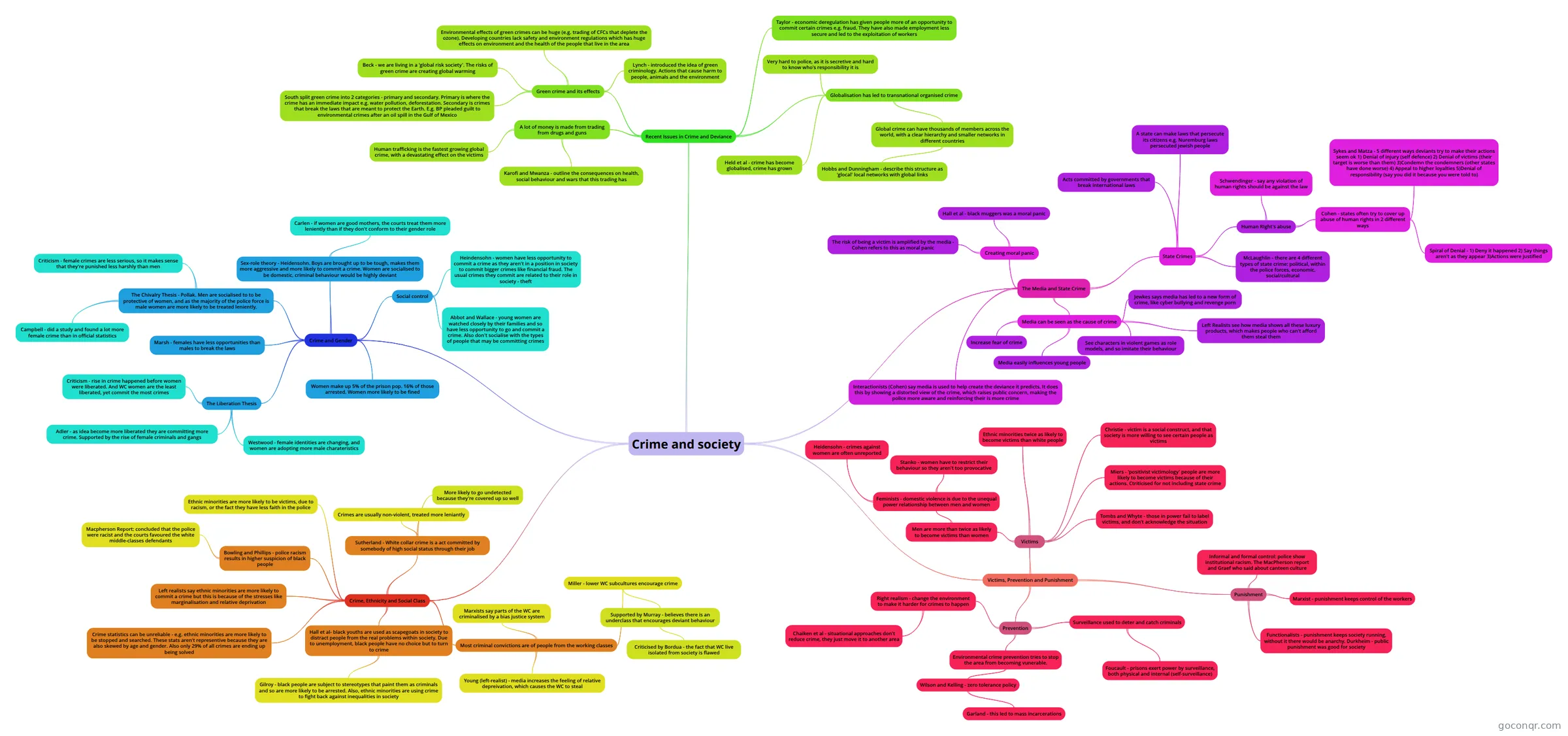
Mind map: Crime and society
Inhalt der Mindmap
Crime and society
Crime, Ethnicity and Social Class
- Crime statistics can be unreliable - e.g. ethnic minorities are more likely to be stopped and searched. These stats aren't representive because they are also skewed by age and gender. Also only 29% of all crimes are ending up being solved
- Bowling and Phillips - police racism results in higher suspicion of black people
- Macpherson Report: concluded that the police were racist and the courts favoured the white middle-classes defendants
- Hall et al- black youths are used as scapegoats in society to distract people from the real problems within society. Due to unemployment, black people have no choice but to turn to crime
- Gilroy - black people are subject to stereotypes that paint them as criminals and so are more likely to be arrested. Also, ethnic minorities are using crime to fight back against inequalities in society
- Left realists say ethnic minorities are more likely to commit a crime but this is because of the stresses like marginalisation and relative deprivation
- Ethnic minorities are more likely to be victims, due to racism, or the fact they have less faith in the police
- Most criminal convictions are of people from the working classes
- Young (left-realist) - media increases the feeling of relative depreivation, which causes the WC to steal
- Marxists say parts of the WC are criminalised by a bias justice system
- Miller - lower WC subcultures encourage crime
- Supported by Murray - believes there is an underclass that encourages deviant behaviour
- Criticised by Bordua - the fact that WC live isolated from society is flawed
- Supported by Murray - believes there is an underclass that encourages deviant behaviour
- Sutherland - White collar crime is a act committed by somebody of high social status through their job
- Crimes are usually non-violent, treated more leniantly
- More likely to go undetected because they're covered up so well
Crime and Gender
- Women make up 5% of the prison pop. 16% of those arrested. Women more likely to be fined
- Marsh - females have less opportunities than males to break the laws
- The Chivalry Thesis - Pollak. Men are socialised to to be protective of women, and as the majority of the police force is male women are more likely to be treated leniently.
- Campbell - did a study and found a lot more female crime than in official statistics
- Criticism - female crimes are less serious, so it makes sense that they're punished less harshly than men
- Sex-role theory - Heidensohn. Boys are brought up to be tough, makes them more aggressive and more likely to commit a crime. Women are socialised to be domestic, criminal behaviour would be highly deviant
- Carlen - if women are good mothers, the courts treat them more leniently than if they don't conform to their gender role
- Social control
- Abbot and Wallace - young women are watched closely by their families and so have less opportunity to go and commit a crime. Also don't socialise with the types of people that may be committing crimes
- Heindensohn - women have less opportunity to commit a crime as they aren't in a position in society to commit bigger crimes like financial fraud. The usual crimes they commit are related to their role in society - theft
- The Liberation Thesis
- Adler - as idea become more liberated they are committing more crime. Supported by the rise of female criminals and gangs
- Westwood - female identities are changing, and women are adopting more male charateristics
- Criticism - rise in crime happened before women were liberated. And WC women are the least liberated, yet commit the most crimes
Recent Issues in Crime and Deviance
- Globalisation has led to transnational organised crime
- Held et al - crime has become globalised, crime has grown
- Global crime can have thousands of members across the world, with a clear hierarchy and smaller networks in different countries
- Hobbs and Dunningham - describe this structure as 'glocal' local networks with global links
- Very hard to police, as it is secretive and hard to know who's responsibility it is
- A lot of money is made from trading from drugs and guns
- Karofi and Mwanza - outline the consequences on health, social behaviour and wars that this trading has
- Human trafficking is the fastest growing global crime, with a devastating effect on the victims
- Green crime and its effects
- Environmental effects of green crimes can be huge (e.g. trading of CFCs that deplete the ozone). Developing countries lack safety and environment regulations which has huge effects on environment and the health of the people that live in the area
- Beck - we are living in a 'global risk society'. The risks of green crime are creating global warming
- Lynch - introduced the idea of green criminology. Actions that cause harm to people, animals and the environment
- South split green crime into 2 categories - primary and secondary. Primary is where the crime has an immediate impact e.g. water pollution, deforestation. Secondary is crimes that break the laws that are meant to protect the Earth. E.g. BP pleaded guilt to environmental crimes after an oil spill in the Gulf of Mexico
- Taylor - economic deregulation has given people more of an opportunity to commit certain crimes e.g. fraud. They have also made employment less secure and led to the exploitation of workers
- Globalisation has led to transnational organised crime
The Media and State Crime
- Interactionists (Cohen) say media is used to help create the deviance it predicts. It does this by showing a distorted view of the crime, which raises public concern, making the police more aware and reinforcing their is more crime
- Media can be seen as the cause of crime
- Media easily influences young people
- See characters in violent games as role models, and so imitate their behaviour
- Increase fear of crime
- Left Realists see how media shows all these luxury products, which makes people who can't afford them steal them
- Jewkes says media has led to a new form of crime, like cyber bullying and revenge porn
- Creating moral panic
- The risk of being a victim is amplified by the media - Cohen refers to this as moral panic
- Hall et al - black muggers was a moral panic
- State Crimes
- Acts committed by governments that break international laws
- A state can make laws that persecute its citizens e.g. Nuremburg laws persecuted jewish people
- McLaughlin - there are 4 different types of state crime: political, within the police forces, economic, social/cultural
- Human RIght's abuse
- Schwendinger - say any violation of human rights should be against the law
- Cohen - states often try to cover up abuse of human rights in 2 different ways
- Spiral of Denial - 1) Deny it happened 2) Say things aren't as they appear 3)Actions were justified
- Sykes and Matza - 5 different ways deviants try to make their actions seem ok 1) Denial of injury (self defence) 2) Denial of victims (their target is worse than them) 3)Condemn the condemners (other states have done worse) 4) Appeal to higher loyalties 5)Denial of responsibility (say you did it because you were told to)
Victims, Prevention and Punishment
- Victims
- Men are more than twice as likely to become victims than women
- Feminists - domestic violence is due to the unequal power relationship between men and women
- Stanko - women have to restrict their behaviour so they aren't too provocative
- Heidensohn - crimes against women are often unreported
- Feminists - domestic violence is due to the unequal power relationship between men and women
- Ethnic minorities twice as likely to become victims than white people
- Christie - victim is a social construct, and that society is more willing to see certain people as victims
- Miers - 'positivist victimology' people are more likely to become victims because of their actions. Ctriticised for not including state crime
- Tombs and Whyte - those in power fail to label victims, and don't acknowledge the situation
- Men are more than twice as likely to become victims than women
- Prevention
- Right realism - change the environment to make it harder for crimes to happen
- Chaiken et al - situational approaches don't reduce crime, they just move it to another area
- Environmental crime prevention tries to stop the area from becoming vunerable.
- Wilson and Kelling - zero tolerance policy
- Garland - this led to mass incarcerations
- Wilson and Kelling - zero tolerance policy
- Surveillance used to deter and catch criminals
- Foucault - prisons exert power by surveillance, both physical and internal (self-surveillance)
- Right realism - change the environment to make it harder for crimes to happen
- Punishment
- Informal and formal control: police show institutional racism. The MacPherson report and Graef who said about canteen culture
- Functionalists - punishment keeps society running, without it there would be anarchy. Durkheim - public punishment was good for society
- Marxist - punishment keeps control of the workers
- Victims
Informationen
- Beschreibung
- A level Sociology Mindmap am Crime and society, erstellt von Hannah Stephens am 15/03/2018.
- Erstellt von
- Hannah Stephens
- Aufrufe
- 0
- Bewertung