
Mindmap
DNA Technology
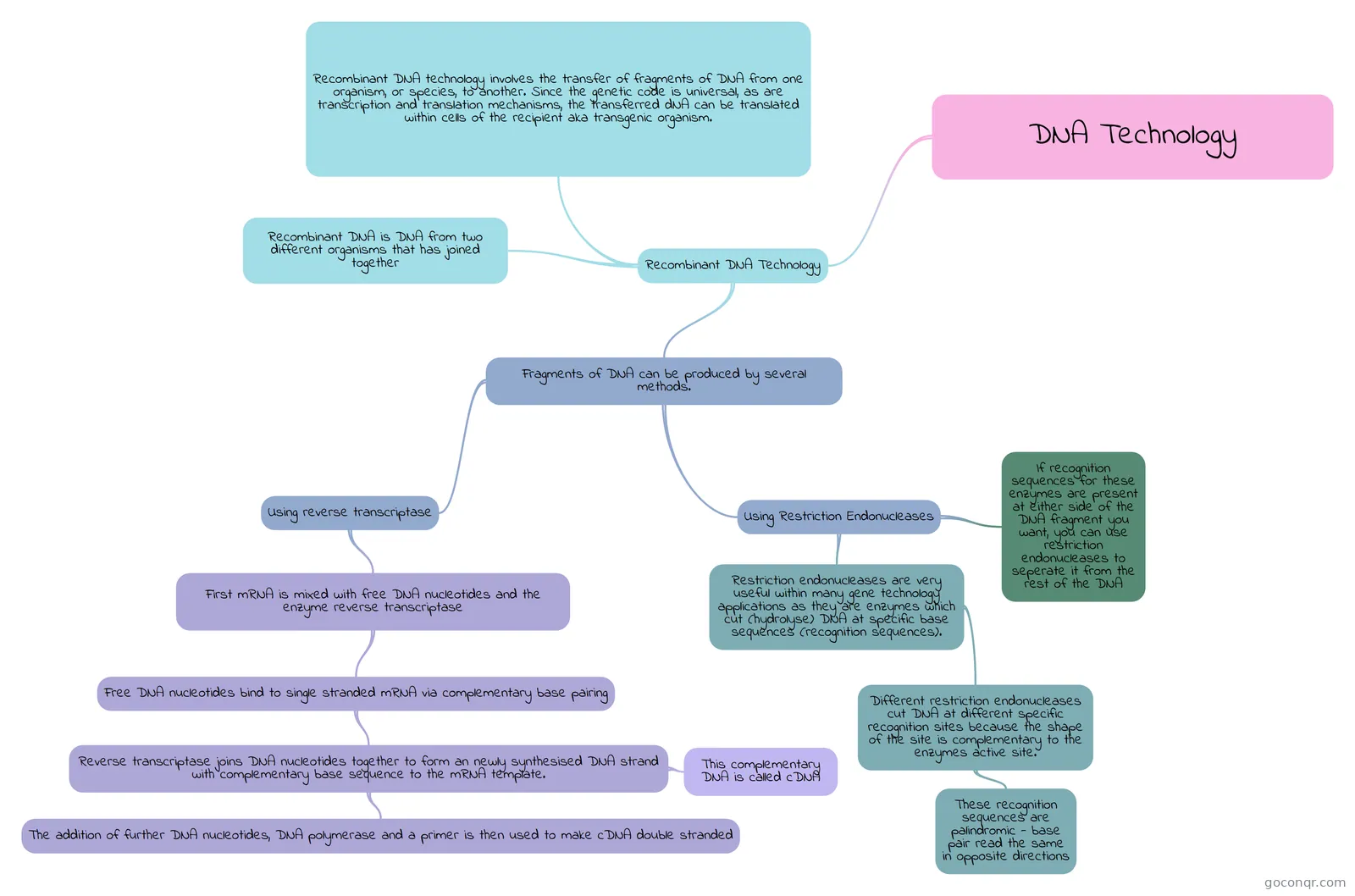
Mind map: DNA technology
Inhalt der Mindmap
DNA Technology
Recombinant DNA Technology
- Recombinant DNA technology involves the transfer of fragments of DNA from one organism, or species, to another. Since the genetic code is universal, as are transcription and translation mechanisms, the transferred dNA can be translated within cells of the recipient aka transgenic organism.
- Recombinant DNA is DNA from two different organisms that has joined together
- Fragments of DNA can be produced by several methods.
- Using reverse transcriptase
- First mRNA is mixed with free DNA nucleotides and the enzyme reverse transcriptase
- Free DNA nucleotides bind to single stranded mRNA via complementary base pairing
- Reverse transcriptase joins DNA nucleotides together to form an newly synthesised DNA strand with complementary base sequence to the mRNA template.
- This complementary DNA is called cDNA
- The addition of further DNA nucleotides, DNA polymerase and a primer is then used to make cDNA double stranded
- Reverse transcriptase joins DNA nucleotides together to form an newly synthesised DNA strand with complementary base sequence to the mRNA template.
- Free DNA nucleotides bind to single stranded mRNA via complementary base pairing
- First mRNA is mixed with free DNA nucleotides and the enzyme reverse transcriptase
- Using Restriction Endonucleases
- Restriction endonucleases are very useful within many gene technology applications as they are enzymes which cut (hydrolyse) DNA at specific base sequences (recognition sequences).
- Different restriction endonucleases cut DNA at different specific recognition sites because the shape of the site is complementary to the enzymes active site.
- These recognition sequences are palindromic - base pair read the same in opposite directions
- Different restriction endonucleases cut DNA at different specific recognition sites because the shape of the site is complementary to the enzymes active site.
- If recognition sequences for these enzymes are present at either side of the DNA fragment you want, you can use restriction endonucleases to seperate it from the rest of the DNA
- Restriction endonucleases are very useful within many gene technology applications as they are enzymes which cut (hydrolyse) DNA at specific base sequences (recognition sequences).
- Using reverse transcriptase
Informationen
- Beschreibung
- A level Biology Mindmap am DNA Technology, erstellt von Flawless Envy Gaming am 23/03/2018.
- Erstellt von
- Flawless Envy Gaming
- Aufrufe
- 0
- Bewertung
Mehr zu Recombinant DNA and Gene Cloning