
Mindmap
Cell Structure and Transport
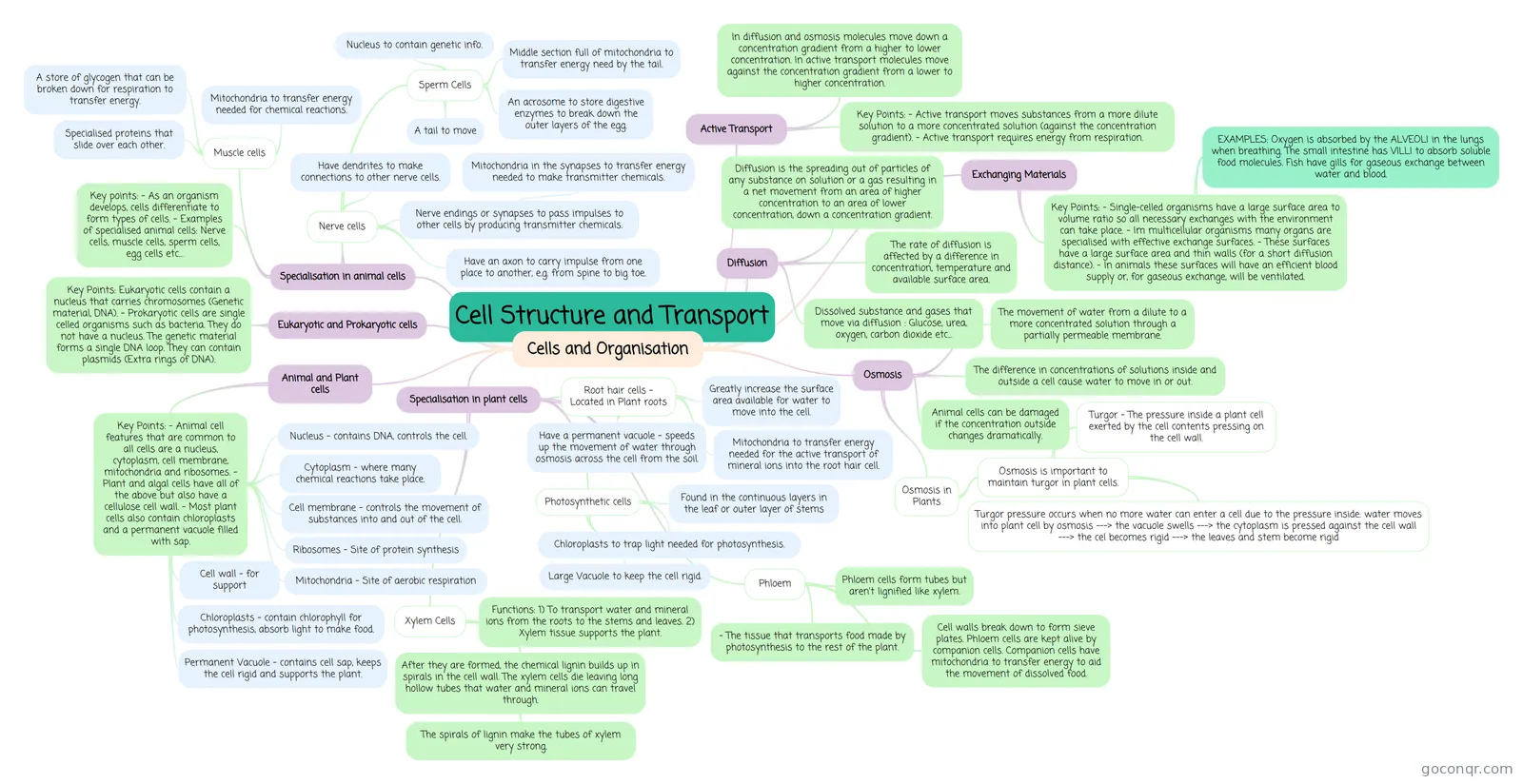
Mind map: Cell structure and transport
Inhalt der Mindmap
Cell Structure and Transport
Cells and Organisation
- Animal and Plant cells
- Key Points: - Animal cell features that are common to all cells are a nucleus, cytoplasm, cell membrane, mitochondria and ribosomes. - Plant and algal cells have all of the above but also have a cellulose cell wall. - Most plant cells also contain chloroplasts and a permanent vacuole filled with sap.
- Nucleus - contains DNA, controls the cell.
- Cytoplasm - where many chemical reactions take place.
- Cell membrane - controls the movement of substances into and out of the cell.
- Mitochondria - Site of aerobic respiration
- Ribosomes - Site of protein synthesis
- Cell wall - for support
- Chloroplasts - contain chlorophyll for photosynthesis, absorb light to make food.
- Permanent Vacuole - contains cell sap, keeps the cell rigid and supports the plant.
- Key Points: - Animal cell features that are common to all cells are a nucleus, cytoplasm, cell membrane, mitochondria and ribosomes. - Plant and algal cells have all of the above but also have a cellulose cell wall. - Most plant cells also contain chloroplasts and a permanent vacuole filled with sap.
- Eukaryotic and Prokaryotic cells
- Key Points: Eukaryotic cells contain a nucleus that carries chromosomes (Genetic material, DNA). - Prokaryotic cells are single celled organisms such as bacteria. They do not have a nucleus. The genetic material forms a single DNA loop. They can contain plasmids (Extra rings of DNA).
- Specialisation in animal cells
- Key points: - As an organism develops, cells differentiate to form types of cells. - Examples of specialised animal cells: Nerve cells, muscle cells, sperm cells, egg cells etc...
- Nerve cells
- Have dendrites to make connections to other nerve cells.
- Have an axon to carry impulse from one place to another, e.g. from spine to big toe.
- Nerve endings or synapses to pass impulses to other cells by producing transmitter chemicals.
- Mitochondria in the synapses to transfer energy needed to make transmitter chemicals.
- Sperm Cells
- A tail to move
- Middle section full of mitochondria to transfer energy need by the tail.
- An acrosome to store digestive enzymes to break down the outer layers of the egg.
- Nucleus to contain genetic info.
- Muscle cells
- Specialised proteins that slide over each other.
- Mitochondria to transfer energy needed for chemical reactions.
- A store of glycogen that can be broken down for respiration to transfer energy.
- Specialisation in plant cells
- Root hair cells - Located in Plant roots
- Greatly increase the surface area available for water to move into the cell.
- Have a permanent vacuole - speeds up the movement of water through osmosis across the cell from the soil.
- Mitochondria to transfer energy needed for the active transport of mineral ions into the root hair cell.
- Photosynthetic cells
- Chloroplasts to trap light needed for photosynthesis.
- Found in the continuous layers in the leaf or outer layer of stems
- Large Vacuole to keep the cell rigid.
- Xylem Cells
- Functions: 1) To transport water and mineral ions from the roots to the stems and leaves. 2) Xylem tissue supports the plant.
- After they are formed, the chemical lignin builds up in spirals in the cell wall. The xylem cells die leaving long hollow tubes that water and mineral ions can travel through.
- The spirals of lignin make the tubes of xylem very strong.
- Phloem
- - The tissue that transports food made by photosynthesis to the rest of the plant.
- Phloem cells form tubes but aren't lignified like xylem.
- Cell walls break down to form sieve plates. Phloem cells are kept alive by companion cells. Companion cells have mitochondria to transfer energy to aid the movement of dissolved food.
- Root hair cells - Located in Plant roots
- Diffusion
- Diffusion is the spreading out of particles of any substance on solution or a gas resulting in a net movement from an area of higher concentration to an area of lower concentration, down a concentration gradient.
- The rate of diffusion is affected by a difference in concentration, temperature and available surface area.
- Dissolved substance and gases that move via diffusion : Glucose, urea, oxygen, carbon dioxide etc...
- Osmosis
- The movement of water from a dilute to a more concentrated solution through a partially permeable membrane.
- The difference in concentrations of solutions inside and outside a cell cause water to move in or out.
- Animal cells can be damaged if the concentration outside changes dramatically.
- Osmosis in Plants
- Osmosis is important to maintain turgor in plant cells.
- Turgor - The pressure inside a plant cell exerted by the cell contents pressing on the cell wall.
- Turgor pressure occurs when no more water can enter a cell due to the pressure inside: water moves into plant cell by osmosis ---> the vacuole swells ---> the cytoplasm is pressed against the cell wall ---> the cel becomes rigid ---> the leaves and stem become rigid
- Osmosis is important to maintain turgor in plant cells.
- Active Transport
- Key Points: - Active transport moves substances from a more dilute solution to a more concentrated solution (against the concentration gradient). - Active transport requires energy from respiration.
- In diffusion and osmosis molecules move down a concentration gradient from a higher to lower concentration. In active transport molecules move against the concentration gradient from a lower to higher concentration.
- Exchanging Materials
- Key Points: - Single-celled organisms have a large surface area to volume ratio so all necessary exchanges with the environment can take place. - Im multicellular organisms many organs are specialised with effective exchange surfaces. - These surfaces have a large surface area and thin walls (for a short diffusion distance). - In animals these surfaces will have an efficient blood supply or, for gaseous exchange, will be ventilated.
- EXAMPLES: Oxygen is absorbed by the ALVEOLI in the lungs when breathing. The small intestine has VILLI to absorb soluble food molecules. Fish have gills for gaseous exchange between water and blood.
- Key Points: - Single-celled organisms have a large surface area to volume ratio so all necessary exchanges with the environment can take place. - Im multicellular organisms many organs are specialised with effective exchange surfaces. - These surfaces have a large surface area and thin walls (for a short diffusion distance). - In animals these surfaces will have an efficient blood supply or, for gaseous exchange, will be ventilated.
- Animal and Plant cells