
Mindmap
Evolution
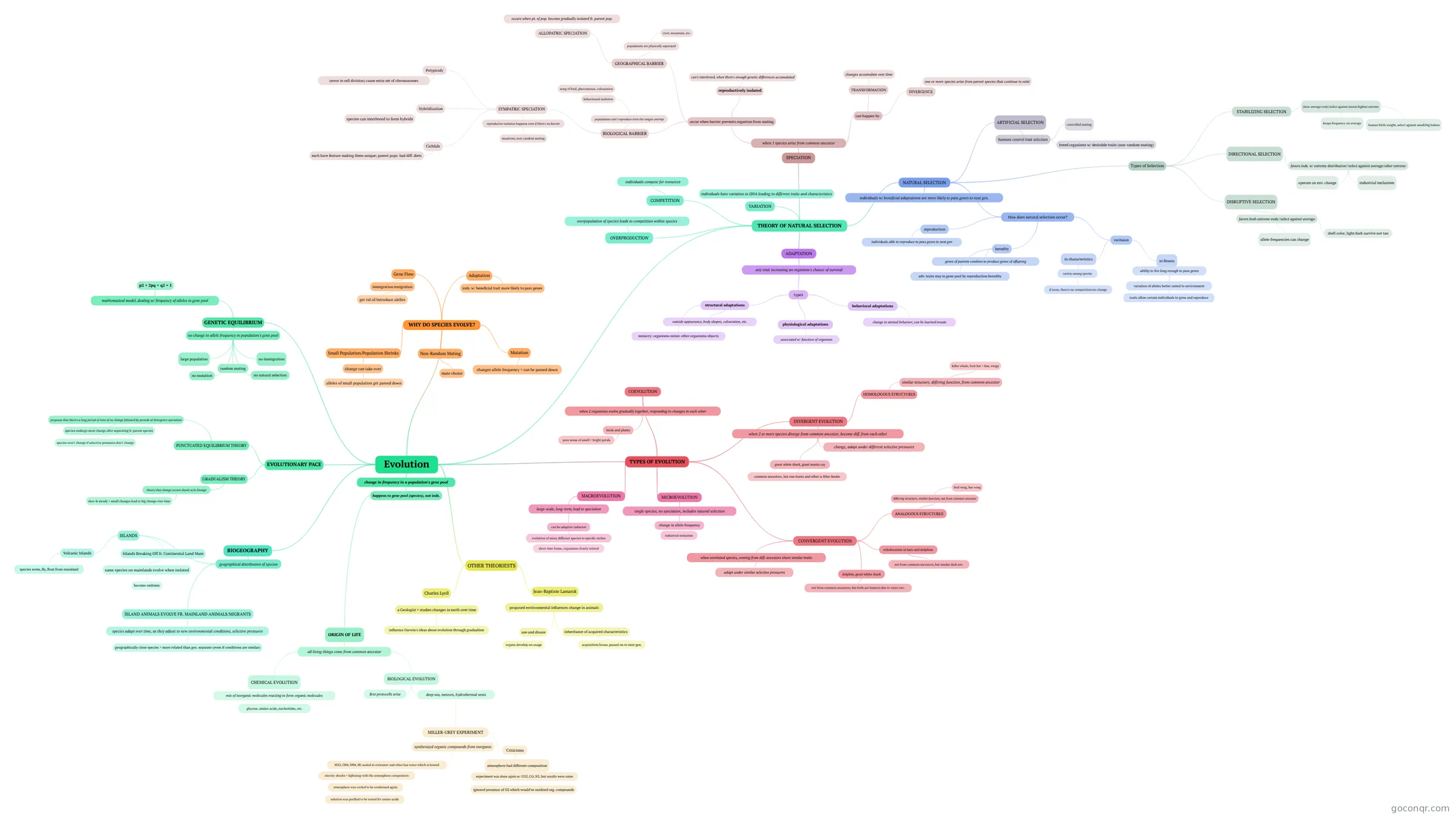
Mind map: Evolution
Inhalt der Mindmap
Evolution
change in frequency in a population's gene pool
- happens to gene pool (species), not inds.
- ORIGIN OF LIFE
- all living things come from common ancestor
- CHEMICAL EVOLUTION
- mix of inorganic molecules reacting to form organic molecules
- glucose, amino acids, nucleotides, etc.
- mix of inorganic molecules reacting to form organic molecules
- BIOLOGICAL EVOLUTION
- first protocells arise
- deep sea, meteors, hydrothermal vents
- MILLER-UREY EXPERIMENT
- synthesized organic compounds from inorganic
- H2O, CH4, NH4, H2 sealed in container and other has water which is heated
- electric shocks = lightning with the atmosphere composition
- atmosphere was cooled to be condensed again
- solution was purified to be tested for amino acids
- atmosphere was cooled to be condensed again
- electric shocks = lightning with the atmosphere composition
- H2O, CH4, NH4, H2 sealed in container and other has water which is heated
- Criticisms
- atmosphere had different composition
- experiment was done again w/ CO2, CO, N2, but results were same
- ignored presence of O2 which would've oxidized org. compounds
- atmosphere had different composition
- synthesized organic compounds from inorganic
- MILLER-UREY EXPERIMENT
- CHEMICAL EVOLUTION
- all living things come from common ancestor
- ORIGIN OF LIFE
- happens to gene pool (species), not inds.
BIOGEOGRAPHY
- geographical distribution of species
- ISLAND ANIMALS EVOLVE FR. MAINLAND ANIMALS/MIGRANTS
- species adapt over time, as they adjust to new environmental conditions, selective pressures
- geographically close species > more related than geo. separate (even if conditions are similar)
- species adapt over time, as they adjust to new environmental conditions, selective pressures
- ISLANDS
- Volcanic Islands
- species swim, fly, float from mainland
- Islands Breaking Off fr. Continental Land Mass
- same species on mainlands evolve when isolated
- become endemic
- same species on mainlands evolve when isolated
- Volcanic Islands
- ISLAND ANIMALS EVOLVE FR. MAINLAND ANIMALS/MIGRANTS
- geographical distribution of species
THEORY OF NATURAL SELECTION
- OVERPRODUCTION
- overpopulation of species leads to competition within species
- COMPETITION
- individuals compete for resources
- VARIATION
- individuals have variation in DNA leading to different traits and characteristics
- ADAPTATION
- any trait increasing an organism's chance of survival
- types
- structural adaptations
- outside appearance, body shapes, colouration, etc.
- mimicry: organisms mimic other organisms/objects
- physiological adaptations
- associated w/ function of organism
- behavioral adaptations
- change in animal behavior; can be learned/innate
- structural adaptations
- types
- any trait increasing an organism's chance of survival
- NATURAL SELECTION
- individuals w/ beneficial adaptations are more likely to pass genes to next gen.
- How does natural selection occur?
- reproduction
- individuals able to reproduce to pass genes to next gen
- heredity
- genes of parents combine to produce genes of offspring
- adv. traits stay in gene pool by reproduction/heredity
- varitaion
- in characteristics
- variety among species
- if none, there's no competition/no change
- variety among species
- in fitness
- ability to live long enough to pass genes
- traits allow certain individuals to grow and reproduce
- variation of alleles better suited to environment
- ability to live long enough to pass genes
- in characteristics
- reproduction
- ARTIFICIAL SELECTION
- humans control trait selection
- breed organisms w/ desirable traits (non-random mating)
- controlled mating
- humans control trait selection
- Types of Selection
- STABILIZING SELECTION
- favor average trait//select against lowest/highest extreme
- keeps frequency on average
- human birth weight, select against small/big babies
- favor average trait//select against lowest/highest extreme
- DIRECTIONAL SELECTION
- favors inds. w/ extreme distribution//select against average/other extreme
- operate on env. change
- industrial melanism
- favors inds. w/ extreme distribution//select against average/other extreme
- DISRUPTIVE SELECTION
- favors both extreme ends//select against average
- allele frequencies can change
- shell color, light/dark survive not tan
- favors both extreme ends//select against average
- STABILIZING SELECTION
- SPECIATION
- when 1 species arise from common ancestor
- can happen by:
- TRANSFORMATION
- changes accumulate over time
- DIVERGENCE
- one or more species arise from parent species that continue to exist
- TRANSFORMATION
- occur when barrier prevents organism from mating
- GEOGRAPHICAL BARRIER
- populations are physically separated
- river, mountain, etc.
- ALLOPATRIC SPECIATION
- occurs when pt. of pop. become gradually isolated fr. parent pop.
- populations are physically separated
- BIOLOGICAL BARRIER
- populations can't reproduce even tho ranges overlap
- behavioural isolation
- song of bird, pheromones, colouration
- behavioural isolation
- SYMPATRIC SPECIATION
- reproductive isolation happens even if there's no barrier
- muations, non-random mating
- Polyploidy
- (error in cell division) cause extra set of chromosomes
- Hybridization
- species can interbreed to form hybrids
- Cichlids
- each have feature making them unique; parent pops. had diff. diets
- reproductive isolation happens even if there's no barrier
- populations can't reproduce even tho ranges overlap
- reproductively isolated
- can't interbreed, when there's enough genetic differences accumulated
- GEOGRAPHICAL BARRIER
- can happen by:
- when 1 species arise from common ancestor
- OVERPRODUCTION
OTHER THEORIESTS
- Charles Lyell
- a Geologist > studies changes in earth over time
- influence Darwin's ideas about evolution through gradualism
- a Geologist > studies changes in earth over time
- Jean-Baptiste Lamarck
- proposed environmental influences change in animals
- use and disuse
- organs develop on usage
- inheritance of acquired characteristics
- acquisition/losses passed on to next gen.
- use and disuse
- proposed environmental influences change in animals
- Charles Lyell
TYPES OF EVOLUTION
- MACROEVOLUTION
- large-scale, long-term, lead to speciation
- can be adaptive radiation
- evolution of many different species to specific niches
- short time frame, organisms closely related
- evolution of many different species to specific niches
- can be adaptive radiation
- large-scale, long-term, lead to speciation
- MICROEVOLUTION
- single species, no speciation, includes natural selection
- change in allele frequency
- industrial melanism
- change in allele frequency
- single species, no speciation, includes natural selection
- DIVERGENT EVOLUTION
- when 2 or more species diverge from common ancestor, become diff. from each other
- change, adapt under different selective pressures
- great white shark, giant manta ray
- common ancestors, but one hunts and other is filter feeder
- HOMOLOGOUS STRUCTURES
- similar structure, differing function, from common ancestor
- killer whale, fruit bat > fins, wings
- similar structure, differing function, from common ancestor
- when 2 or more species diverge from common ancestor, become diff. from each other
- CONVERGENT EVOLUTION
- dolphin, great white shark
- not from common ancestors, but both are hunters due to water env.
- echolocation in bats and dolphins
- not from common ancestors, but similar dark env.
- when unrelated species, coming from diff. ancestors share similar traits
- adapt under similar selective pressures
- ANALOGOUS STRUCTURES
- differing structure, similar function, not from common ancestor
- bird wing, bee wing
- differing structure, similar function, not from common ancestor
- dolphin, great white shark
- COEVOLUTION
- when 2 organisms evolve gradually together, responding to changes in each other
- birds and plants
- poor sense of smell = bright petals
- birds and plants
- when 2 organisms evolve gradually together, responding to changes in each other
- MACROEVOLUTION
GENETIC EQUILIBRIUM
- no change in allele frequency in population's gene pool
- large population
- random mating
- no immigration
- no mutation
- no natural selection
- mathematical model, dealing w/ frequency of alleles in gene pool
- p2 + 2pq + q2 = 1
- no change in allele frequency in population's gene pool
WHY DO SPECIES EVOLVE?
- Small Population/Population Shrinks
- change can take over
- alleles of small population get passed down
- change can take over
- Non-Random Mating
- mate choice
- Mutation
- changes allele frequency > can be passed down
- Gene Flow
- immigration/emigration
- get rid of/introduce alelles
- immigration/emigration
- Adaptation
- inds. w/ beneficial trait more likely to pass genes
- Small Population/Population Shrinks
EVOLUTIONARY PACE
- GRADUALISM THEORY
- theory that change occurs slowly w/in lineage
- slow & steady > small changes lead to big change over time
- theory that change occurs slowly w/in lineage
- PUNCTUATED EQUILIBRIUM THEORY
- proposes that there's a long period of time of no change followed by periods of divergence speciation
- species undergo most change after separating fr. parent species
- species won't change if selective pressures don't change
- species undergo most change after separating fr. parent species
- proposes that there's a long period of time of no change followed by periods of divergence speciation
- GRADUALISM THEORY
Informationen
- Beschreibung
- Grade 11 Biology Mindmap am Evolution, erstellt von Tricia Toledo am 25/04/2018.
- Erstellt von
- Tricia Toledo
- Aufrufe
- 0
- Bewertung