
Mindmap
Transport in humans
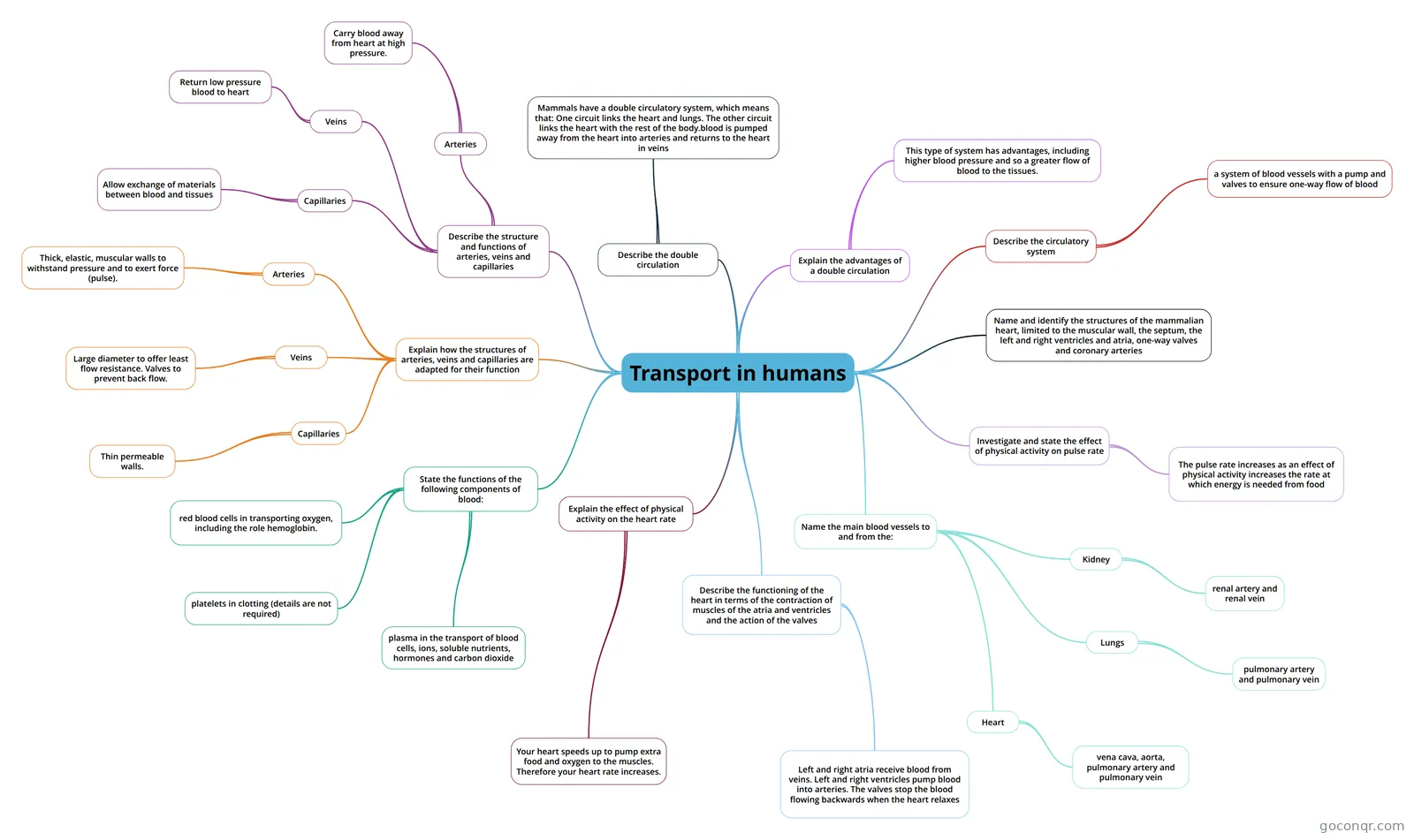
Mind map: Transport in humans
Inhalt der Mindmap
Transport in humans
Describe the circulatory system
- a system of blood vessels with a pump and valves to ensure one-way flow of blood
Describe the double circulation
- Mammals have a double circulatory system, which means that: One circuit links the heart and lungs. The other circuit links the heart with the rest of the body.blood is pumped away from the heart into arteries and returns to the heart in veins
Explain the advantages of a double circulation
- This type of system has advantages, including higher blood pressure and so a greater flow of blood to the tissues.
Name and identify the structures of the mammalian heart, limited to the muscular wall, the septum, the left and right ventricles and atria, one-way valves and coronary arteries
Describe the functioning of the heart in terms of the contraction of muscles of the atria and ventricles and the action of the valves
- Left and right atria receive blood from veins. Left and right ventricles pump blood into arteries. The valves stop the blood flowing backwards when the heart relaxes
Name the main blood vessels to and from the:
- Heart
- vena cava, aorta, pulmonary artery and pulmonary vein
- Lungs
- pulmonary artery and pulmonary vein
- Kidney
- renal artery and renal vein
- Heart
Investigate and state the effect of physical activity on pulse rate
- The pulse rate increases as an effect of physical activity increases the rate at which energy is needed from food
Explain the effect of physical activity on the heart rate
- Your heart speeds up to pump extra food and oxygen to the muscles. Therefore your heart rate increases.
Describe the structure and functions of arteries, veins and capillaries
- Arteries
- Carry blood away from heart at high pressure.
- Veins
- Return low pressure blood to heart
- Capillaries
- Allow exchange of materials between blood and tissues
- Arteries
Explain how the structures of arteries, veins and capillaries are adapted for their function
- Arteries
- Thick, elastic, muscular walls to withstand pressure and to exert force (pulse).
- Veins
- Large diameter to offer least flow resistance. Valves to prevent back flow.
- Capillaries
- Thin permeable walls.
- Arteries
State the functions of the following components of blood:
- red blood cells in transporting oxygen, including the role hemoglobin.
- platelets in clotting (details are not required)
- plasma in the transport of blood cells, ions, soluble nutrients, hormones and carbon dioxide
Informationen
- Beschreibung
- Biology Mindmap am Transport in humans, erstellt von Shravani Chingre am 11/06/2018.
- Erstellt von
- Shravani Chingre
- Aufrufe
- 31
- Bewertung