
Mindmap
Sensory Marketing
Inhalt der Mindmap
Sensory Marketing
Senses dictate what appeals to us.
- Businesses need to establish a 'Sensory Signature'
Vision
- Bryantt (1999)- Colours stimulate emotions. Eg red- appetite, blue- relaxed
- Frank and Gilovich (1988)- Associations reaction to colour for example black colour of mourning in uk, powerful sports team in USA.
- Thomas (2001)- Older people prefer white. Colours become duller with age.
- Colours change with fashion. Eg pantone colour of the year
Smell
- Processed in 'Lymbric systems' part of the brain. (gives fastest emotional response)
- Evoke memories and cane be either a positive or negative stimuli.
Touch (Haptic Sense)
- When consumers touch a product they have a higher sense of attachment to it.
- E.g. Apple products
- Ability to influence sales interaction. E.G turtle Bay trained to touch people on shoulder when doing check backs.
Hearing
- Music can influence peoples mood and behaviour
- Sound symbolism- The way a word sounds influences our assumptions.
- E.G Kellogs- Kruchy, Pepsi- Pop
Taste
- Taste receptors contribute to experience of products
- Cultural factors determine the tastes found desirable
Perception process
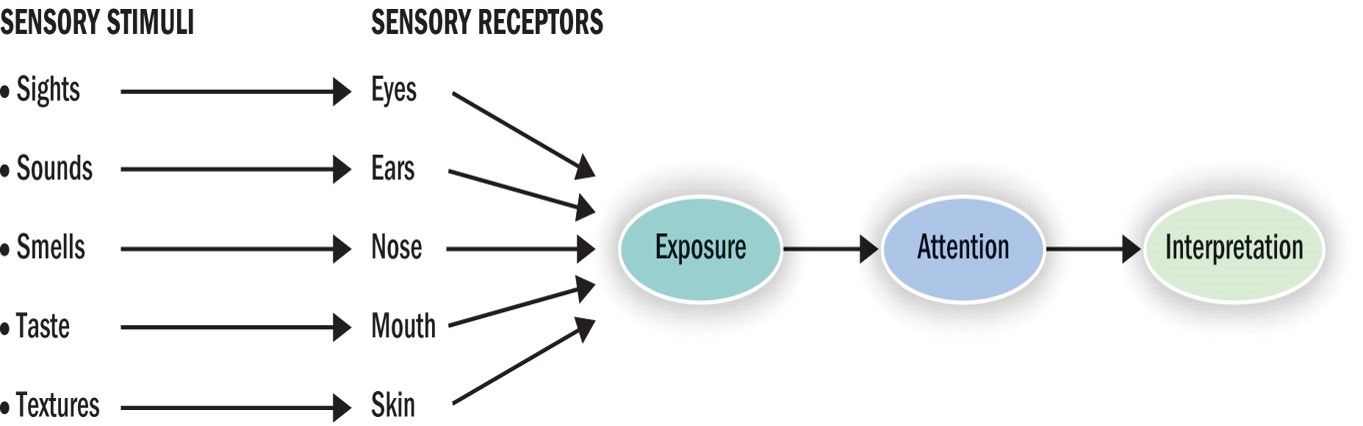
- Process where senses are selected, organised and interpreted (depends on different factors)
- Perceptual Process (Sensory stimuli, sensory receptors -> exposure, attention, interpretation
- Stage 1- Exposure
- 1) Stimuli comes within sensory receptors
- 2) Impact on sensory threshold.
- Absolute Threshold- The minimum amount of stimuli that can be detected from one of the senses
- Differential Threshold- The ability the sensory system can detect changes between two stimuli.
- Minimum change called Just Noticeable Difference (J.N.D)
- Webbers Law- The stronger the initial stimuli the greater the change must be for us to notice it.
- Psychophysics- how people mix physical environment into own personal world.
- 2) Impact on sensory threshold.
- 1) Stimuli comes within sensory receptors
- Stage 2- Attention
- Consumers often in a state of 'Sensory Overload'
- Personal selection
- Experience (from stimuli)
- Perceptual Vigilance (Aware of stimuli that relates to needs),
- Perceptual Defence (See what they want to see)
- Adaptation (How often consumers notice stimuli eg exposure, relevance.
- Stimuli characteristics eg exposure, size.
- Stage 3- Interpretation
- Solomon (2011)- The meaning (schema) we apply to a stimuli
- Schema- set of beliefs
- Priming- something to evoke a schema.
- Solomon (2011)- The meaning (schema) we apply to a stimuli
Bilder und Dateien der Mindmap
Informationen
- Beschreibung
- hgfhfghfg
- Erstellt von
- Diego Cabral
- Aufrufe
- 11
- Tags
- Verlauf
-
- Erstellt von Paisley Williams · 29 Mär 2016
- Kopiert von Diego Cabral · 24 Nov 2018
- Bewertung