
Mindmap
Chemistry Unit 1
Inhalt der Mindmap
Chemistry Unit 1
C1.2.The Limestone Cycle
- Limestone is mainly calcium carbonate
- It can be used to make cement, mortar, glass and concrete
- These react with carbon dioxide and acid rain water and wear away
- Calcium oxide
- quicklime
- water
- calcium hydroxide
- slaked lime
- Ca(OH)2 (s)
- dissolve in water
- calcium hydroxide solution
- Carbon dioxide turns limewater cloudy
- Ca(OH)2 (aq)
- CaCO3
- bubble in carbon dioxide
- limewater
- alkali that can be used in the neutralisation of acids
- CaO (s)
- carbon dioxide
- thermal decomposition
- Limestone is heated with clay to give cement
- cement is mixed with sand to make mortar
- cement + sand + aggregate = concrete
- It can be used to make cement, mortar, glass and concrete
- other carbonates decompose in a similar way
- magnesium, copper, zinc, calcium and sodium
- Carbonates react with acids to produce carbon dioxide
- A salt and water
- Limestone is mainly calcium carbonate
C1.1- Fundamental Ideas in Chemistry
- C1.1.1 Atoms
- Structure
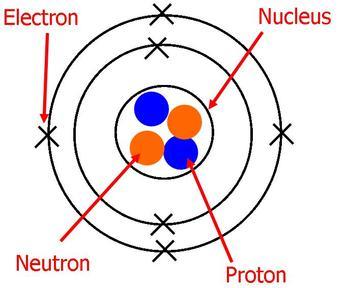
- Atoms have a central nucleus which is made up of protons and neutrons, and surrounded by "shells" of electrons
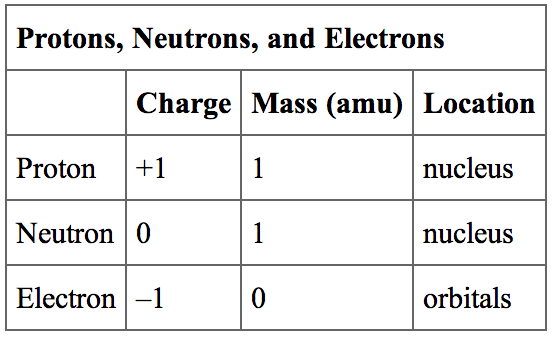
- The relative electrical charges in an atom are
- substances made up of only one kind of atom are elements
- Elements in the same group have similar properties
- no. of protons = no. of electrons
- atoms have no overall electric charge
- All atoms of a particular element have the same number of protons
- atoms of different elements have different numbers of protons
- no. of protons = atomic number
- no. of neutrons + protons = mass of atom
- Structure
- C1.1.2 The Periodic Table
- Elements in the same group have the same number of outer electrons
- This gives them similar properties
- Group 0 = noble gases
- unreactive
- stable arrangement of outer electrons
- full shell
- Elements in the same group have the same number of outer electrons
- C1.1.3 Chemical Reactions
- When atoms react together they form compounds
- Ionic = transfer of shared electrons
- covalent = sharing of electrons
- metallic = dropping of surplus electrons to form a sea of de-localised electrons
- mass of products = mass of reactants
- When atoms react together they form compounds
- C1.1.1 Atoms
C1.3 Metals and their Uses
- C1.3.1 Extracting metals
- Ores are economical to extract
- mined and purified before extraction and purified
- unreactive metals found as pure metals
- most found as compounds
- require chemical reactions to extract
- most found as compounds
- copper is extracted from ores through smelting
- requires heat and energy
- purified through electrolysis
- traditional mining is bad for the environment
- phytomining
- uses plants to absorb metal compounds and that the plants are burned to produce ash that contains the metal compounds
- bioleaching
- uses bacteria to produce leachate solutions that contain metal compounds.
- phytomining
- extraction through carbon
- Metals that are less reactive than carbon can be extracted by reacting them with carbon
- iron oxide + carbon + heat = iron + carbon dioxide
- Metals that are more reactive than carbon can be extracted by electrolysis
- requires large amounts of energy so is more expensive
- Metals that cannot be extracted via carbon are expensive
- there are lots of stages in the process
- large amounts of energy are needed
- Metals that are less reactive than carbon can be extracted by reacting them with carbon
- Ores are economical to extract
- C1.3.2 Alloys
- Iron from the blast furnace contains about 96% iron
- The impurities make it brittle and so it has limited uses
- An alloy is a mixture of two or more elements, where at least one element is a metal
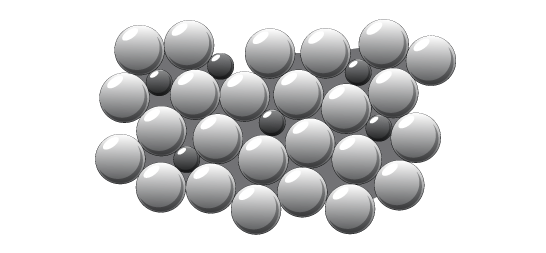
- Alloys contain atoms of different sizes, making it more difficult for the layers to slide over each other, so alloys are harder than the pure metal.
- most metals we use everyday are alloys as pure metals are too soft
- Alloys contain atoms of different sizes, making it more difficult for the layers to slide over each other, so alloys are harder than the pure metal.
- Alloys can be designed to have certain properties
- Low-carbon steels - easily shaped
- high carbon steels - hard
- stainless steels - resistant to corosion
- Iron from the blast furnace contains about 96% iron
- C1.3.1 Extracting metals
C1.4 Crude oil and fuels
- C1.4.1 Crude Oil
- mixture of lots of compounds
- Most of these are saturated hydrocarbons (alkanes)
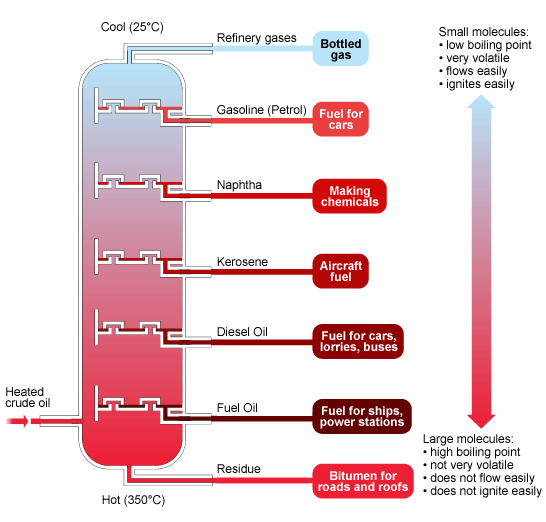
- can be separated by physical means
- mixture of lots of compounds
- C1.4.2 Hydrocarbons
- alkanes
- saturated
- CnH2n+2
- saturated
- alkenes
- unsaturated
- CnH2n
- unsaturated
- fractional distillation
- alkanes
- C1.4.3 Hydrocarbon fuels
- All fuels contain sulfur
- This can be removed
- This is released into the atmosphere when fuels are burned
- During combustion the carbon and hydrogen in the fuels are oxidised.
- biofuels
- ethanol
- biodielsel
- Sulfur dioxide and oxides of nitrogen cause acid rain
- solid particles cause global dimming
- All fuels contain sulfur
- C1.4.1 Crude Oil
C1.5 Other useful materials from crude oil
Bilder und Dateien der Mindmap
Informationen
- Beschreibung
- Mindmap am Chemistry Unit 1, erstellt von Apoorva Sriram am 26/12/2014.
- Erstellt von
- Apoorva Sriram
- Aufrufe
- 0
- Bewertung